



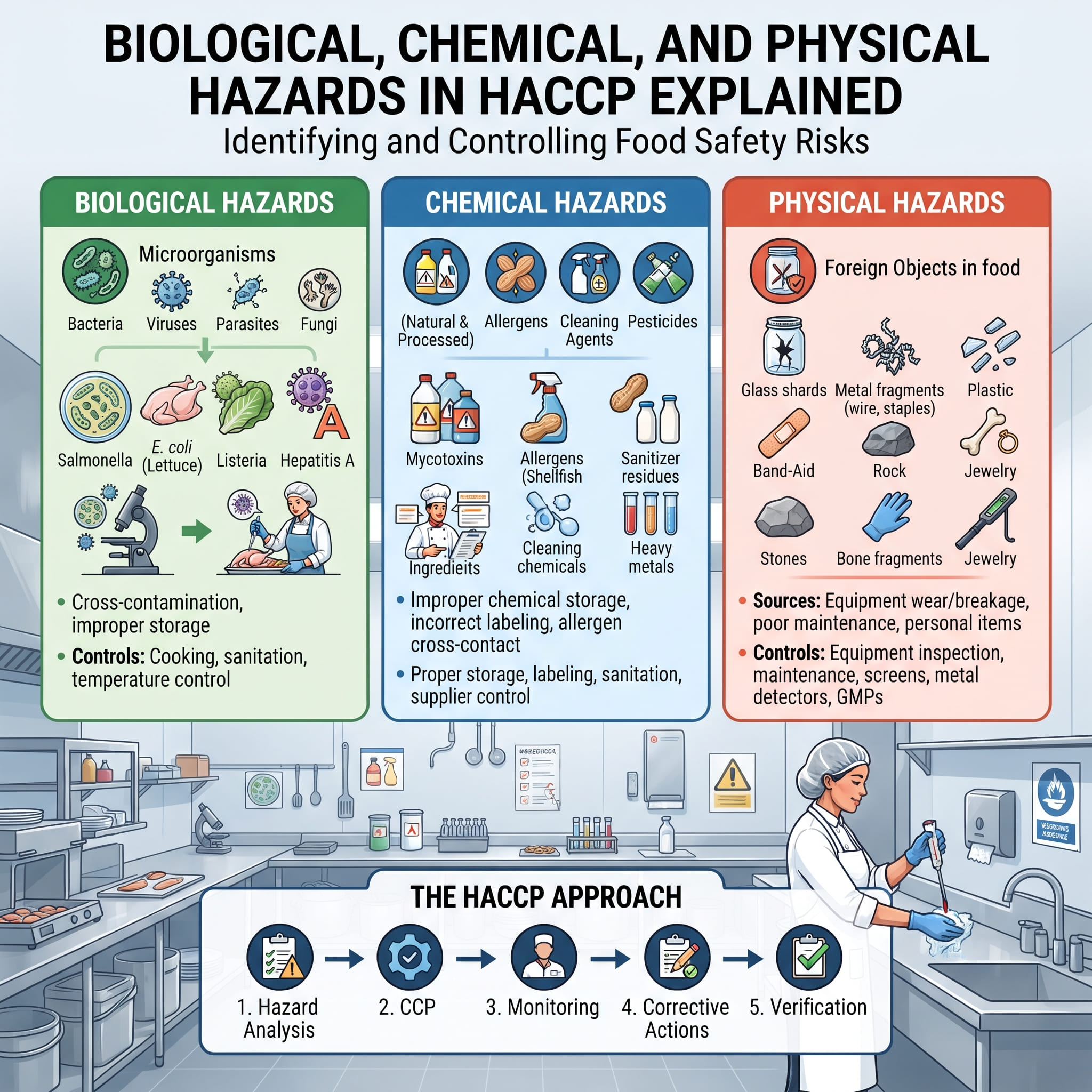
Understanding food safety hazards is one of the foundations of an effective HACCP system. Every food business needs to consider what could make food unsafe and establish appropriate controls to prevent, eliminate or reduce those risks.
For people completing HACCP training in Ireland, understanding the difference between biological, chemical and physical hazards is particularly important. These three categories are commonly used when carrying out HACCP hazard analysis, although allergen hazards and other relevant risks must also be appropriately considered.
A restaurant, café, hotel, bakery, catering business or food manufacturer can face different hazards depending on its products, equipment, processes and working environment.
This guide explains biological, chemical and physical hazards in HACCP, gives practical examples and explains how food businesses can control them.
What Are Food Safety Hazards?
A food safety hazard is something that could cause food to become unsafe and potentially harm a consumer.
When carrying out HACCP hazard analysis, a food business examines each stage of its operation and considers what could go wrong.
For example, hazards may occur during:
- Receiving ingredients
- Storage
- Food preparation
- Cooking
- Cooling
- Packaging
- Transportation
- Service
The HACCP team then determines which hazards require control and establishes appropriate measures.
The Food Safety Authority of Ireland (FSAI) identifies hazard analysis as the first principle of HACCP. This involves identifying hazards that need to be prevented, eliminated or reduced to acceptable levels.
The Three Main Types of HACCP Hazards
The three traditional categories are:
- Biological hazards
- Chemical hazards
- Physical hazards
Each type presents different risks and requires different control measures.
Understanding the difference is an important part of a HACCP course in Ireland.
1. Biological Hazards
Biological hazards involve microorganisms or other biological agents that can make food unsafe.
Examples include:
- Bacteria
- Viruses
- Parasites
- Fungi
Some microorganisms can cause foodborne illness when contaminated food is consumed.
Biological hazards can enter food at different stages of the food process.
For example, contamination could occur because of:
- Poor personal hygiene
- Contaminated ingredients
- Cross-contamination
- Inadequate cooking
- Incorrect storage
- Poor temperature control
Examples of Biological Hazards
Bacteria
Bacteria are an important consideration in food safety.
Certain harmful bacteria can multiply when food is stored under unsuitable conditions.
This is why appropriate temperature control, hygiene and food handling procedures are important.
Viruses
Viruses can also contaminate food.
Food handlers can play an important role in preventing contamination by following appropriate personal hygiene and handwashing procedures.
Parasites
Parasites can be associated with certain foods and food production environments.
Appropriate sourcing, preparation and cooking procedures can help control relevant risks.
Fungi
Fungi such as moulds can affect certain foods.
The appropriate control depends on the type of food and the specific hazard involved.
How Can Biological Hazards Be Controlled?
Control measures depend on the specific hazard.
They can include:
- Good personal hygiene
- Effective handwashing
- Preventing cross-contamination
- Appropriate refrigeration
- Controlled cooking
- Suitable storage
- Cleaning and sanitation
- Appropriate supplier controls
For example, separating raw food from ready-to-eat food can help reduce cross-contamination.
Temperature control may also be important for preventing or limiting the growth of certain microorganisms.
2. Chemical Hazards
Chemical hazards involve chemicals or substances that could contaminate food and cause harm.
They can enter the food chain or food preparation environment in several ways.
Examples include:
- Cleaning chemicals
- Sanitising products
- Lubricants
- Pesticide residues
- Chemicals used incorrectly
- Naturally occurring toxins
Chemical hazards are particularly important because contamination may not always be visible.
Cleaning Chemicals
Food businesses use cleaning and sanitising products to maintain hygiene.
However, these chemicals can become a hazard if they are:
- Stored incorrectly
- Used incorrectly
- Not properly controlled
- Accidentally mixed with food
- Applied to food-contact surfaces inappropriately
For this reason, businesses need suitable procedures for storing and using cleaning chemicals.
Employees should understand which products are used and follow workplace instructions.
Chemical Contamination From Equipment
Some equipment may require lubricants or other substances for maintenance.
If these substances come into contact with food, they could potentially create a chemical hazard.
Appropriate equipment maintenance procedures can help control this risk.
The HACCP team should consider whether equipment used in the business could introduce chemical contamination.
Pesticide Residues
Ingredients can potentially contain pesticide residues.
Food businesses should consider supplier controls and the specifications applicable to the ingredients they purchase.
Appropriate sourcing and supplier management can form part of the wider HACCP system.
How Can Chemical Hazards Be Controlled?
Control measures can include:
- Correct storage of chemicals
- Appropriate labelling
- Following manufacturer instructions
- Keeping chemicals away from food
- Using suitable cleaning procedures
- Proper equipment maintenance
- Supplier controls
- Appropriate staff training
Employees completing HACCP training should understand that chemicals must never be handled casually in food preparation areas.
3. Physical Hazards
Physical hazards involve foreign objects that could accidentally enter food.
Examples include:
- Glass
- Metal
- Plastic
- Stones
- Wood
- Packaging materials
- Broken equipment components
Physical hazards can occur at different stages of the food process.
Examples of Physical Contamination
Imagine a food business preparing sandwiches.
A physical hazard could potentially originate from:
- Damaged packaging
- Broken utensils
- Equipment components
- Glass containers
- Packaging materials
The HACCP team needs to consider where physical contamination could occur and establish suitable controls.
Glass as a Physical Hazard
Glass can be a serious physical contamination risk if it breaks near food.
A food business may therefore have procedures concerning:
- Glass containers
- Glass equipment
- Breakages
- Cleaning after breakage
- Disposal of contaminated food
Employees should know what to do if glass breaks in a food preparation or storage area.
Metal as a Physical Hazard
Metal contamination can potentially originate from:
- Equipment
- Machinery
- Damaged utensils
- Packaging
- Maintenance activities
Food businesses need appropriate equipment maintenance and inspection procedures.
Larger food production facilities may also use additional controls such as metal detection, depending on the nature of their operation.
Plastic and Packaging Materials
Plastic can also become a physical hazard.
Packaging can break or become damaged during:
- Delivery
- Storage
- Opening
- Preparation
- Production
Food businesses should handle packaging appropriately and prevent unnecessary contamination.
How Can Physical Hazards Be Controlled?
Possible control measures include:
- Equipment maintenance
- Regular inspections
- Appropriate storage
- Careful handling of packaging
- Good housekeeping
- Suitable supplier controls
- Breakage procedures
- Staff training
The appropriate control depends on the business and the particular hazard.
Biological vs Chemical vs Physical Hazards
Understanding the difference between these categories can make HACCP training in Ireland easier to understand.
| Hazard Type | Examples | Possible Controls |
|---|---|---|
| Biological | Bacteria, viruses, parasites | Hygiene, cooking, temperature control |
| Chemical | Cleaning chemicals, pesticides, lubricants | Storage, handling, supplier controls |
| Physical | Glass, metal, plastic | Maintenance, inspection, handling |
These categories should not be treated as completely separate from one another.
A single process can involve several different hazards.
For example, food preparation could present:
- A biological hazard from cross-contamination
- A chemical hazard from cleaning products
- A physical hazard from damaged equipment
This is why businesses need to examine each process carefully.
What About Allergen Hazards?
Allergens require specific attention in food safety management.
An allergen may be present intentionally as an ingredient or may be transferred accidentally through cross-contact.
Potential problems can include:
- Incorrect ingredient information
- Miscommunication
- Shared equipment
- Poor cleaning
- Incorrect storage
- Cross-contact during preparation
Businesses need appropriate procedures for managing allergens and communicating relevant information.
For food handlers, allergen awareness can therefore be an important part of food safety and HACCP training.
How HACCP Controls These Hazards
Identifying a hazard is only the first stage.
A HACCP system then determines how the hazard should be controlled.
The seven HACCP principles provide the framework:
- Conduct a hazard analysis
- Determine Critical Control Points
- Establish critical limits
- Establish monitoring procedures
- Establish corrective actions
- Establish verification procedures
- Establish documentation and record keeping
The FSAI identifies these seven principles as the foundation of HACCP-based food safety management.
Hazard Analysis in an Irish Food Business
Consider a restaurant preparing cooked chicken.
During delivery, the business might consider whether ingredients are suitable and whether packaging is intact.
During storage, the business needs to consider contamination and temperature-related risks.
During preparation, cross-contamination may be an important consideration.
During cooking, the business needs appropriate controls for relevant biological hazards.
During service, the business needs to maintain appropriate hygiene and food handling procedures.
The exact hazards and controls depend on the restaurant's specific processes.
This demonstrates why a HACCP system in Ireland should be developed around the individual food business rather than copied without consideration of its actual activities.
Why HACCP Training Is Important
Employees need to understand the hazards that could affect their work.
A HACCP training course can help learners understand:
- Biological hazards
- Chemical hazards
- Physical hazards
- Allergen risks
- Cross-contamination
- Temperature control
- Hygiene procedures
- HACCP principles
The appropriate level of training depends on the person's responsibilities.
A food handler may need basic knowledge of hazards and workplace procedures.
A supervisor or HACCP team member may require more detailed knowledge.
The FSAI states that people responsible for developing and maintaining HACCP-based procedures need adequate training in applying HACCP principles.
HACCP Certificate and Training in Ireland
If you are looking for a HACCP certificate in Ireland, it is important to choose training appropriate to your role.
A suitable HACCP course in Ireland may cover food hazards, HACCP principles and practical food safety controls.
Depending on the course, you may also find:
- HACCP Level 1 training
- HACCP Level 2 training
- HACCP certification
- HACCP certification online
- HACCP training online
- HACCP course online
- HACCP food safety training
Before enrolling, check the course syllabus, intended audience, assessment and certificate.
A certificate demonstrates completion of a particular course; it does not automatically mean that the holder is responsible for managing a food business's HACCP system.
Online HACCP Training
Online HACCP training can be a convenient option for food workers and businesses.
Depending on the provider, learners may be able to study:
- Food safety hazards
- HACCP principles
- Cross-contamination
- Temperature control
- Monitoring
- Corrective actions
Online training can be particularly useful for people with changing work schedules because they may be able to complete the course without attending a physical training centre.
However, online training should complement the specific food safety procedures used by the employer.
Common Mistakes When Managing Food Hazards
Food businesses should avoid several common mistakes.
Focusing on Only One Type of Hazard
A business should consider biological, chemical and physical hazards rather than concentrating exclusively on one category.
Ignoring Allergen Risks
Allergen management should receive appropriate attention.
Using Generic Procedures
HACCP controls should reflect the actual activities of the food business.
Poor Staff Training
Employees need to understand the procedures relevant to their responsibilities.
Failing to Monitor Controls
A control is only useful if the business has appropriate procedures for checking that it remains effective.
Not Reviewing Changes
New ingredients, equipment or processes can change the hazard profile of a business.
Final Thoughts
Understanding biological, chemical and physical hazards in HACCP is essential for effective food safety management.
Biological hazards can include bacteria, viruses, parasites and fungi. Chemical hazards can involve cleaning products, pesticides, lubricants and other harmful substances. Physical hazards can include glass, metal, plastic and other foreign objects.
Food businesses in Ireland need to consider the hazards relevant to their own products and processes and establish appropriate controls.
For employees, HACCP training Ireland programmes can provide important knowledge about food safety hazards and HACCP principles. For supervisors and people responsible for maintaining HACCP systems, more detailed training may be appropriate.
If you are choosing a HACCP course Ireland, HACCP certificate Ireland or HACCP certification course, look beyond the certificate itself. Check that the course content, level and assessment are appropriate for your role.
Ultimately, the goal of HACCP is not simply to identify hazards. It is to understand where they can occur, establish effective controls and ensure those controls continue to protect food safety.