



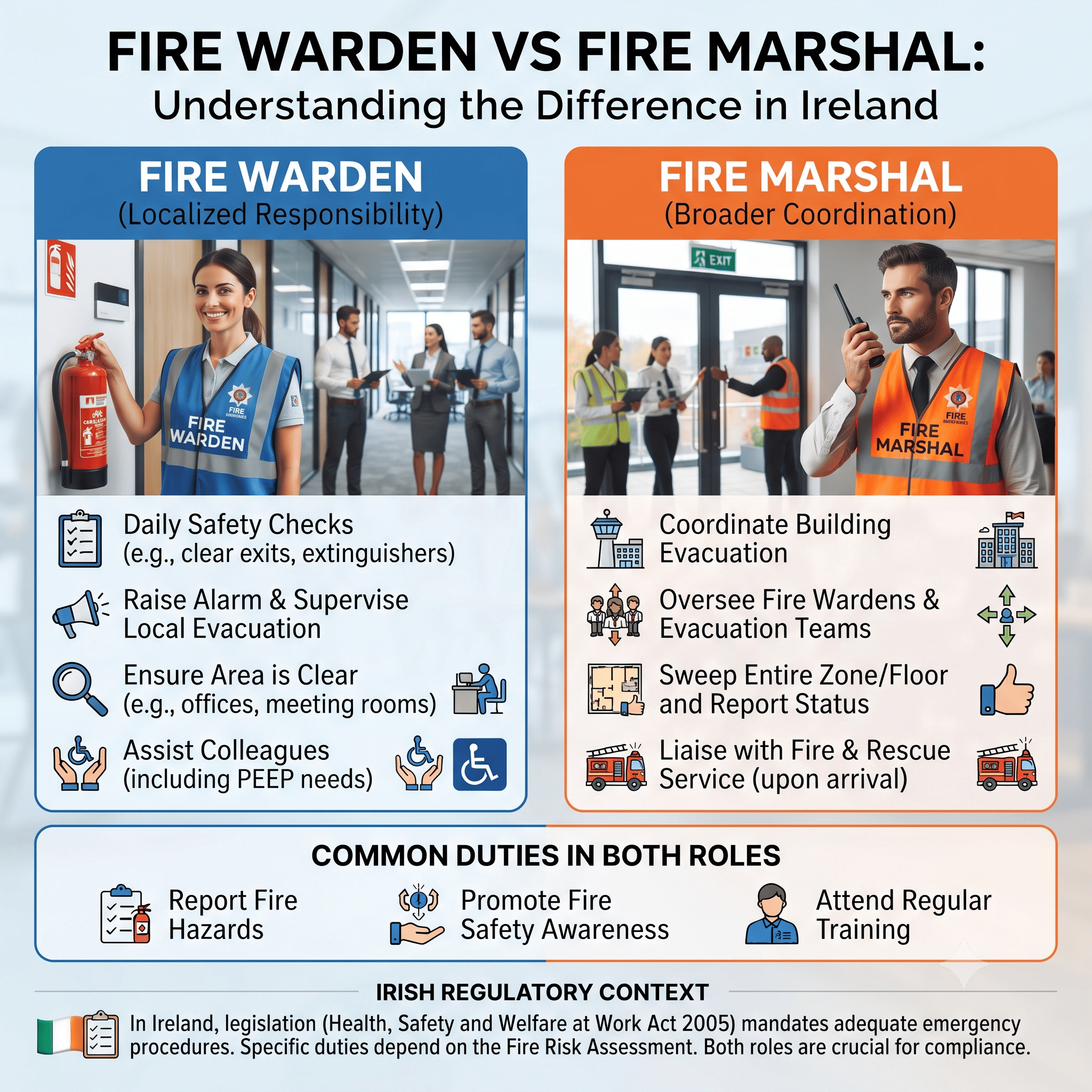
If you're researching workplace fire safety, you've probably come across the terms Fire Warden and Fire Marshal. Many people wonder whether these are two different roles, whether they require different qualifications, or if one has greater responsibility than the other. This is one of the most common questions asked by employers and employees looking for Fire Warden Training Ireland or Fire Marshal Training Ireland.
The good news is that, in most workplaces across Ireland, the terms Fire Warden and Fire Marshal are used interchangeably. Both refer to employees who have been appointed to help maintain workplace fire safety, support emergency procedures, and assist with evacuations if a fire occurs.
Although the titles may differ between organisations, the responsibilities and training are usually very similar. In this guide, we'll explain the role of each, explore any differences you may encounter, and help you understand why fire safety training is important for businesses across Ireland.
What Is a Fire Warden?
A fire warden is a designated employee responsible for helping manage fire safety within the workplace.
Their responsibilities typically include:
- Promoting fire prevention.
- Identifying fire hazards.
- Monitoring escape routes.
- Supporting emergency procedures.
- Assisting with workplace evacuations.
- Helping visitors during emergencies.
- Encouraging employees to follow fire safety procedures.
The role focuses on preventing fires before they happen and helping people leave the building safely if an emergency occurs.
What Is a Fire Marshal?
A fire marshal has a very similar role.
In many Irish workplaces, a fire marshal performs exactly the same duties as a fire warden.
Typical responsibilities include:
- Carrying out workplace fire safety checks.
- Reporting potential hazards.
- Supporting fire drills.
- Coordinating evacuations.
- Helping employees reach assembly points.
- Assisting emergency services with relevant information.
Some organisations simply prefer the title Fire Marshal, while others use Fire Warden. In practice, both positions usually involve the same workplace responsibilities.
Is There a Difference?
For most businesses in Ireland, there is very little practical difference between the two roles.
Both fire wardens and fire marshals are responsible for:
- Fire prevention.
- Workplace fire awareness.
- Emergency preparedness.
- Evacuation support.
- Promoting safe working practices.
The main difference is often the terminology chosen by the employer.
Some international organisations use the term Fire Marshal, while many Irish businesses prefer Fire Warden. Regardless of the title, the objective remains the same: improving workplace fire safety.
Why Do Different Names Exist?
The terms developed over time through different industries and countries.
For example:
- Some organisations traditionally use Fire Warden.
- Others use Fire Marshal.
- International companies may adopt whichever title is used within their global health and safety policies.
Employees should always follow the terminology used by their employer, but they should also understand that both roles generally require the same level of training and responsibility.
What Responsibilities Do They Share?
Whether called a fire warden or a fire marshal, the day-to-day responsibilities are largely identical.
Fire Prevention
One of the most important duties is helping prevent fires before they occur.
This includes:
- Reporting electrical hazards.
- Identifying blocked emergency exits.
- Monitoring housekeeping standards.
- Checking for unsafe storage of combustible materials.
- Encouraging safe working practices.
Fire prevention is often the most valuable contribution these employees make.
Workplace Inspections
Fire wardens and fire marshals may help identify:
- Faulty electrical equipment.
- Damaged fire safety signage.
- Obstructed escape routes.
- Poor housekeeping.
- Fire hazards requiring attention.
Regular observations help reduce workplace risks.
Fire Drills
Both roles often assist with organising or supporting workplace fire drills.
This helps employees:
- Become familiar with evacuation routes.
- Locate assembly points.
- Understand emergency procedures.
- Improve evacuation times.
Regular practice builds confidence throughout the organisation.
Emergency Evacuations
If a fire occurs, both fire wardens and fire marshals may:
- Raise the alarm if necessary.
- Guide employees towards exits.
- Assist visitors.
- Help prevent panic.
- Direct people to assembly points.
- Report missing persons to emergency services.
Their role is to help coordinate an orderly evacuation while protecting their own safety.
Do Fire Wardens and Fire Marshals Receive Different Training?
Generally, no.
Whether the course is described as Fire Warden Training Ireland or Fire Marshal Training Ireland, the learning outcomes are usually very similar.
Training commonly covers:
- Fire safety principles.
- Fire prevention.
- Workplace hazards.
- Emergency procedures.
- Fire extinguisher awareness.
- Evacuation planning.
- Fire safety responsibilities.
Some providers even use both terms within the same course title because employers search for both.
Who Should Become a Fire Warden or Fire Marshal?
Employers typically appoint employees who are familiar with the workplace and capable of assisting during emergencies.
Common choices include:
- Managers.
- Supervisors.
- Team leaders.
- Health and safety representatives.
- Shift supervisors.
- Experienced employees.
The most important qualities are good communication skills, reliability, and the ability to remain calm under pressure.
Which Industries Need Fire Wardens or Fire Marshals?
Almost every workplace benefits from trained personnel responsible for fire safety.
Common industries include:
Offices
Office buildings contain electrical equipment, kitchens, paper storage, and meeting rooms that require ongoing fire safety awareness.
Construction
Construction sites often involve hot works, fuels, temporary electrical systems, and combustible materials.
Warehouses
Large storage areas require effective evacuation procedures and regular fire safety monitoring.
Manufacturing
Factories frequently operate machinery and industrial equipment that increase fire risks.
Retail
Retail stores welcome employees and customers throughout the day, making organised evacuations particularly important.
Hospitality
Hotels, restaurants, cafés, and entertainment venues often accommodate visitors unfamiliar with the building layout.
Healthcare
Hospitals and nursing homes require detailed evacuation planning because some occupants may need additional assistance.
Education
Schools, colleges, and universities benefit from staff who understand emergency procedures and can guide students safely.
Benefits of Completing Fire Warden or Fire Marshal Training
Regardless of the title used, completing professional training provides many benefits.
Employees learn how to:
- Identify fire hazards.
- Promote safer working practices.
- Support workplace inspections.
- Assist during emergencies.
- Improve evacuation procedures.
- Encourage greater fire safety awareness.
For employers, trained personnel help strengthen workplace safety and improve emergency preparedness.
Why Online Training Is the Preferred Option
Many organisations now choose Online Fire Warden Training Ireland because it provides flexibility and convenience.
Learn at Your Own Pace
Participants can complete the course whenever it suits their schedule.
Study Anywhere
Training can be completed:
- At home.
- In the office.
- At remote workplaces.
Immediate Access
Most online courses are available immediately after registration, allowing learners to begin without waiting for classroom dates.
Cost-Effective
Online learning reduces travel costs, minimises disruption to work, and allows businesses to train multiple employees efficiently.
Choosing the Right Course
When selecting training, look for a course that includes:
- Comprehensive fire safety content.
- Practical workplace examples.
- Flexible online learning.
- Interactive assessments.
- Certification upon successful completion.
Whether the course is called Fire Warden Training Ireland or Fire Marshal Training Ireland, the content should prepare learners for real workplace responsibilities.
Which Term Should You Use?
If you're an employer, it's a good idea to use the title that best matches your organisation's internal policies. However, from an SEO and marketing perspective, it's beneficial to recognise that people search for both terms.
Many training providers optimise their websites for both Fire Warden and Fire Marshal because the responsibilities are so closely aligned. This helps learners find the right course regardless of which title they use when searching online.
Conclusion
When comparing Fire Warden vs Fire Marshal, the differences are usually minimal. In most workplaces across Ireland, the two titles describe the same role: an employee responsible for promoting fire safety, identifying hazards, supporting emergency procedures, and assisting during evacuations.
Whether your organisation uses the title Fire Warden or Fire Marshal, completing professional training ensures that designated employees have the knowledge and confidence to help protect colleagues, visitors, and the workplace.
With flexible online learning, comprehensive course content, and convenient certification, Fire Warden Training Ireland and Fire Marshal Training Ireland provide an effective way to strengthen workplace fire safety and improve emergency preparedness across a wide range of industries.