



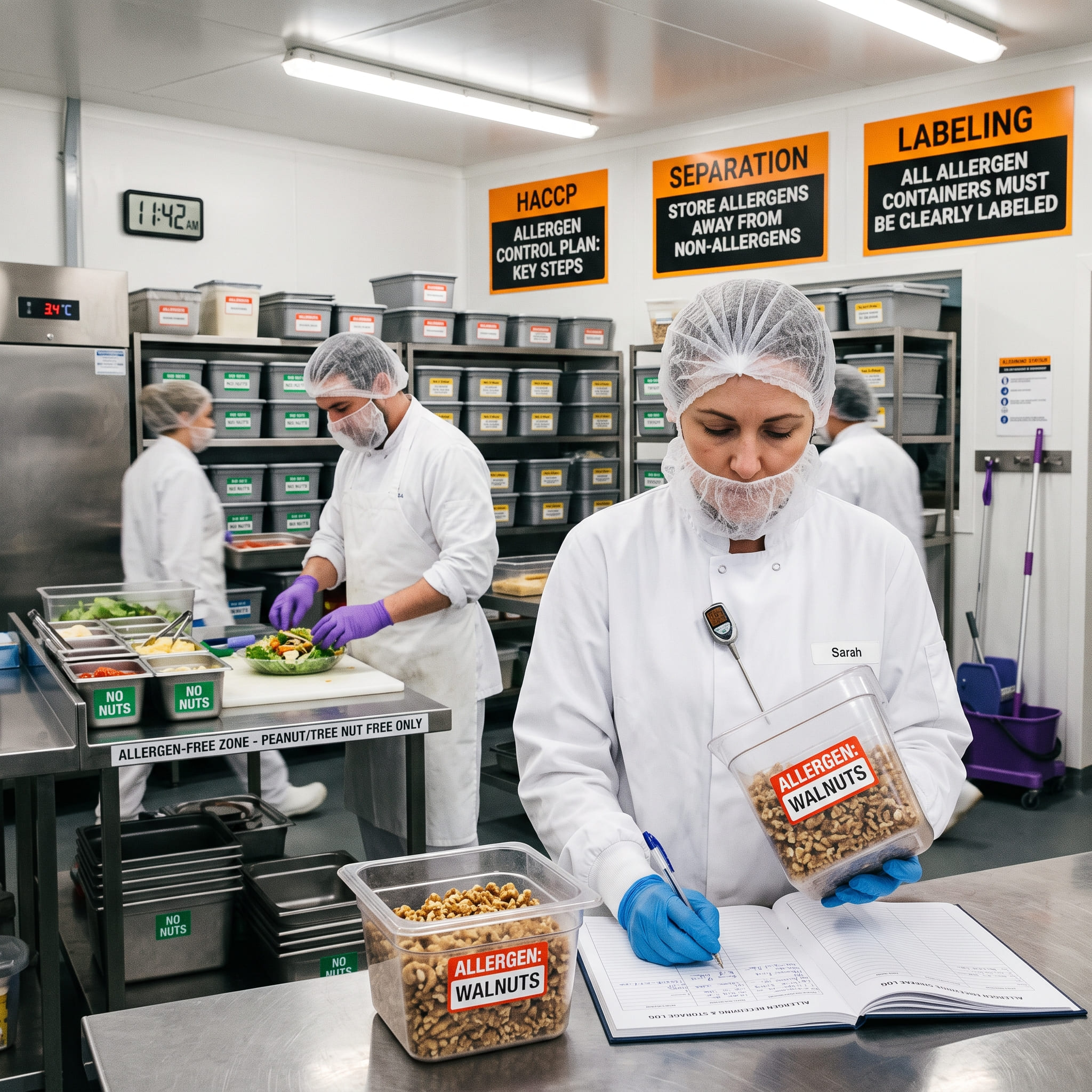
HACCP allergen control is an important part of food safety for restaurants, cafés, takeaways, catering businesses, bakeries, food retailers and other food businesses. Allergens need to be carefully managed from the point ingredients arrive at a business through storage, preparation, cooking, service and, where applicable, delivery.
For food businesses in Ireland, appropriate HACCP training Ireland can help employees understand how allergen hazards can occur and what controls can be used to reduce the risk of unintended allergen exposure.
Allergen management is not simply about knowing which ingredients contain allergens. Food businesses also need appropriate procedures for preventing allergen cross-contact, maintaining accurate information and ensuring staff understand their responsibilities.
This guide explains how HACCP allergen control works and the practical steps food businesses can take to manage allergens safely.
What Is Allergen Control?
Allergen control refers to the procedures a food business uses to identify, manage and communicate information about food allergens.
Food businesses need to consider allergens throughout their operations.
Potential risks can arise from:
- Ingredients
- Suppliers
- Storage
- Food preparation
- Cooking
- Utensils
- Equipment
- Work surfaces
- Packaging
- Staff handling
- Customer communication
Effective allergen management therefore needs to be incorporated into the business's overall food safety system.
Why Are Allergens Important in HACCP?
HACCP involves identifying hazards that could affect food safety and establishing appropriate controls.
Allergens can be considered within the hazard analysis where they are relevant to the food business.
For example, a restaurant may use:
- Milk
- Eggs
- Cereals containing gluten
- Soybeans
- Peanuts
- Tree nuts
- Fish
- Crustaceans
The business needs to understand where allergen hazards can occur and establish controls appropriate to its operation.
The exact controls depend on the products, processes and services provided.
Understanding Food Allergens
Food businesses should understand which ingredients contain allergens and how allergen information is managed.
In Ireland and the EU, food allergen information is regulated, and businesses need to follow applicable requirements when providing food to consumers.
The Food Safety Authority of Ireland provides guidance for food businesses on allergen information and food allergen management.
Employees should not rely on memory when answering customer questions.
Instead, they should use the business's approved allergen information.
Identifying Allergens in Ingredients
Allergen control starts with knowing what is contained in the ingredients used by the business.
This means businesses need reliable information from suppliers and should maintain appropriate ingredient information.
For example, an ingredient that appears simple may contain an allergen as part of its formulation.
Potential sources can include:
- Sauces
- Dressings
- Stock products
- Bakery ingredients
- Chocolate
- Seasonings
- Prepared foods
- Processed meats
Staff should know where the business keeps allergen information and who is responsible for maintaining it.
Supplier and Ingredient Controls
Food businesses should consider allergen information when purchasing ingredients.
Supplier information can help the business determine:
- Which allergens are present
- Whether formulations have changed
- Whether ingredients have been substituted
- What information needs to be passed to customers
When a supplier changes an ingredient or product, the business should review its allergen information.
A change in recipe can potentially change the allergen profile of a food.
Allergen Storage
Storage is another area where allergen controls may be necessary.
Ingredients should be stored in a way that reduces the possibility of unintended allergen cross-contact.
Businesses may use:
- Clearly labelled containers
- Suitable packaging
- Appropriate separation
- Organised storage areas
- Closed containers
Employees should follow the storage procedures established by the business.
Good storage organisation can make it easier for staff to identify ingredients and reduce handling errors.
Preventing Allergen Cross-Contact
Allergen cross-contact occurs when an allergen is unintentionally transferred to another food.
For example, an ingredient containing nuts could potentially come into contact with another food through:
- Shared utensils
- Equipment
- Work surfaces
- Hands
- Containers
- Ingredients
- Food preparation areas
Businesses need appropriate controls based on their processes.
These may include:
- Cleaning
- Separation
- Dedicated equipment where appropriate
- Ingredient controls
- Staff hygiene
- Organised workflows
Cleaning and Allergen Control
Cleaning can be an important part of allergen management.
When equipment or work surfaces are used for different foods, businesses need procedures to reduce the possibility of allergen residues being transferred.
Cleaning procedures should specify:
- What needs to be cleaned
- When cleaning is required
- How cleaning should be performed
- Which products should be used
- How cleaning is verified where necessary
Staff should understand that simply removing visible food residue may not always be sufficient for the business's allergen control procedure.
Hand Hygiene and Allergens
Hands can also transfer allergen-containing ingredients.
For example, an employee may handle a food containing an allergen and then handle another food.
Appropriate hand hygiene is therefore an important part of preventing unintended transfer.
Employees should follow workplace procedures for:
- Hand washing
- Changing tasks
- Handling allergen-containing ingredients
- Preparing allergen-related customer orders
Hand hygiene should form part of the wider food safety system.
Managing Allergens During Food Preparation
Food preparation should be organised to reduce allergen cross-contact.
A business may establish procedures for:
- Identifying the allergen-related order.
- Checking the approved ingredient information.
- Preparing the food according to the procedure.
- Using appropriately cleaned equipment.
- Preventing contact with unsuitable ingredients.
- Verifying the order before service.
The exact process will depend on the business.
Employees should follow the procedure rather than creating their own method.
Allergen Controls in Restaurants
Restaurants may handle many different dishes containing different allergens.
A restaurant may need to manage allergen information for:
- Starters
- Main courses
- Desserts
- Sauces
- Side dishes
- Drinks
Employees taking orders need access to accurate information.
Kitchen employees also need to understand how allergen-related requests are communicated to the kitchen.
A breakdown in communication can create unnecessary risks.
Allergen Controls in Cafés
Cafés may sell:
- Sandwiches
- Cakes
- Pastries
- Salads
- Soups
- Coffee drinks
- Desserts
Many of these products can contain allergens.
Staff should understand how allergen information is managed for both prepared products and packaged ingredients.
Where products are prepared on site, employees should follow the business's procedures for ingredient and allergen control.
Allergen Controls in Takeaways
Takeaways may have a fast-paced environment where employees handle many orders.
Allergen procedures should therefore be clear and practical.
Staff should know:
- How allergen requests are identified
- Where allergen information is available
- How orders are communicated
- Which ingredients are suitable
- What cleaning procedure is required
- Who to contact if there is uncertainty
Speed of service should never be a reason to guess about allergen information.
Communicating Allergen Information
Food businesses need appropriate procedures for providing allergen information to customers.
Employees should know:
- What information is available
- Where it can be found
- Who is responsible for maintaining it
- How to respond to customer questions
- What to do when information is uncertain
A staff member should never invent an answer.
If an employee does not know whether a product contains a particular allergen, they should follow the business's procedure for obtaining the correct information.
HACCP Allergen Hazard Analysis
During hazard analysis, a food business considers where allergen hazards may arise.
For example, the business might examine:
Receiving → Storage → Preparation → Cooking → Service
At each stage, the business can consider whether allergens could be:
- Introduced
- Misidentified
- Transferred
- Incorrectly communicated
The HACCP team can then establish appropriate controls.
Allergen control should reflect the actual operation rather than simply copying procedures from another business.
Are Allergens Always a Critical Control Point?
Not necessarily.
An allergen hazard does not automatically become a CCP.
HACCP requires the business to determine where control is essential and how significant hazards should be managed.
Some allergen controls may instead be managed through prerequisite programmes, operational procedures or other food safety controls.
The important point is that significant allergen risks should be identified and appropriately controlled.
Monitoring Allergen Controls
Monitoring helps determine whether allergen procedures are being followed.
Depending on the business, monitoring might involve:
- Checking ingredient information
- Reviewing labels
- Checking cleaning procedures
- Verifying preparation procedures
- Reviewing staff practices
- Checking records
- Reviewing allergen-related incidents
The business should establish appropriate monitoring procedures based on its own HACCP system.
Corrective Actions
Businesses should also have procedures for dealing with allergen control failures.
For example, an employee may discover that an incorrect ingredient was used in a dish.
The response should follow the business's established procedure.
Possible steps could include:
- Stop the affected process.
- Inform the responsible person.
- Identify affected food.
- Prevent the food from being served.
- Assess what happened.
- Take appropriate corrective action.
- Record the incident where required.
- Review the cause and prevent recurrence.
The exact action depends on the circumstances.
HACCP Allergen Records
Food businesses may maintain records relating to allergen management.
These can include:
- Ingredient specifications
- Allergen information
- Supplier information
- Cleaning records
- Training records
- Corrective actions
- Verification checks
Documentation should reflect the actual procedures used by the business.
Accurate records can also help businesses identify recurring problems.
HACCP Training for Allergen Control
HACCP training Ireland can help employees understand how allergen hazards fit into food safety management.
Training may cover:
- Food safety hazards
- Allergen hazards
- Cross-contamination
- HACCP principles
- Monitoring
- Corrective actions
- Documentation
The Food Safety Authority of Ireland states that people responsible for developing and maintaining HACCP-based procedures need adequate training in applying HACCP principles.
Employees should also receive workplace-specific allergen training appropriate to their responsibilities.
HACCP Level 1 and Level 2 Training
Food businesses may encounter HACCP Level 1 and HACCP Level 2 training.
The content can vary between training providers.
A basic course may introduce food safety and HACCP principles.
A more detailed HACCP Level 2 training programme may cover:
- Hazard analysis
- CCPs
- Critical limits
- Monitoring
- Corrective actions
- Verification
- Documentation
If you are required to obtain a HACCP Level 2 certificate, check the course syllabus and intended audience before enrolling.
HACCP Certificate Ireland
People searching for a HACCP certificate Ireland may find a range of training options.
Courses may be described as:
- HACCP training Ireland
- HACCP course Ireland
- HACCP certification Ireland
- HACCP certification course
- HACCP training certificate
- HACCP Level 2 certificate
- HACCP food safety training
When selecting training, consider:
- Course content
- Level
- Assessment
- Certificate
- Intended audience
- Employer requirements
A certificate demonstrates completion of a training programme, but it does not replace the food business's own allergen management procedures.
Online HACCP Training
Online HACCP training can be a flexible option for food workers.
An online HACCP course Ireland may cover:
- HACCP principles
- Food safety hazards
- Allergen control
- Cross-contamination
- Critical Control Points
- Monitoring
- Corrective actions
- Documentation
Online training can allow employees to study around their work schedule.
However, employees still need to understand the specific allergen procedures used by their employer.
Common Allergen Control Mistakes
Food businesses should be particularly careful about common mistakes such as:
Guessing About Ingredients
Staff should never guess whether an allergen is present.
Outdated Allergen Information
Ingredient changes should trigger an appropriate review.
Poor Cleaning
Allergen residues can potentially remain on equipment or surfaces.
Shared Equipment
Equipment should be managed according to the business's allergen control procedures.
Poor Communication
Customer allergen requests need to be communicated clearly.
Incorrect Labelling
Businesses should have appropriate procedures for maintaining accurate information.
Lack of Staff Training
Employees need to understand the allergen procedures relevant to their role.
Practical HACCP Allergen Control Checklist
A food business can review its allergen management by asking:
- Do we know which allergens are present in our ingredients?
- Is our allergen information current?
- Are supplier changes monitored?
- Are allergens stored appropriately?
- Are cleaning procedures suitable?
- Do employees understand cross-contact risks?
- Do staff know where allergen information is kept?
- Do employees know what to do if they are unsure?
- Are allergen incidents recorded where appropriate?
- Is staff training kept up to date?
The checklist should be adapted to the individual food business.
Final Thoughts
HACCP allergen control is an important part of managing food safety.
Allergen risks can occur during:
- Purchasing
- Receiving
- Storage
- Preparation
- Cooking
- Cleaning
- Service
- Communication with customers
Effective allergen management requires more than identifying allergens in individual ingredients. Businesses also need to consider how allergens could be transferred between foods and how accurate information is communicated.
For food businesses in Ireland, suitable HACCP training Ireland can help employees understand their responsibilities and the importance of allergen control.
If you are looking for a HACCP course Ireland, HACCP certificate Ireland, HACCP certification course, HACCP Level 2 training, HACCP training certificate or online HACCP training, check that the course covers the HACCP principles and responsibilities relevant to your role.
Most importantly, allergen management should be part of the everyday food safety culture of the business. When employees understand allergen hazards, follow appropriate procedures, maintain good hygiene, prevent cross-contact and use accurate allergen information, food businesses can better protect customers and manage allergen-related food safety risks.