



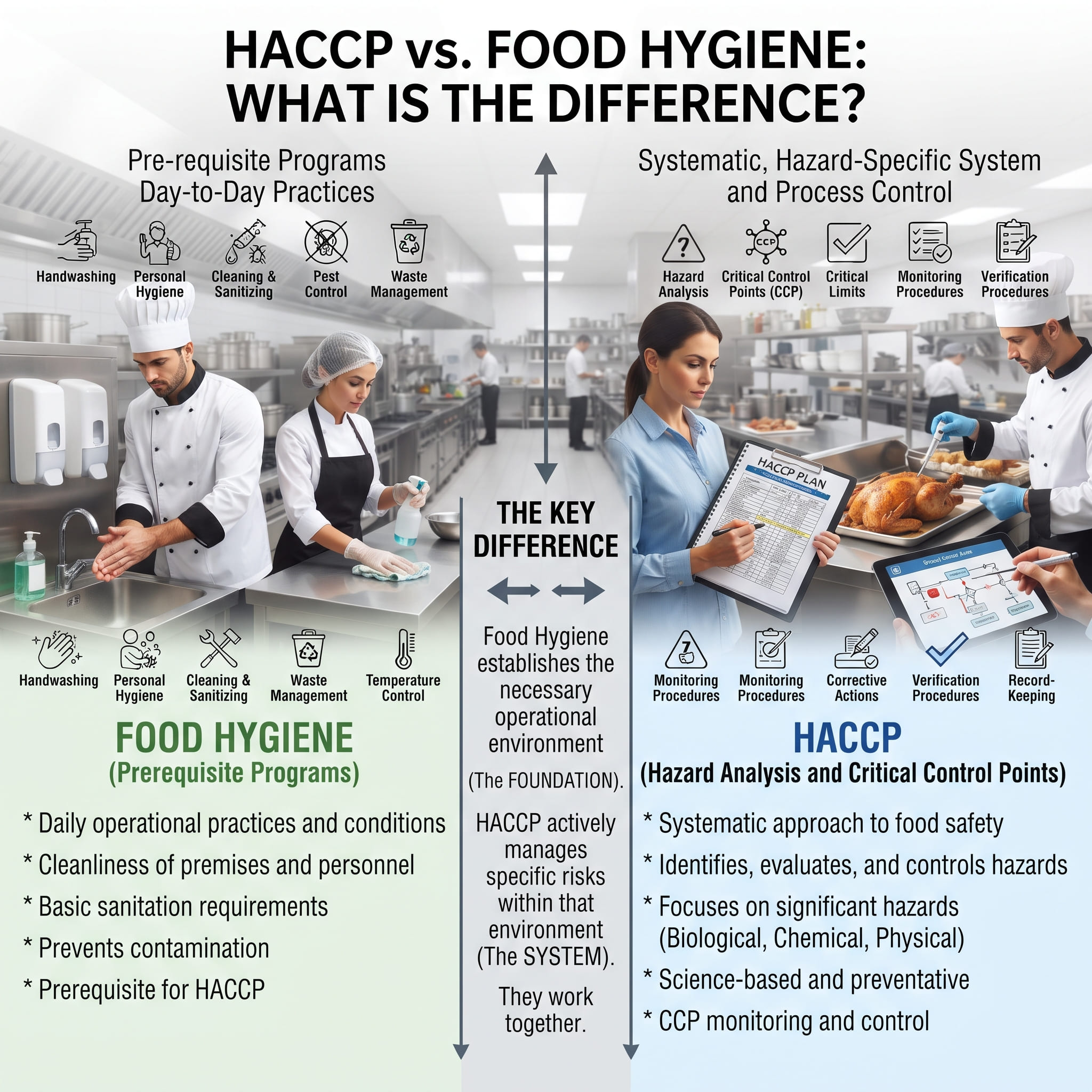
HACCP and food hygiene are closely connected, but they are not the same thing. Both are important parts of food safety, and understanding the difference can help food handlers, supervisors and food business owners understand their responsibilities.
If you are completing HACCP training in Ireland, you may come across terms such as HACCP certification, food hygiene training, HACCP training certificate and food safety training. Although these areas overlap, they focus on different aspects of keeping food safe.
In simple terms, food hygiene focuses on the practices used to maintain safe and hygienic food handling, while HACCP is a systematic approach for identifying food safety hazards and controlling significant hazards throughout a food process.
This article explains the difference between HACCP and food hygiene, how they work together and why both are important for food businesses in Ireland.
What Is Food Hygiene?
Food hygiene refers to the practices and conditions necessary to maintain food safety and prevent contamination.
Food hygiene covers many everyday activities carried out by food handlers.
These can include:
- Washing hands correctly
- Keeping work surfaces clean
- Preventing cross-contamination
- Storing food appropriately
- Handling food safely
- Maintaining personal hygiene
- Cleaning equipment
- Controlling pests
- Managing waste
- Maintaining suitable food premises
The objective is to prevent food from becoming contaminated or unsafe.
Food hygiene is therefore something food handlers practise every day.
What Is HACCP?
HACCP stands for Hazard Analysis and Critical Control Points.
It is a structured food safety system used to identify, evaluate and control hazards that could make food unsafe.
HACCP focuses on identifying potential hazards before they cause a problem and establishing controls to manage them.
The seven HACCP principles include:
- Conduct a hazard analysis.
- Determine Critical Control Points.
- Establish critical limits.
- Establish monitoring procedures.
- Establish corrective actions.
- Establish verification procedures.
- Establish documentation and record keeping.
The Food Safety Authority of Ireland (FSAI) recognises HACCP as a systematic approach to identifying and controlling food safety hazards.
HACCP vs Food Hygiene
The easiest way to understand the difference is to think about scope and approach.
Food Hygiene
Food hygiene is primarily concerned with maintaining hygienic practices and preventing contamination.
Examples include:
- Washing hands
- Cleaning surfaces
- Storing food correctly
- Preventing cross-contamination
HACCP
HACCP provides a structured system for identifying significant food safety hazards and controlling them.
Examples include:
- Hazard analysis
- Critical Control Points
- Critical limits
- Monitoring
- Corrective actions
- Verification
Food hygiene is therefore an important part of food safety, while HACCP provides a systematic framework for managing food safety hazards.
Why Do HACCP and Food Hygiene Work Together?
HACCP does not replace good food hygiene.
In fact, HACCP depends on appropriate basic hygiene and food safety practices.
For example, a HACCP system may identify cross-contamination as a significant hazard.
The controls may include:
- Hand hygiene
- Separation of raw and ready-to-eat foods
- Cleaning
- Appropriate food storage
- Correct handling procedures
These are food hygiene practices that support the HACCP system.
This is why it is more useful to think of HACCP and food hygiene as complementary, rather than competing systems.
An Example: Hand Washing
Hand washing is a simple example of the difference.
A food hygiene procedure might require employees to wash their hands:
- Before handling food
- After handling raw food
- After using the toilet
- After touching potentially contaminated surfaces
- When necessary during food preparation
This is a basic hygiene practice.
HACCP may consider hand hygiene as one of the controls used to manage hazards such as contamination.
However, hand washing itself is not automatically a Critical Control Point.
The HACCP team determines which hazards are significant and which controls are essential within the particular food process.
An Example: Cooking
Cooking provides another useful example.
Food hygiene includes following safe food preparation practices.
However, a particular cooking process may be identified through HACCP hazard analysis as a Critical Control Point if control at that stage is essential for managing a significant biological hazard.
The HACCP system can then establish:
- The relevant critical limit
- Monitoring procedure
- Corrective action
- Verification
- Record keeping
This demonstrates how a routine food operation can become part of a structured HACCP control system.
Food Hygiene Is Not Just Cleaning
Another common misunderstanding is that food hygiene simply means cleaning.
Cleaning is important, but food hygiene is much broader.
It can include:
Personal Hygiene
Employees need appropriate personal hygiene practices.
Food Handling
Food should be handled in ways that minimise contamination.
Cleaning
Equipment and food-contact surfaces need appropriate cleaning.
Storage
Food should be stored according to appropriate requirements.
Cross-Contamination Control
Raw and ready-to-eat foods may need to be separated appropriately.
Pest Control
Businesses need suitable measures to prevent pest contamination.
Waste Management
Food waste should be managed appropriately.
All these activities contribute to food hygiene.
HACCP Looks at the Whole Food Process
One of the major strengths of HACCP is that it looks systematically at the food process.
A simplified process might be:
Receiving → Storage → Preparation → Cooking → Cooling → Service
At each stage, the HACCP team considers:
What could go wrong?
Potential hazards may include:
- Biological hazards
- Chemical hazards
- Physical hazards
- Allergen hazards
The team then considers how those hazards can be controlled.
This systematic approach helps prevent important hazards from being overlooked.
Prerequisite Hygiene Practices and HACCP
Many HACCP systems rely on basic hygiene and other prerequisite controls.
These may include:
- Cleaning and sanitation
- Personal hygiene
- Pest control
- Waste management
- Supplier controls
- Maintenance
- Training
- Premises design
These foundational practices help create an environment where the HACCP system can operate effectively.
If basic hygiene controls are poor, the HACCP system may become unnecessarily complicated.
HACCP and Food Hygiene Training
There are different types of training available to food workers.
Food hygiene training may focus on practical food handling and hygiene requirements.
A HACCP course may focus more specifically on:
- Hazard analysis
- HACCP principles
- Critical Control Points
- Critical limits
- Monitoring
- Corrective actions
- Verification
- Documentation
Both types of knowledge can be valuable.
The appropriate training depends on the employee's role.
HACCP Training in Ireland
For people searching for HACCP training Ireland, it is useful to understand what the course covers before enrolling.
A HACCP course may be designed for:
- Food handlers
- Supervisors
- Managers
- Food business owners
- HACCP team members
The level of responsibility can influence the type of training required.
The FSAI states that food businesses need to ensure that people responsible for developing and maintaining HACCP-based procedures have adequate training in applying HACCP principles.
HACCP Level 1 vs Level 2
You may also see courses advertised as HACCP Level 1 and HACCP Level 2.
The exact course content can differ between providers, so the course syllabus should always be checked.
Generally, introductory HACCP training may focus on understanding basic food safety and HACCP concepts.
More advanced training may provide greater detail about:
- Hazard analysis
- CCPs
- Monitoring
- Corrective actions
- Verification
- HACCP documentation
If an employer requires a particular HACCP certificate in Ireland, check the exact training requirement before choosing a course.
HACCP Certificate vs Food Hygiene Certificate
A HACCP certificate and a food hygiene certificate are not necessarily the same qualification.
A food hygiene course may focus on safe food handling and hygiene practices.
A HACCP course may focus on the HACCP system and its principles.
Some training programmes may cover both areas.
Therefore, if a job advertisement or employer specifically asks for a HACCP training certificate, make sure the course you choose explicitly covers HACCP.
Likewise, if a role requires food hygiene training, a HACCP certificate should not automatically be assumed to fulfil every separate training requirement.
HACCP Certification in Ireland
If you are searching for HACCP certification Ireland, look beyond the word "certification."
Check:
- Course syllabus
- Training level
- Intended audience
- Assessment method
- Certificate provided
- Training provider
- Whether the course meets your employer's requirements
You may find terms such as:
- HACCP certification course
- HACCP certificate Ireland
- HACCP training certificate
- HACCP course Ireland
- HACCP food safety training
- HACCP Level 2 certificate
The right choice depends on why you need the training.
Online HACCP and Food Hygiene Training
Both HACCP and food hygiene training can be available online.
An online HACCP course may cover the theoretical principles of HACCP, while an online food hygiene course may focus on safe food handling practices.
Online training can be convenient because learners can complete lessons around their schedules.
However, completing an online course does not remove the need for workplace-specific procedures.
For example, an employee may complete online HACCP training but still need to learn:
- Their employer's HACCP plan
- Workplace cleaning procedures
- Specific monitoring requirements
- Allergen procedures
- Corrective actions
- Reporting procedures
Which Is More Important: HACCP or Food Hygiene?
This is not really an either/or question.
Both are important.
Food hygiene provides the practical foundation for safe food handling.
HACCP provides a systematic method for identifying and controlling significant food safety hazards.
A business with excellent HACCP documentation but poor everyday hygiene would still have serious food safety problems.
Similarly, good hygiene practices without a properly considered HACCP approach may not adequately address every significant hazard in a complex food process.
The two approaches work together.
How HACCP Uses Food Hygiene Controls
Consider a restaurant preparing raw chicken and salads.
The business may use food hygiene controls such as:
- Hand washing
- Separate preparation areas
- Cleaning equipment
- Appropriate storage
- Preventing cross-contamination
The HACCP system then considers the hazards associated with each stage.
It may identify particular stages where control is critical and establish monitoring and corrective action procedures.
This creates a connection between everyday hygiene and systematic HACCP management.
Common Mistakes
Food businesses and employees should avoid several misunderstandings.
Thinking HACCP Replaces Food Hygiene
It does not.
Thinking Food Hygiene Is Only About Cleaning
Food hygiene covers much more than cleaning.
Assuming Every Hygiene Procedure Is a CCP
A hygiene control is not automatically a Critical Control Point.
Treating a Certificate as the Entire HACCP System
Training provides knowledge. The food business still needs its own appropriate food safety procedures.
Using a Generic HACCP Plan Without Reviewing It
The HACCP system should reflect the actual business and its processes.
Final Thoughts
HACCP and food hygiene are closely related but serve different purposes.
Food hygiene focuses on the everyday practices and conditions needed to keep food safe and prevent contamination.
HACCP provides a structured approach to identifying significant food safety hazards and establishing controls to manage them.
The key difference can be summarised simply:
Food hygiene is about safe and hygienic food handling practices, while HACCP is a systematic approach to identifying and controlling food safety hazards.
For food businesses in Ireland, both areas are important.
If you are looking for HACCP training Ireland, a HACCP course Ireland, HACCP certificate Ireland, HACCP certification course or HACCP training certificate, choose training that matches your responsibilities and the requirements of your workplace.
Understanding both HACCP and food hygiene helps employees recognise not only how to handle food safely, but also why particular controls are necessary.
When good hygiene practices are combined with an effective HACCP system, food businesses have a stronger framework for preventing contamination, controlling hazards and protecting consumers.