



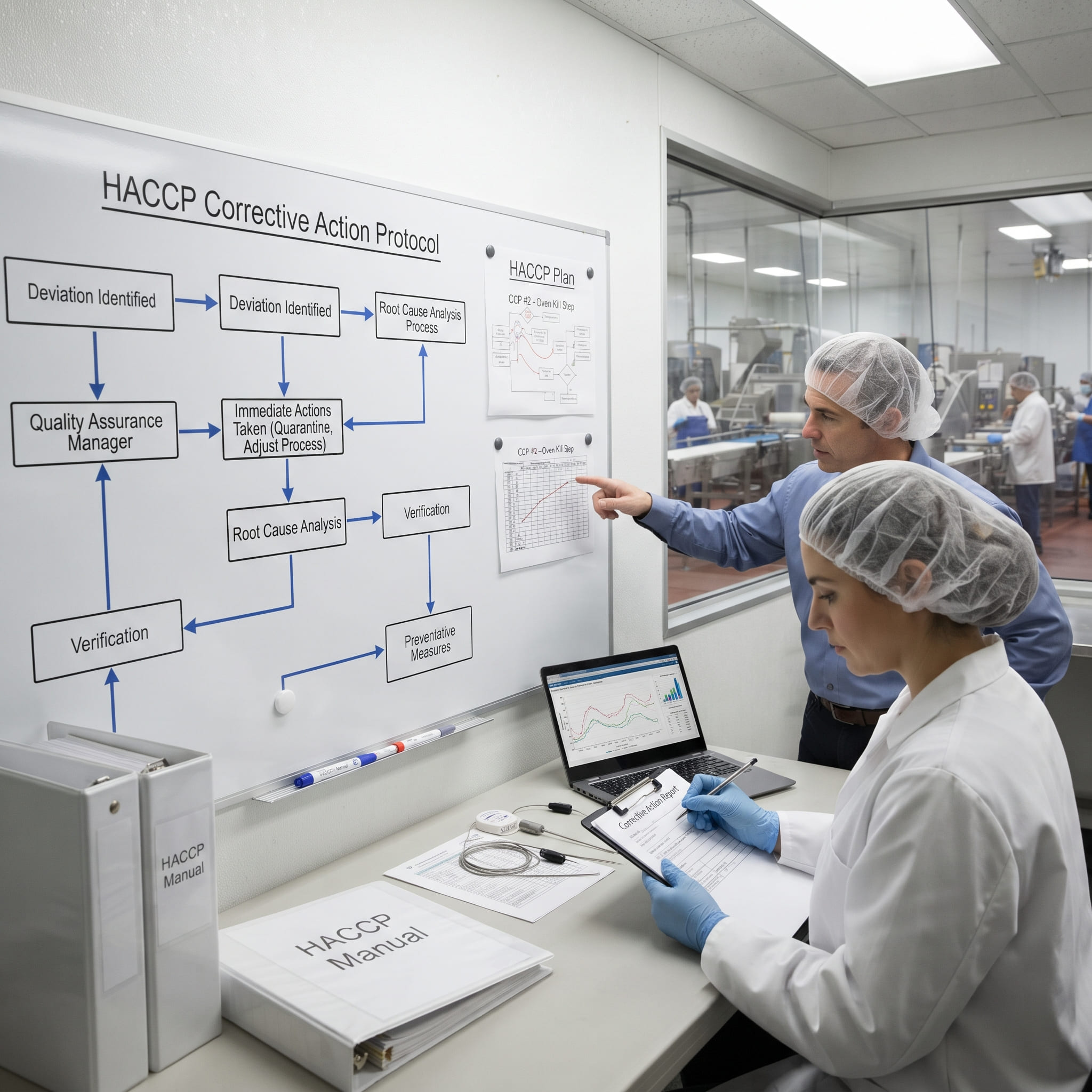
HACCP corrective action procedures are an essential part of an effective food safety management system. Even when a food business has carefully designed controls, problems can sometimes occur. A temperature may fall outside an established limit, equipment may fail, or a monitoring check may identify that a required procedure has not been followed.
A HACCP system needs to explain what employees should do when something goes wrong.
Corrective actions provide a structured response to these situations. They help the business regain control, deal with potentially affected food and investigate the reason for the failure.
For restaurants, cafés, takeaways, catering businesses, bakeries, food manufacturers and other food businesses in Ireland, understanding corrective actions is an important part of HACCP training Ireland.
What Is a HACCP Corrective Action?
A HACCP corrective action is an action taken when monitoring shows that a control at a Critical Control Point has failed to meet an established critical limit.
In simple terms, it answers the question:
What should we do when something goes wrong?
A corrective action procedure may involve:
- Stopping or adjusting the affected process
- Identifying affected food
- Assessing the food
- Preventing unsuitable food from being used or sold
- Restoring the process to control
- Recording what happened
- Investigating the cause
- Taking steps to prevent the problem from happening again
The exact response depends on the hazard, process and circumstances.
Why Are Corrective Actions Important?
HACCP is designed to prevent food safety hazards from causing harm.
However, controls are not always perfect.
Equipment can fail. Employees can make mistakes. Processes can change. Unexpected circumstances can occur.
A corrective action procedure ensures that employees do not have to improvise when a food safety control fails.
For example, if a monitoring check identifies that a CCP has exceeded its critical limit, the employee should know what action to take.
Without a clear procedure, an employee might continue with the process without understanding the potential food safety consequences.
Corrective Actions and Critical Control Points
Corrective actions are particularly important when a Critical Control Point (CCP) is outside its critical limit.
A simplified HACCP system might look like this:
Hazard → CCP → Critical Limit → Monitoring → Corrective Action → Verification
For example:
Hazard: Significant biological hazard
CCP: Specific cooking process
Critical limit: Established time/temperature criterion
Monitoring: Employee checks the process
Deviation: Required limit is not achieved
Corrective action: Follow the documented response for the affected food and process
The exact limits and actions should be established for the individual HACCP system.
Step 1: Identify the Problem
The first part of a corrective action procedure is identifying that a deviation has occurred.
This normally happens through monitoring.
For example:
- A temperature reading is outside the critical limit.
- A cooking process does not achieve the required criterion.
- A monitoring check is missed.
- A required control is not operating correctly.
Employees need to understand how to recognise a deviation.
This is one reason practical HACCP training is important.
Step 2: Take Immediate Action
Once a problem is identified, immediate action may be required to prevent further food safety risks.
Depending on the situation, this could involve:
- Stopping the affected process
- Separating affected food
- Preventing food from being served
- Adjusting equipment
- Repeating a process where appropriate
- Informing a responsible manager
The appropriate response depends on the nature of the deviation.
Employees should not simply continue working as normal if an important HACCP control has failed.
Step 3: Identify Affected Food
The business should determine which food may have been affected.
This could include food processed:
- Since the previous successful check
- During an equipment failure
- During a period when a critical limit was exceeded
- Under conditions where the control could not be confirmed
The business should use its monitoring records to help establish the relevant period.
This is one reason accurate HACCP documentation is important.
Step 4: Assess the Affected Food
The business needs to determine what should happen to potentially affected food.
Depending on the situation, the food may need to be:
- Reprocessed where appropriate
- Held pending assessment
- Discarded
- Prevented from being distributed
- Managed according to established food safety procedures
The decision should be based on the hazard, the extent of the deviation and appropriate food safety information.
Employees should not make unsupported assumptions about whether food is safe.
Step 5: Restore the Process to Control
Corrective action should also address the process itself.
For example, if a refrigeration unit is not maintaining the required conditions, the business may need to:
- Check the equipment
- Move food if necessary
- Repair the equipment
- Adjust the operating conditions
- Increase monitoring
- Contact a maintenance provider
The objective is to bring the process back under control.
Step 6: Investigate the Cause
An effective corrective action procedure should go beyond fixing the immediate problem.
The business should ask:
Why did this happen?
Possible causes include:
- Equipment failure
- Employee error
- Inadequate training
- Incorrect procedures
- Excessive workload
- Poor maintenance
- Incorrect monitoring
- Process changes
- Inadequate resources
Understanding the underlying cause can help prevent recurrence.
Step 7: Prevent Recurrence
Once the cause has been identified, the business can consider preventive improvements.
These might include:
- Staff retraining
- Updating procedures
- Increasing monitoring
- Equipment maintenance
- Changing workflow
- Improving communication
- Revising cleaning procedures
- Reviewing supplier controls
The appropriate action depends on the cause.
Repeated deviations may indicate that the HACCP system itself needs to be reviewed.
Step 8: Record the Corrective Action
Corrective actions should be documented appropriately.
A corrective action record may include:
- Date
- Time
- Process or CCP
- Problem identified
- Monitoring result
- Food affected
- Immediate action
- Final decision regarding affected food
- Cause of the deviation
- Corrective action taken
- Person responsible
- Verification or follow-up
Good records provide evidence that the business responded appropriately.
They can also help identify recurring problems.
Example: Cooking Deviation
Imagine a restaurant has a cooking process identified as a CCP.
An employee performs the required monitoring check and discovers that the established critical limit has not been achieved.
An appropriate corrective action procedure could require the employee to:
- Stop the affected process.
- Identify the food affected.
- Follow the established procedure for dealing with the food.
- Notify the responsible person.
- Investigate why the required cooking condition was not achieved.
- Correct the process.
- Record the incident.
- Increase monitoring or take other appropriate action if required.
The exact procedure should be based on the business's HACCP system and appropriate food safety evidence.
Example: Refrigeration Problem
Consider a café where a refrigeration unit is not operating as expected.
The business may need to:
- Identify affected foods.
- Establish how long the problem may have existed.
- Check monitoring records.
- Assess the food using the business's established procedures.
- Prevent potentially unsafe food from being used.
- Move food if appropriate.
- Repair the refrigeration equipment.
- Record the incident.
- Investigate why the failure occurred.
The procedure should be established before an incident happens.
Corrective Actions and HACCP Monitoring
Monitoring and corrective actions work together.
Monitoring identifies a problem.
Corrective action responds to the problem.
For example:
Monitoring: Employee checks a CCP.
↓
Result: Critical limit is exceeded.
↓
Corrective action: Employee follows the documented response.
↓
Verification: Manager reviews whether the corrective action was effective.
This creates a continuous food safety control process.
Corrective Actions and Verification
Verification helps determine whether corrective action has actually addressed the problem.
For example, if an equipment failure caused a deviation, the business may verify that:
- The equipment is functioning correctly.
- Subsequent monitoring results are satisfactory.
- Employees understand the revised procedure.
- Similar deviations are not continuing.
Verification is particularly useful when a problem has occurred repeatedly.
Corrective Actions and Validation
Corrective action should not be confused with validation.
Validation asks whether a control measure is capable of effectively controlling the identified hazard.
Verification checks whether the HACCP system is operating as intended.
Corrective action deals with a deviation or loss of control.
These concepts work together within an effective HACCP system.
Common Corrective Action Mistakes
Food businesses should avoid several common problems.
Only Fixing the Immediate Problem
The business may restore the process without investigating why the failure occurred.
Failing to Identify Affected Food
If the business does not establish what food may have been affected, it may not be able to make an appropriate decision.
Poor Documentation
Without records, it can be difficult to demonstrate what happened and what action was taken.
Giving Employees Vague Instructions
Employees need clear procedures for responding to deviations.
Repeating the Same Corrective Action
Repeated failures may indicate that the underlying system needs improvement.
Corrective Actions for Small Food Businesses
Corrective action procedures are not limited to large food manufacturers.
A small restaurant or café may need procedures for:
- Cooking deviations
- Refrigeration failures
- Allergen incidents
- Cross-contamination
- Cleaning failures
- Equipment breakdowns
- Delivery problems
The system should be proportionate to the business while still providing effective control.
HACCP Corrective Actions and Staff Training
Employees should understand what to do when a food safety control fails.
Training can help employees recognise:
- Critical Control Points
- Critical limits
- Monitoring requirements
- Deviations
- Corrective actions
- Reporting procedures
HACCP training Ireland can help food workers and managers develop an understanding of these principles.
Training should be appropriate to the responsibilities of each employee.
HACCP Level 1 and Level 2 Training
Different employees may require different levels of HACCP knowledge.
HACCP Level 1 training may introduce:
- Food hygiene
- Food safety hazards
- Basic HACCP principles
- Food handler responsibilities
HACCP Level 2 training may provide more detailed information about:
- Hazard analysis
- Critical Control Points
- Critical limits
- Monitoring
- Corrective actions
- Verification
- Documentation
If you are looking for a HACCP Level 2 certificate, check the course syllabus to make sure it covers the topics relevant to your role.
HACCP Certificate Ireland
People searching for a HACCP certificate Ireland may find courses advertised using terms such as:
- HACCP course Ireland
- HACCP training Ireland
- HACCP certification Ireland
- HACCP certification course
- HACCP training certificate
- HACCP Level 2 certificate
- HACCP food safety training
When selecting a course, consider the responsibilities associated with your job.
Someone working directly with food may have different training requirements from a person responsible for developing or maintaining a HACCP system.
Online HACCP Training
Online HACCP training can provide a flexible way to learn about corrective actions and other HACCP principles.
An online HACCP course Ireland may cover:
- Food safety hazards
- Hazard analysis
- Critical Control Points
- Critical limits
- Monitoring
- Corrective actions
- Verification
- Documentation
Online learning can be useful for employees and managers who need flexible study arrangements.
However, general training should be supported by the specific procedures used within the workplace.
Practical Corrective Action Checklist
A food business can ask:
- Have CCPs been clearly identified?
- Are critical limits established?
- Are monitoring procedures documented?
- Can employees recognise a deviation?
- Is there a corrective action for each relevant CCP?
- Does the procedure address affected food?
- Does it restore the process to control?
- Does it identify who is responsible?
- Are corrective actions recorded?
- Is the underlying cause investigated?
- Are recurring problems reviewed?
- Is follow-up verification carried out?
This checklist can help identify weaknesses in an existing HACCP system.
When Should Corrective Action Procedures Be Reviewed?
Corrective action procedures should be reviewed when:
- A new product is introduced
- A new process is introduced
- Equipment changes
- Recipes change
- Monitoring identifies recurring failures
- A food safety incident occurs
- Employees report difficulties following procedures
- Verification identifies weaknesses
A repeated deviation can be particularly important.
If the same problem occurs several times, the business should consider whether the underlying HACCP control is suitable.
Final Thoughts
HACCP corrective action procedures provide food businesses with a structured response when a food safety control fails.
An effective procedure should help the business:
- Identify the deviation.
- Take immediate action.
- Identify affected food.
- Assess what should happen to that food.
- Restore the process to control.
- Investigate the cause.
- Prevent recurrence.
- Document the response.
- Verify that the action was effective.
For food businesses in Ireland, appropriate HACCP training Ireland can help employees and managers understand how corrective actions fit into the wider HACCP system.
If you are looking for a HACCP course Ireland, HACCP certificate Ireland, HACCP certification course, HACCP Level 2 training, HACCP training certificate or online HACCP training, consider whether the course content matches your role and responsibilities.
Corrective actions should not be viewed simply as paperwork completed after something goes wrong. They are an important part of maintaining control over food safety processes. When deviations are identified quickly, affected food is managed appropriately and the underlying causes are addressed, a food business can continuously improve its HACCP system and reduce the likelihood of the same problem happening again.