



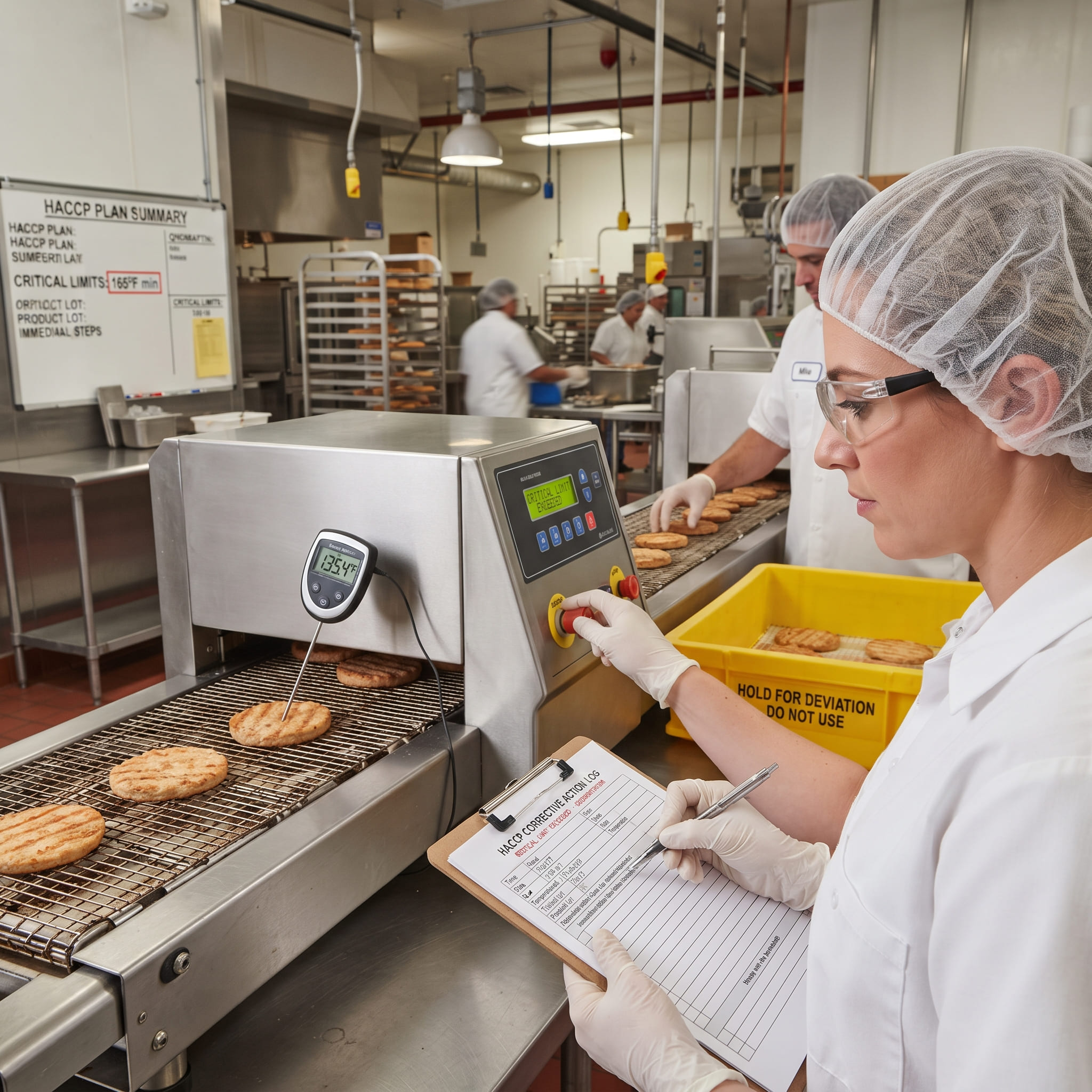
HACCP corrective actions are an essential part of any effective HACCP food safety system. Identifying hazards and establishing Critical Control Points is not enough on its own. Food businesses also need clear procedures explaining what to do when a control fails or a critical limit is exceeded.
For food businesses in Ireland, corrective actions are particularly important because they provide a structured response when a food safety process is no longer under control.
For people completing HACCP training in Ireland, understanding corrective actions is an important part of learning how HACCP works in practice. Employees need to know not only how to monitor a Critical Control Point (CCP), but also what to do when monitoring identifies a problem.
This article explains what HACCP corrective actions are, when they are required, what businesses should consider and why proper documentation is important.
What Is a HACCP Corrective Action?
A HACCP corrective action is the action taken when monitoring shows that a critical limit at a Critical Control Point has not been achieved.
In simple terms:
A critical limit is exceeded → control has been lost → corrective action is required.
Corrective actions are part of the fifth HACCP principle.
The purpose is not simply to fix the immediate problem. An effective corrective action procedure should also address affected food where appropriate and help prevent the problem from happening again.
The Food Safety Authority of Ireland (FSAI) identifies establishing corrective actions as one of the seven principles of HACCP.
What Is a Critical Limit?
Before understanding corrective actions, it is important to understand what a critical limit is.
A critical limit is a measurable or observable boundary used to determine whether a CCP is under control.
Depending on the food process, critical limits may relate to factors such as:
- Temperature
- Time
- pH
- Other measurable conditions
For example, a HACCP system may establish a specific cooking requirement for a particular food process.
If monitoring shows that the required limit has not been achieved, the CCP may no longer be under control.
This is when the established corrective action procedure should be followed.
Why Are Corrective Actions Important?
Food safety problems can occur even when a business has a well-designed HACCP system.
Equipment can fail.
Employees can make mistakes.
Ingredients can arrive in unsuitable condition.
Processes can deviate from established requirements.
Corrective actions provide employees with a clear response.
Without a defined procedure, staff may not know:
- What to do with affected food
- Who to inform
- Whether the process should continue
- Whether the equipment needs attention
- What needs to be recorded
- How to prevent recurrence
A written corrective action procedure removes much of this uncertainty.
When Is a Corrective Action Required?
Corrective actions are generally required when monitoring identifies that a critical limit has not been met.
For example:
- A cooking process does not meet its established critical limit.
- A CCP monitoring result is outside the acceptable range.
- Required process conditions are not achieved.
- Equipment failure causes loss of control at a CCP.
The exact response depends on the specific hazard, critical limit and HACCP procedure.
It is therefore important that corrective actions are established before a problem occurs.
Step 1: Identify the Problem
The first step is recognising that a deviation has occurred.
This usually happens through routine monitoring.
For example, an employee may carry out a required check and obtain a result outside the established critical limit.
The employee should understand that the result indicates a loss of control and should follow the established corrective action procedure.
The problem should not simply be ignored or the measurement changed to make the record appear acceptable.
Step 2: Take Immediate Corrective Action
The next step is to restore control of the process.
The action will depend on the situation.
It may involve:
- Stopping the process
- Correcting the process
- Adjusting equipment
- Repeating a process where appropriate
- Notifying a supervisor
- Separating affected food
- Taking another action specified in the HACCP procedure
The objective is to regain control as quickly as reasonably possible.
Step 3: Deal With Affected Food
One of the most important questions is:
What happened to the food while the CCP was outside control?
The business may need to determine whether food produced during the deviation is safe and suitable.
Depending on the circumstances, affected food may need to be:
- Held
- Assessed
- Reprocessed where appropriate
- Rejected
- Disposed of
The decision should follow the business's HACCP procedures and food safety requirements.
Employees should not simply decide that affected food is safe without following the established process.
Step 4: Find the Cause
Corrective action should ideally address more than the immediate problem.
The business should consider:
Why did the critical limit fail?
Possible causes could include:
- Equipment malfunction
- Incorrect settings
- Employee error
- Inadequate training
- Poor maintenance
- Incorrect procedures
- Insufficient monitoring
- Changes in the production process
Finding the underlying cause can help prevent the same problem from happening again.
Step 5: Prevent the Problem From Happening Again
After identifying the cause, the business may need to take further action.
For example, it may need to:
- Repair equipment
- Review a procedure
- Provide additional staff training
- Change the monitoring frequency
- Improve maintenance
- Review the HACCP system
- Introduce an additional control
The appropriate action depends on the cause of the deviation.
This is an important distinction between simply correcting a problem and preventing recurrence.
A Simple HACCP Corrective Action Example
Imagine a food business where cooking has been identified as a CCP.
The HACCP system establishes a critical limit for the cooking process.
An employee performs the required monitoring and discovers that the critical limit has not been achieved.
The corrective action procedure could require the employee to:
- Identify the deviation.
- Inform the responsible person.
- Stop or hold the affected process.
- Assess the affected food according to the HACCP procedure.
- Correct the cooking process where appropriate.
- Check the equipment.
- Record the deviation and action taken.
- Investigate why the problem occurred.
This is a simplified example.
The actual corrective action must be based on the specific HACCP system and food safety hazard.
Corrective Actions Must Be Planned in Advance
A strong HACCP system does not wait until something goes wrong before deciding what to do.
Corrective actions should be established when the HACCP system is developed.
For each relevant CCP, the business should consider:
- What could cause the critical limit to be exceeded?
- How will the deviation be identified?
- What immediate action is required?
- What happens to affected food?
- Who is responsible?
- What needs to be recorded?
- What follow-up investigation is required?
This allows employees to respond quickly and consistently.
Corrective Action Records
Documentation is an important part of HACCP.
When a critical limit is exceeded, the business may need to record:
- Date
- Time
- CCP involved
- Monitoring result
- Critical limit
- Nature of the deviation
- Food or product affected
- Immediate action taken
- Person responsible
- Final disposition of affected food
- Follow-up action
The exact information required depends on the business's HACCP procedures.
Good records provide evidence that the business identified and responded to the problem.
Why Accurate Records Matter
Employees should record what actually happened.
For example, if a monitoring check produces an unacceptable result, the record should not be changed simply to make it appear that the critical limit was achieved.
Accurate records help businesses:
- Identify recurring problems
- Investigate failures
- Review equipment performance
- Demonstrate that corrective actions were taken
- Verify the HACCP system
- Improve food safety procedures
A series of corrective action records may also reveal a pattern.
For example, repeated deviations involving the same piece of equipment could indicate that maintenance or replacement is required.
Corrective Actions and Verification
Corrective actions are closely connected to HACCP verification.
After corrective action has been taken, the business may need to verify that the problem has actually been resolved.
For example:
- Has the equipment been repaired?
- Is the process now meeting the critical limit?
- Has the monitoring result returned to an acceptable level?
- Was the affected food dealt with appropriately?
- Has the underlying cause been addressed?
Verification helps confirm that the corrective action was effective.
Corrective Action vs Preventive Action
These terms can sometimes be confused.
Corrective Action
A corrective action responds to a deviation or loss of control.
For example:
A CCP fails to meet its critical limit, so the business follows its established corrective action procedure.
Preventive Approach
Preventive measures are designed to reduce the likelihood of a problem occurring in the first place.
Examples include:
- Staff training
- Equipment maintenance
- Supplier controls
- Preventive maintenance
- Clear procedures
- Routine monitoring
A good HACCP system uses both effective controls and appropriate corrective actions.
Who Is Responsible for Corrective Actions?
Responsibilities should be clearly defined.
Depending on the size of the food business, corrective actions may involve:
- Food handlers
- Supervisors
- Managers
- HACCP team members
- Food safety personnel
An employee carrying out CCP monitoring should know exactly what to do if a critical limit is exceeded.
They should also know who must be informed.
This is particularly important in larger businesses where the person monitoring the CCP may not be the person responsible for making final decisions about affected food.
HACCP Training and Corrective Actions in Ireland
Understanding corrective actions is an important part of HACCP training in Ireland.
A suitable HACCP course in Ireland may cover:
- HACCP principles
- Hazard analysis
- Critical Control Points
- Critical limits
- Monitoring
- Corrective actions
- Verification
- Record keeping
HACCP Level 1 training may introduce learners to the basic concepts.
HACCP Level 2 training may provide more detailed knowledge for people with additional food safety responsibilities.
The FSAI states that people responsible for developing and maintaining HACCP-based procedures need adequate training in applying HACCP principles.
HACCP Certificate and Certification
If you are looking for a HACCP certificate in Ireland, it is worth checking whether the course covers corrective actions and the other core HACCP principles.
You may find courses described as:
- HACCP training Ireland
- HACCP course Ireland
- HACCP certificate Ireland
- HACCP certification Ireland
- HACCP training certificate
- HACCP certification course
- HACCP food safety training
- HACCP Level 2 certificate
The most suitable course depends on the learner's role.
A certificate confirms completion of a particular training programme, but it does not automatically mean that someone is qualified to design or manage every HACCP system.
Online HACCP Training
Online HACCP training can provide a flexible way to learn about corrective actions.
An online course may cover:
- Critical Control Points
- Critical limits
- Monitoring
- Deviations
- Corrective actions
- Verification
- Documentation
This can be useful for food workers who need to study around work commitments.
However, general online training does not replace workplace-specific procedures.
Employees still need to know the corrective actions established by their employer's HACCP system.
Common Corrective Action Mistakes
Food businesses should avoid several common mistakes.
Ignoring a Failed Monitoring Result
An unacceptable result should never simply be ignored.
Changing the Record
Monitoring records should accurately reflect what was measured.
Not Dealing With Affected Food
The business should follow its established procedure for assessing and managing affected food.
Fixing the Immediate Problem Only
If the underlying cause is not addressed, the same problem may happen again.
Not Recording the Action
Corrective actions should be documented according to the HACCP system.
Unclear Responsibilities
Employees need to know who is responsible for taking action and who must be informed.
Final Thoughts
HACCP corrective actions provide a structured response when a critical limit is exceeded or control at a Critical Control Point is lost.
An effective corrective action process should answer several important questions:
- What went wrong?
- How was the problem identified?
- What immediate action should be taken?
- What happens to affected food?
- How can control be restored?
- Why did the deviation happen?
- How can recurrence be prevented?
- What needs to be recorded?
Corrective actions are therefore much more than simply fixing a problem.
For food businesses in Ireland, they are an important part of maintaining an effective HACCP system and ensuring that employees know how to respond when something goes outside the established limits.
If you are looking for HACCP training Ireland, a HACCP course Ireland, HACCP certificate Ireland or HACCP certification course, look for training that explains all seven HACCP principles, including monitoring and corrective actions.
Ultimately, the strength of a HACCP system is not determined by whether problems ever occur. Problems can happen in any food business. What matters is whether the business can identify a loss of control quickly, take appropriate corrective action, deal with affected food and prevent the same problem from happening again.