



Food safety is a vital responsibility for businesses involved in preparing, storing, transporting, or serving food. Restaurants, cafés, hotels, catering companies, supermarkets, and food manufacturers must take appropriate steps to prevent contamination and protect consumers. Employees also need to understand how their everyday activities influence food safety and why established hygiene procedures must be followed.
A suitable haccp food safety course can help learners understand how food safety hazards are identified, assessed, and controlled. However, courses differ in their content, duration, assessment methods, and intended audiences. Choosing the right programme requires more than comparing prices or selecting the first available certificate.
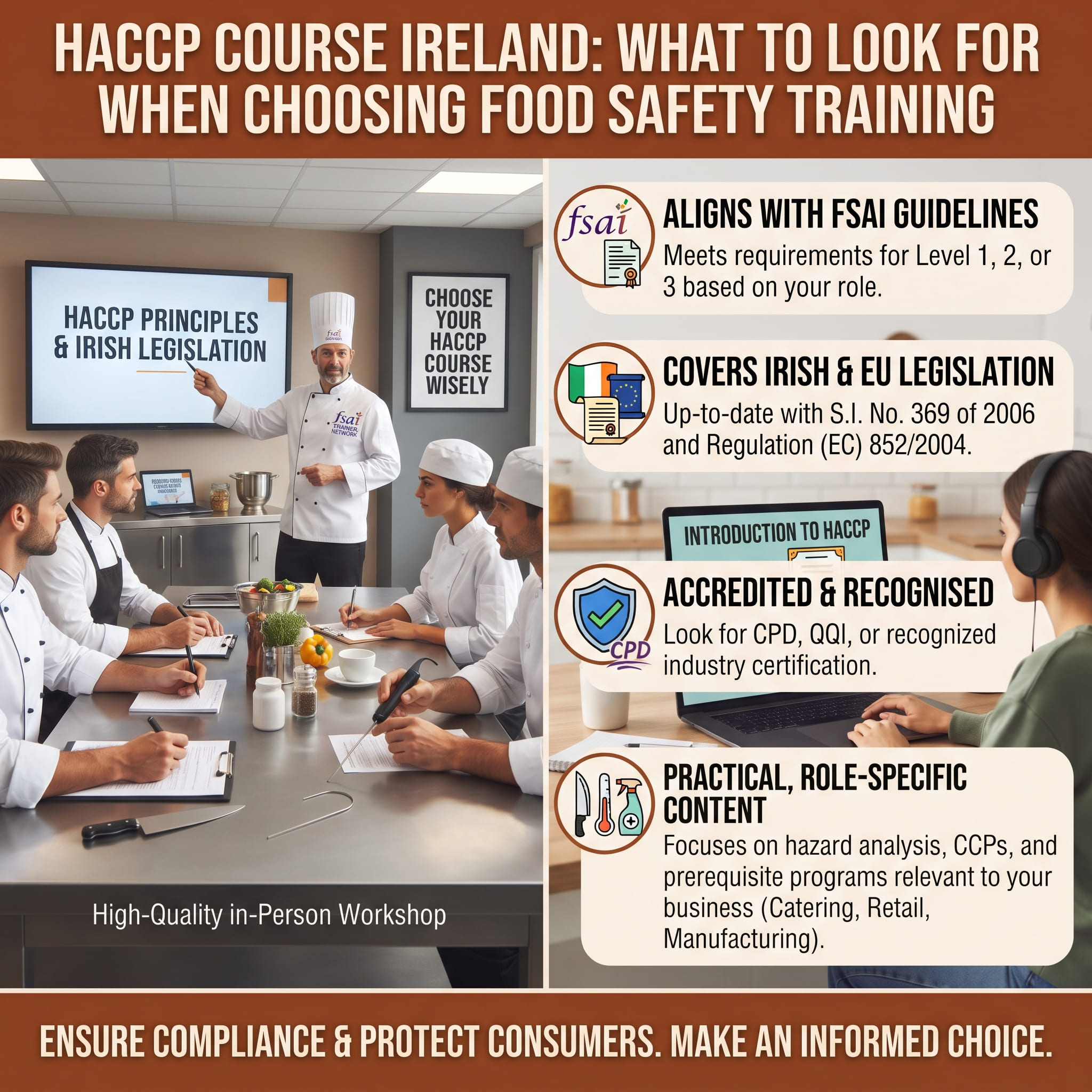
If you are searching for a haccp course online or classroom-based training in Ireland, you should consider the course syllabus, the provider's transparency, the assessment process, and the relevance of the training to your job.
This guide explains what to look for when choosing food safety training and how to make a more informed decision.
1. Check the Course Content and Learning Objectives
The first step when comparing haccp training providers is to review the syllabus. A suitable course should clearly explain what learners will study and what knowledge they are expected to gain.
HACCP stands for Hazard Analysis and Critical Control Points. It is a systematic approach to identifying food safety hazards and establishing measures to prevent, eliminate, or reduce significant hazards to acceptable levels.
Depending on the course level, topics may include:
-
The purpose and principles of HACCP.
-
Biological, chemical, and physical food safety hazards.
-
Food contamination and cross-contamination.
-
Personal hygiene and safe food handling.
-
Cleaning and disinfection procedures.
-
Temperature control and safe food storage.
-
Monitoring and record keeping.
-
Critical Control Points (CCPs).
-
Corrective actions when controls fail.
-
Verification of food safety procedures.
Check that the advertised course content matches the training you need. An introductory programme for food handlers may not provide sufficient detail for someone responsible for developing or reviewing a HACCP plan.
Clear learning objectives help you determine whether the course is appropriate before paying for it.
2. Choose Training That Matches Your Job Role
Food safety responsibilities vary between workplaces and job positions. A kitchen assistant, food production operative, restaurant supervisor, and food safety manager may need different levels of knowledge.
For example, a food handler may need to understand how to prevent cross-contamination, maintain personal hygiene, and follow temperature-control procedures. A supervisor may also need to monitor staff practices, review records, and ensure corrective actions are taken when problems occur.
People responsible for developing and maintaining HACCP-based procedures may require more advanced training in hazard analysis, identifying CCPs, establishing critical limits, and verifying controls.
Before enrolling in a haccp certification course, ask yourself:
-
Is the course intended for food handlers, supervisors, or managers?
-
Does it cover hazards relevant to my workplace?
-
Will it help me understand my responsibilities?
-
Does it provide the level of detail required for my position?
-
Does my employer require a particular course or qualification?
Choosing training that matches your duties helps prevent situations where a certificate is obtained but important workplace skills remain undeveloped.
3. Understand What the Certificate Represents
The word certification can refer to different outcomes, depending on the training provider and programme. Some courses issue certificates of completion, while others involve a formal assessment or a qualification awarded by a specified organisation.
Before purchasing haccp certification, establish exactly what you will receive.
Check the following details:
-
The name of the organisation issuing the certificate.
-
The course title and learning outcomes.
-
Whether the certificate confirms attendance or successful assessment.
-
Whether an assessment is compulsory.
-
Whether the certificate includes your name and completion date.
-
Whether the certificate can be independently verified.
-
Whether any renewal or refresher training is recommended.
If a provider advertises an accredited or regulated qualification, verify the claim and establish which organisation awards it. Do not assume that every course using the term HACCP has the same recognition or qualification status.
A certificate can provide evidence of completed training, but it does not automatically demonstrate practical competence in every food-handling task. Nor does an individual certificate, by itself, prove that a food business has met all its food safety obligations.
4. Review the Training Provider's Credibility
A reliable training provider should give clear information about its organisation, course content, pricing, assessment requirements, and customer support.
When reviewing a provider's website, look for a detailed course description rather than relying only on marketing statements.
Consider whether the provider explains:
-
Who delivers the training.
-
What experience or relevant qualifications the instructors have.
-
What learning materials are included.
-
How learners can contact the provider.
-
How assessments and certificates are handled.
-
What the refund and cancellation terms are.
-
How personal information is collected and protected.
Be cautious of websites making unsupported claims about official recognition, guaranteed employment, or universal acceptance of certificates.
In Ireland, the Food Safety Authority of Ireland (FSAI) provides information about food safety responsibilities and training. You can consult its website at https://www.fsai.ie/ to understand the requirements relevant to food businesses.
Reviewing the provider's information alongside official guidance can help you make a more informed choice.
5. Consider Whether Online Training Suits You
Online learning can be convenient for employees and employers who need flexibility. A haccp course online may allow learners to study from home or another suitable location without attending a classroom at a fixed time.
However, flexibility should not be the only consideration. The quality of the learning experience matters just as much.
Look for online training that includes:
-
Well-organised modules.
-
Clear explanations of food safety principles.
-
Visual examples and practical workplace scenarios.
-
Knowledge checks or quizzes.
-
A final assessment, where appropriate.
-
Access to learning materials for review.
-
Clear instructions for completing the course and obtaining the certificate.
For example, a lesson could explain what to do when a refrigerator temperature falls outside the range specified by the business. Learners should understand why the problem must be reported, why affected food may need assessment, and why the appropriate corrective action depends on the circumstances.
An online programme can develop knowledge, but practical instruction or workplace supervision may also be necessary for certain tasks.
Before enrolling, check the expected study time, technical requirements, learner support, and whether the course can be completed at your own pace.
6. Check How Food Safety Knowledge Is Assessed
Assessment is an important part of choosing food safety training. It helps determine whether learners have understood the material and can apply the relevant concepts.
Some programmes use multiple-choice questions, while others include written exercises, case studies, or practical assessments.
A course may assess knowledge of food contamination, personal hygiene, temperature control, food storage, and HACCP principles.
Before choosing a haccp certification course, find out:
-
Whether the course includes an assessment.
-
Whether a minimum passing score applies.
-
Whether learners can retake an unsuccessful assessment.
-
Whether feedback is provided.
-
Whether successful completion is required before a certificate is issued.
Practical scenarios can be particularly helpful. For instance, learners might be asked to identify potential contamination risks when raw ingredients are delivered or explain what should happen when a required monitoring check reveals a problem.
A transparent assessment process makes it easier to understand what successful course completion means.
7. Check That the Course Reflects Irish Food Safety Requirements
When selecting food safety training in Ireland, make sure the programme addresses the responsibilities relevant to Irish food businesses.
Under applicable EU food hygiene rules, food business operators must ensure that food handlers receive appropriate hygiene instruction or training in line with their work. People responsible for developing and maintaining HACCP-based procedures must also receive adequate training in applying HACCP principles.
A suitable haccp food safety course should help learners understand how food safety procedures operate in real workplaces.
Depending on the programme, useful topics may include:
-
Checking deliveries and ingredient condition.
-
Storing food under appropriate conditions.
-
Preventing contamination during preparation.
-
Managing allergens and avoiding unintended allergen transfer.
-
Following cooking, cooling, and reheating procedures.
-
Monitoring relevant food safety controls.
-
Maintaining accurate records.
-
Reporting problems and following corrective actions.
The FSAI website provides guidance on food safety management systems and food business responsibilities. Reviewing this information can help you identify whether the course covers relevant subjects.
Remember that training needs depend on the person's duties and the type of food operation. An introductory course may not be sufficient for someone responsible for managing a complex food safety system.
8. Compare Prices, Course Duration, and Support
Price is an important consideration, especially for small businesses arranging training for multiple employees. However, the lowest price does not necessarily represent the best value.
When comparing haccp training options, establish what is included in the advertised cost.
Check whether the price covers learning materials, assessments, certificate issuance, and any permitted retakes. For businesses training several employees, ask whether group pricing is available.
Course duration should also be considered. A short introductory course may suit someone who needs basic food safety knowledge, while a more responsible role may require a longer and more detailed programme.
There is no single duration that makes every course suitable. What matters is whether the content and assessment provide sufficient depth for the intended learners.
Learner support is another important factor. Check whether assistance is available if you have questions about course content, experience technical problems, or need clarification about the assessment process.
For employers, reliable support can make it easier to coordinate staff training and maintain appropriate records.
9. Look for Practical Examples and Relevant Learning Materials
Food safety training is more useful when learners can connect theoretical principles with everyday tasks.
A good course should explain not only what food safety hazards are but also how they can arise and what procedures help control them.
For example, a restaurant employee may need to understand how contaminated utensils can transfer microorganisms to ready-to-eat food. A food production worker may need to understand the importance of following monitoring procedures at a designated CCP.
Practical learning materials may include diagrams, workplace examples, short scenarios, quizzes, and explanations of common mistakes.
When evaluating haccp certification, check whether the course encourages learners to apply what they learn rather than simply memorising definitions.
The most suitable programme will help you recognise risks, understand your responsibilities, and follow the food safety procedures established for your workplace.
Conclusion
Choosing a suitable HACCP course in Ireland involves reviewing several factors, including course content, the intended audience, certificate requirements, assessment methods, provider transparency, and the relevance of the training to your work.
A well-chosen haccp certification course should provide clear learning objectives and help learners understand food safety hazards, contamination prevention, temperature control, and the principles of HACCP.
Whether you select classroom instruction or a haccp course online, check what the programme includes and confirm that it matches your responsibilities. Do not rely solely on price, course duration, or claims of accreditation without verifying the details.
By selecting appropriate haccp training, learners can strengthen their food safety knowledge and contribute to safer workplace practices. Ultimately, haccp certification should be considered part of an ongoing commitment to food safety, supported by practical skills, appropriate supervision, accurate records, and consistent implementation of workplace procedures.