



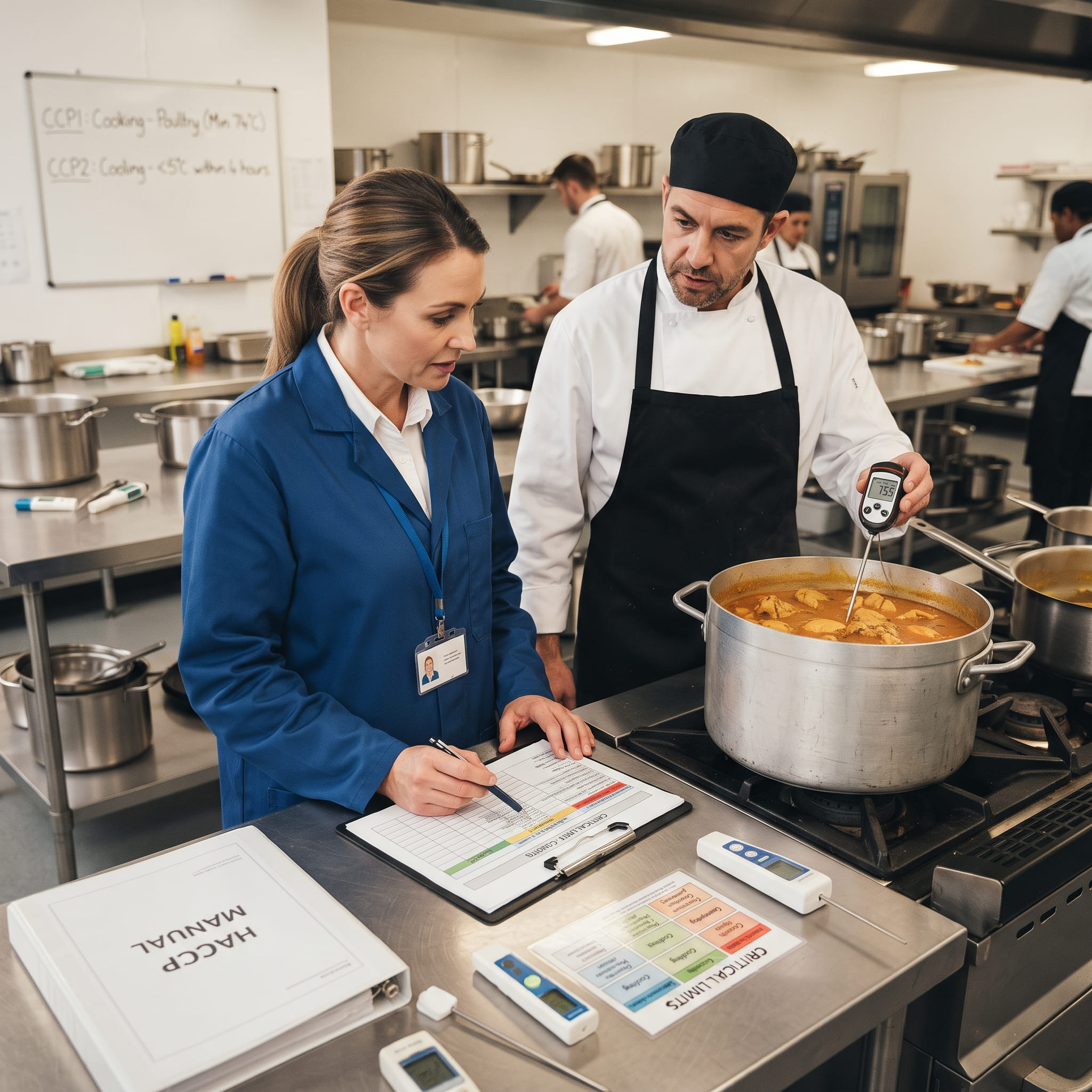
HACCP critical limits are an essential part of a food safety management system. Once a food business has identified a Critical Control Point (CCP), it needs to establish a clear boundary between acceptable and unacceptable conditions.
This boundary is known as a critical limit.
Critical limits help food businesses determine whether a CCP is under control. They can relate to factors such as temperature, time, pH, water activity or other measurable criteria, depending on the food process and hazard being controlled.
For restaurants, cafés, takeaways, catering businesses, bakeries, food manufacturers and other food businesses in Ireland, understanding critical limits is an important part of applying HACCP principles.
This is also why HACCP training Ireland can be valuable for employees and managers who are responsible for food safety procedures.
What Is a HACCP Critical Limit?
A critical limit is a measurable or observable criterion that separates acceptable conditions from unacceptable conditions at a Critical Control Point.
In simple terms, it defines the point at which a food safety control is considered to be outside the required limits.
For example, if a particular cooking process is identified as a CCP, the HACCP system may establish a specific time and temperature requirement based on appropriate evidence.
The critical limit must be appropriate for controlling the hazard associated with that CCP.
It should not simply be an arbitrary number selected because it seems reasonable.
Why Are Critical Limits Important?
Critical limits provide a clear basis for determining whether a CCP is under control.
Without a defined limit, employees may not know when corrective action is required.
For example, imagine a business tells employees:
"Keep food at a safe temperature."
This instruction is not sufficiently specific to provide a measurable HACCP control.
A HACCP procedure needs an appropriate criterion that employees can monitor and record.
Critical limits therefore help turn general food safety requirements into practical controls.
Critical Limits and Critical Control Points
Critical limits are directly connected to Critical Control Points (CCPs).
A CCP is a step where control is essential for preventing, eliminating or reducing a significant food safety hazard to an acceptable level.
Once a CCP has been identified, the business needs to establish appropriate critical limits.
For example:
Hazard: Biological contamination
CCP: Specific cooking process
Control: Cooking
Critical limit: An evidence-based time/temperature criterion appropriate to the product and process
Monitoring: Measurement and recording according to the HACCP procedure
Corrective action: Action taken if the critical limit is not achieved
The exact limits depend on the individual process.
How Are Critical Limits Established?
Critical limits should be supported by appropriate evidence.
Sources can include:
- Scientific research
- Regulatory requirements
- Food safety guidance
- Industry standards
- Technical information
- Validated processes
- Expert advice
- Appropriate testing
The evidence should be relevant to the food, hazard and process being controlled.
This is closely connected with HACCP validation.
Validation provides evidence that a selected control measure is capable of controlling the hazard effectively.
Critical Limits Should Be Measurable
Where possible, critical limits should be based on measurable criteria.
Examples can include:
- Temperature
- Time
- pH
- Water activity
- Concentration
- Physical measurements
The appropriate measurement depends on the food process.
For example, temperature may be highly relevant to a cooking process, while pH could be relevant to certain specialised food production processes.
Temperature as a Critical Limit
Temperature is one of the most common measurements used in food safety systems.
Depending on the business, temperature controls can apply to:
- Cooking
- Refrigeration
- Hot holding
- Cooling
- Reheating
- Transportation
However, not every temperature check is automatically a critical limit.
The HACCP team needs to determine whether the particular temperature control is part of a CCP and whether a specific critical limit is required.
Time as a Critical Limit
Time can also be important in controlling food safety hazards.
A process may rely on a combination of time and temperature.
For example, a business may need to control how long food remains under particular conditions.
The HACCP system should specify the relevant criteria and how employees are expected to monitor them.
The limit should be supported by appropriate evidence.
Combining Time and Temperature
Some food safety controls involve both time and temperature.
For example, a business may need to establish an appropriate process involving:
Temperature + exposure time
The HACCP team should consider how these factors interact.
Employees should understand exactly what needs to be measured and recorded.
If the process falls outside the established critical limit, the appropriate corrective action should be followed.
Critical Limits for Cooling
Cooling processes may also require carefully established controls.
A food business that prepares food in advance may need to control the cooling process to reduce the opportunity for harmful microorganisms to multiply.
The business should establish an appropriate process based on:
- Food characteristics
- Quantity
- Container size
- Cooling equipment
- Starting temperature
- Cooling method
- Time
- Temperature
The critical limits should be based on suitable evidence rather than guesswork.
Critical Limits for Reheating
Reheating may also form part of a food business's HACCP controls.
Where reheating is identified as a CCP, an appropriate critical limit should be established.
The procedure should explain:
- What needs to be monitored
- How it is measured
- What limit applies
- How the result is recorded
- What happens when the limit is not achieved
Employees need to understand the procedure before they are expected to carry it out.
Critical Limits and Allergen Controls
Not all critical limits are related to temperature.
Depending on the process, HACCP controls can also involve allergen management.
For example, a business may establish specific criteria for a cleaning or production process designed to control allergen cross-contact.
The appropriate criteria should be supported by suitable evidence.
Allergen management should also include appropriate prerequisite procedures and staff training.
Critical Limits vs Operating Limits
Food businesses may also use the concept of operating limits.
An operating limit can provide a target or threshold used to maintain control before a critical limit is reached.
For example, a business might choose an internal operating target that provides a margin of safety around a critical limit.
The distinction is important.
A critical limit defines the boundary between acceptable and unacceptable conditions at a CCP.
An operating limit may be set more conservatively to help prevent the process from reaching that boundary.
Monitoring Critical Limits
Once critical limits have been established, the business needs an effective monitoring procedure.
Monitoring should specify:
- What is measured
- How it is measured
- When it is measured
- How frequently it is checked
- Who performs the check
- Where the result is recorded
Monitoring must be practical.
If employees cannot realistically complete the required checks during normal operations, the procedure may need to be reviewed.
What Happens When a Critical Limit Is Exceeded?
A HACCP system should establish corrective actions before a problem occurs.
If a critical limit is exceeded, employees should know:
- What immediate action to take.
- How to manage affected food.
- Who to notify.
- How to restore control.
- What needs to be recorded.
- Whether the cause needs to be investigated.
The exact action depends on the food process and the hazard involved.
Corrective Actions and Critical Limits
Corrective actions should not simply address the immediate problem.
The business should also consider why the critical limit was exceeded.
For example, repeated temperature failures could be caused by:
- Faulty equipment
- Incorrect procedures
- Poor employee training
- Excessive workload
- Inadequate monitoring
- Incorrect storage arrangements
Identifying the underlying cause can help prevent recurrence.
Verification of Critical Limits
Critical limits should also be subject to verification.
Verification can include:
- Reviewing monitoring records
- Observing employees
- Checking measuring equipment
- Reviewing corrective actions
- Conducting internal audits
- Reviewing the HACCP system
Verification helps determine whether the HACCP system is being implemented effectively.
It is different from validation.
Validation asks whether the control can work.
Verification asks whether the HACCP system is working as intended.
Measuring Equipment
Reliable measurement is essential when critical limits depend on numerical values.
Depending on the process, businesses may use:
- Thermometers
- Scales
- pH meters
- Other measuring equipment
Equipment should be maintained appropriately and checked for accuracy where required.
If the measuring equipment is unreliable, the monitoring results may also be unreliable.
HACCP Critical Limits for Small Businesses
Critical limits are not only relevant to large food manufacturers.
Restaurants, cafés and takeaways may also use HACCP systems containing CCPs.
For example, a restaurant may identify a particular cooking process as a CCP.
The business then needs to establish an appropriate critical limit and monitoring procedure.
The system should be proportionate to the size and complexity of the business while still providing effective food safety control.
HACCP Training Ireland and Critical Limits
HACCP training Ireland can help food workers and managers understand the purpose of critical limits.
Training may cover:
- Hazard identification
- Hazard analysis
- CCPs
- Critical limits
- Monitoring
- Corrective actions
- Verification
- Validation
- HACCP documentation
People responsible for developing or maintaining HACCP procedures need appropriate knowledge of how these principles are applied.
The Food Safety Authority of Ireland states that people responsible for developing and maintaining HACCP-based procedures need adequate training in applying HACCP principles.
HACCP Level 1 and Level 2 Training
Food businesses may use different levels of HACCP training.
HACCP Level 1 may introduce:
- Food safety hazards
- Hygiene
- Basic HACCP principles
- Food handler responsibilities
HACCP Level 2 training may provide more detailed information about:
- Hazard analysis
- Critical Control Points
- Critical limits
- Monitoring
- Corrective actions
- Verification
- Documentation
If you are looking for a HACCP Level 2 certificate, check the course syllabus carefully to ensure that it covers the subjects relevant to your responsibilities.
HACCP Certificate Ireland
People searching for a HACCP certificate Ireland may encounter training courses advertised as:
- HACCP course Ireland
- HACCP training Ireland
- HACCP certification Ireland
- HACCP certification course
- HACCP training certificate
- HACCP Level 2 certificate
- HACCP food safety training
When selecting a course, consider whether the level and content are appropriate for your role.
A food handler may need different training from a person responsible for developing, maintaining or reviewing a HACCP system.
Online HACCP Training
Online HACCP training can provide a flexible way to learn about critical limits and other HACCP principles.
An online HACCP course Ireland may cover:
- Food safety hazards
- HACCP principles
- CCPs
- Critical limits
- Monitoring
- Corrective actions
- Verification
- Documentation
Online learning can be convenient for employees and managers who need flexible study arrangements.
However, employees should also understand how critical limits apply to the procedures used in their actual workplace.
Common Critical Limit Mistakes
Food businesses should avoid several common mistakes.
Choosing Arbitrary Limits
Critical limits should have an appropriate evidence-based basis.
Using Vague Instructions
Employees need clear and measurable criteria where appropriate.
Confusing Targets With Critical Limits
An internal target is not necessarily the same as a critical limit.
Failing to Monitor
A critical limit is only useful if it can be monitored appropriately.
Ignoring Equipment Accuracy
Unreliable measuring equipment can undermine monitoring.
Not Establishing Corrective Actions
Employees need to know what to do when a limit is exceeded.
Failing to Review Limits
Changes to products or processes can affect the suitability of existing controls.
Practical HACCP Critical Limit Checklist
A food business can ask:
- Has each relevant CCP been identified?
- What hazard is being controlled?
- What control measure is being used?
- What critical limit applies?
- What evidence supports the limit?
- Is the limit measurable?
- How is it monitored?
- Who performs the monitoring?
- How are results recorded?
- What happens if the limit is exceeded?
- Is measuring equipment appropriate?
- Are verification procedures established?
- Is the control reviewed when processes change?
This checklist can help businesses identify weaknesses in their HACCP system.
When Should Critical Limits Be Reviewed?
Critical limits should be reviewed when there is a significant change to the food process.
Examples include:
- New recipes
- New products
- New equipment
- Changes to ingredients
- Changes in processing methods
- Changes to storage arrangements
- New suppliers
- Changes to production volumes
The business should consider whether the existing critical limits remain appropriate.
If the process has changed significantly, additional validation may be required.
Final Thoughts
HACCP critical limits provide clear boundaries for determining whether a Critical Control Point is under control.
Effective critical limits should be:
- Appropriate to the hazard
- Relevant to the specific process
- Based on suitable evidence
- Measurable where appropriate
- Clearly communicated
- Properly monitored
- Supported by corrective actions
- Reviewed when significant changes occur
For food businesses in Ireland, appropriate HACCP training Ireland can help employees and managers understand how critical limits fit into the wider HACCP system.
If you are looking for a HACCP course Ireland, HACCP certificate Ireland, HACCP certification course, HACCP Level 2 training, HACCP training certificate or online HACCP training, consider whether the course content matches your responsibilities.
Ultimately, a critical limit should not be treated as just another number written in a HACCP document. It should represent an appropriate, evidence-based boundary that helps the business determine whether a significant food safety hazard is being effectively controlled.
When critical limits are properly established, monitored, verified and supported by corrective actions, they become a practical part of an effective food safety management system.