



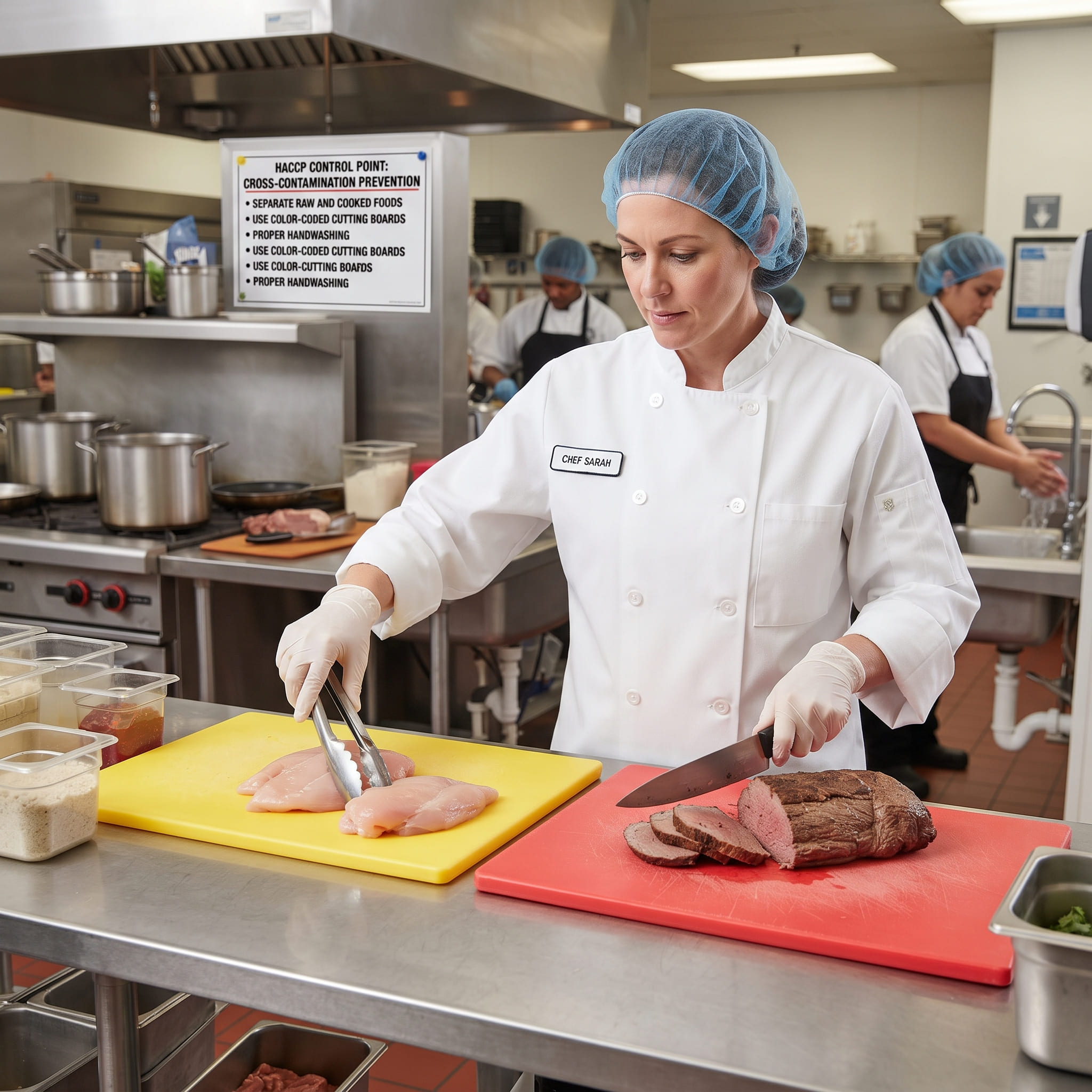
HACCP cross-contamination is an important food safety issue for restaurants, cafés, takeaways, catering companies, food shops and other food businesses. When harmful microorganisms, allergens or other hazards are transferred from one food, surface, piece of equipment or person to another, food can become contaminated.
Preventing cross-contamination is therefore an essential part of an effective HACCP system.
For food businesses in Ireland, appropriate HACCP training Ireland can help employees understand how cross-contamination occurs, how it can be prevented and what procedures should be followed during everyday food handling.
A good HACCP system does not simply identify hazards. It establishes practical controls that employees can follow consistently.
This article explains what HACCP cross-contamination means, where it can occur and how food businesses can reduce the risk.
What Is Cross-Contamination?
Cross-contamination occurs when a hazard is unintentionally transferred from one place or item to another.
The hazard could come from:
- Raw food
- Contaminated surfaces
- Hands
- Equipment
- Utensils
- Food packaging
- Cleaning equipment
- Allergens
For example, if a knife used to prepare raw chicken is then used to prepare a ready-to-eat sandwich without appropriate cleaning, contamination could potentially be transferred to the sandwich.
This is why food businesses need procedures for separating foods and maintaining good hygiene.
Why Is Cross-Contamination Important in HACCP?
HACCP focuses on identifying and controlling significant food safety hazards.
Cross-contamination can be a route through which hazards move between foods or surfaces.
A HACCP system should therefore consider where cross-contamination could occur and establish suitable controls.
Depending on the food business, these controls may include:
- Separation
- Cleaning
- Personal hygiene
- Equipment controls
- Storage procedures
- Food handling procedures
- Allergen controls
The exact controls should be based on the business's products and processes.
Types of Cross-Contamination
Cross-contamination is not limited to one type of hazard.
Biological Cross-Contamination
This involves the transfer of microorganisms such as:
- Bacteria
- Viruses
- Parasites
- Fungi
Raw meat, poultry, seafood or other contaminated ingredients can potentially transfer microorganisms to ready-to-eat foods.
Chemical Cross-Contamination
Chemicals can contaminate food if they are stored, handled or used incorrectly.
Examples can include:
- Cleaning chemicals
- Sanitising products
- Other substances unsuitable for food contact
Businesses should have procedures to ensure chemicals are used and stored appropriately.
Physical Cross-Contamination
Physical contamination involves foreign objects entering food.
Examples include:
- Glass
- Metal
- Plastic
- Packaging
- Broken equipment components
Good maintenance and appropriate food handling can help reduce these risks.
Allergen Cross-Contact
Allergen cross-contact is another important consideration.
For example, an allergen-containing ingredient may come into contact with food that is intended to be prepared without that allergen.
Controls may include:
- Ingredient management
- Cleaning
- Separation
- Storage
- Equipment controls
- Staff training
Employees should follow the business's allergen procedures and never guess about allergen information.
How Does Cross-Contamination Happen?
Cross-contamination can happen in many different ways.
Hands
An employee may handle raw food and then touch ready-to-eat food without following the appropriate hand hygiene procedure.
Utensils
A knife, spoon or other utensil may be used between different foods without appropriate cleaning.
Cutting Boards
A cutting board used for raw food may contaminate ready-to-eat food if it is not properly cleaned and managed.
Work Surfaces
Contamination can transfer through worktops and preparation surfaces.
Storage
Incorrect storage can allow raw food to contaminate other products.
Equipment
Food processors, mixers and other equipment can transfer contamination if not properly cleaned.
Understanding these routes is an important part of HACCP training.
Hand Hygiene
Good hand hygiene is one of the most important ways to prevent cross-contamination.
Employees should wash their hands according to workplace procedures, particularly:
- Before handling food
- After handling raw food
- After using the toilet
- After handling waste
- After touching potentially contaminated surfaces
- When changing tasks
Hand washing should be carried out properly rather than simply rinsing the hands quickly.
Businesses should also provide suitable hand-washing facilities.
Separating Raw and Ready-to-Eat Food
One of the most important controls is appropriate separation.
Raw ingredients such as meat, poultry and fish should be managed in a way that reduces the risk of contaminating ready-to-eat food.
Businesses may use:
- Separate preparation areas
- Separate equipment
- Separate storage
- Appropriate containers
- Organised workflows
The exact approach depends on the size and layout of the food business.
Safe Food Storage
Storage arrangements can have a major impact on cross-contamination.
For example, raw meat should be stored appropriately so that it cannot contaminate ready-to-eat food.
Food businesses should consider:
- Storage locations
- Containers
- Packaging
- Separation
- Shelf organisation
- Labelling
Employees should follow the storage procedures established by the business.
Cleaning Equipment and Utensils
Equipment that comes into contact with food needs to be appropriately cleaned.
This may include:
- Knives
- Cutting boards
- Mixers
- Food processors
- Tongs
- Containers
- Work surfaces
Cleaning procedures should specify:
- What needs to be cleaned
- When it needs to be cleaned
- Which products should be used
- How cleaning should be performed
- How cleaning is checked
Cleaning is an important prerequisite for controlling contamination, although not every cleaning activity is a Critical Control Point.
Preventing Cross-Contamination During Food Preparation
Food preparation should be organised to minimise unnecessary movement of contamination.
For example, a business may establish procedures for:
- Preparing raw ingredients.
- Cleaning and sanitising equipment and surfaces.
- Washing hands.
- Preparing ready-to-eat food.
- Storing prepared food appropriately.
Employees should follow the workflow established by the business.
A poorly organised kitchen can make cross-contamination more likely.
Using Colour-Coded Equipment
Some food businesses use colour-coded equipment to help employees distinguish between different food preparation activities.
This can include:
- Cutting boards
- Knives
- Containers
- Cleaning equipment
Colour coding can be useful, but it is only effective when staff understand what the colours mean and follow the system consistently.
A colour does not replace proper cleaning.
Cleaning and Sanitising
Cleaning and sanitising are important controls for food-contact surfaces.
Employees should understand the difference between removing visible dirt and reducing microorganisms to an appropriate level.
A business should establish appropriate cleaning procedures covering:
- Food-contact surfaces
- Equipment
- Utensils
- Worktops
- Storage areas
Cleaning chemicals should also be used according to the manufacturer's instructions and workplace procedures.
Cross-Contamination and Allergens
Allergen management requires particular attention because even a small amount of an allergen can be significant for a sensitive customer.
Food businesses should consider potential allergen cross-contact during:
- Ingredient storage
- Food preparation
- Cooking
- Serving
- Cleaning
Staff should know where allergen information is kept and who is responsible for responding to customer questions.
If an employee is unsure whether a food contains an allergen, they should follow the established procedure rather than guessing.
Cross-Contamination During Food Storage
Storage is an area where simple mistakes can create unnecessary risks.
For example, placing raw meat above ready-to-eat food could create a contamination risk if liquid leaks from the raw product.
Businesses should establish suitable storage arrangements.
Staff should understand:
- Where raw foods are stored
- Where ready-to-eat foods are stored
- Which containers should be used
- How food should be covered
- How storage areas are cleaned
Cross-Contamination During Food Service
The risk does not disappear once food preparation is complete.
During service, employees may use:
- Serving utensils
- Tongs
- Plates
- Containers
- Display equipment
Staff should ensure that appropriate procedures are followed to prevent contamination.
This is particularly important for ready-to-eat foods.
Cross-Contamination During Delivery
Food businesses that deliver prepared food also need to consider contamination risks.
Delivery procedures may need to address:
- Packaging
- Food separation
- Containers
- Transport equipment
- Temperature control
- Handling
Raw and ready-to-eat products should be managed appropriately during transportation.
What Should Happen When Cross-Contamination Is Suspected?
Employees should know what to do if they believe contamination has occurred.
The business's corrective action procedure may require staff to:
- Stop the affected process.
- Inform the responsible person.
- Identify affected food.
- Assess what happened.
- Dispose of or otherwise manage affected food according to the procedure.
- Clean and sanitise affected equipment or surfaces.
- Record the incident where required.
- Investigate the cause.
The exact corrective action depends on the circumstances and the business's HACCP system.
HACCP Monitoring for Cross-Contamination
Monitoring helps determine whether controls are being followed.
Depending on the business, monitoring may include:
- Checking cleaning procedures
- Observing food handling
- Reviewing storage arrangements
- Checking allergen controls
- Reviewing records
- Verifying equipment cleaning
Monitoring procedures should specify what is checked, how it is checked and what happens when a problem is identified.
HACCP Records and Documentation
Food businesses may maintain records relating to cross-contamination controls.
These could include:
- Cleaning records
- Temperature records
- Allergen procedures
- Corrective action records
- Staff training records
- Verification records
Not every business will use the same documentation.
The records should reflect the actual HACCP system and food processes.
HACCP Training Ireland
HACCP training Ireland can help employees understand the relationship between food safety hazards and cross-contamination.
Training may cover:
- Biological hazards
- Chemical hazards
- Physical hazards
- Allergen hazards
- Personal hygiene
- Cleaning
- HACCP principles
- Critical Control Points
- Monitoring
- Corrective actions
The Food Safety Authority of Ireland states that people responsible for developing and maintaining HACCP-based procedures need adequate training in applying HACCP principles.
The level of training should reflect the person's responsibilities.
HACCP Level 1 and Level 2 Training
Food workers may encounter courses described as HACCP Level 1 and HACCP Level 2.
The exact course content can vary between providers.
Introductory training may focus on basic food safety and HACCP principles.
More detailed HACCP Level 2 training may cover:
- Hazard analysis
- CCPs
- Critical limits
- Monitoring
- Corrective actions
- Verification
- Documentation
If an employer requires a HACCP Level 2 certificate, employees should check that the selected course meets the relevant workplace requirements.
HACCP Certificate Ireland
People searching for a HACCP certificate Ireland may find several types of training.
Courses may be described as:
- HACCP training Ireland
- HACCP course Ireland
- HACCP certification Ireland
- HACCP certification course
- HACCP training certificate
- HACCP Level 2 certificate
- HACCP food safety training
When selecting a course, consider:
- Course syllabus
- Intended audience
- Training level
- Assessment
- Certificate
- Employer requirements
A certificate demonstrates completion of a training programme, but workplace-specific procedures still need to be followed.
Online HACCP Training
Online HACCP training can provide a flexible way to learn about HACCP and cross-contamination.
An online HACCP course Ireland may cover:
- Food safety hazards
- Cross-contamination
- HACCP principles
- Critical Control Points
- Monitoring
- Corrective actions
- Documentation
Online learning can be useful for employees who need to study around their working hours.
However, general online training should be supported by workplace-specific instruction.
Common Cross-Contamination Mistakes
Food businesses should watch out for several common problems.
Using the Same Equipment
Using equipment between raw and ready-to-eat foods without appropriate cleaning can transfer contamination.
Poor Hand Hygiene
Employees can transfer contamination through their hands.
Incorrect Storage
Raw food may contaminate ready-to-eat food if storage procedures are not followed.
Inadequate Cleaning
Surfaces may remain contaminated if cleaning procedures are not completed correctly.
Mixing Cleaning Equipment
Cleaning equipment used in unsuitable areas can potentially spread contamination.
Ignoring Allergen Controls
Allergen cross-contact can occur if ingredients and equipment are not appropriately managed.
Practical Cross-Contamination Checklist
Food businesses can use a simple checklist to review their controls:
- Are hands washed appropriately?
- Are raw and ready-to-eat foods separated?
- Are food-contact surfaces cleaned properly?
- Are utensils managed correctly?
- Are storage areas organised appropriately?
- Are allergen controls followed?
- Are cleaning procedures documented where required?
- Are employees trained?
- Are monitoring checks completed?
- Are corrective actions taken when problems occur?
The exact checklist should be adapted to the individual business.
Final Thoughts
HACCP cross-contamination controls are an important part of maintaining food safety.
Cross-contamination can occur through:
- Hands
- Equipment
- Utensils
- Work surfaces
- Storage
- Cleaning equipment
- Food packaging
- Poor workflow
Food businesses can reduce these risks through appropriate separation, cleaning, personal hygiene, storage procedures, allergen controls and staff training.
For businesses in Ireland, appropriate HACCP training Ireland can help employees understand why these controls matter and how they should be applied.
If you are looking for a HACCP course Ireland, HACCP certificate Ireland, HACCP certification course, HACCP Level 2 training, HACCP training certificate or online HACCP training, check that the course covers the HACCP principles and food safety responsibilities relevant to your role.
Ultimately, preventing cross-contamination is not the responsibility of one employee alone. Everyone involved in receiving, storing, preparing, cooking, serving and cleaning has a role to play. When food businesses establish clear procedures and employees consistently follow them, the risk of transferring harmful hazards between foods and surfaces can be significantly reduced.