



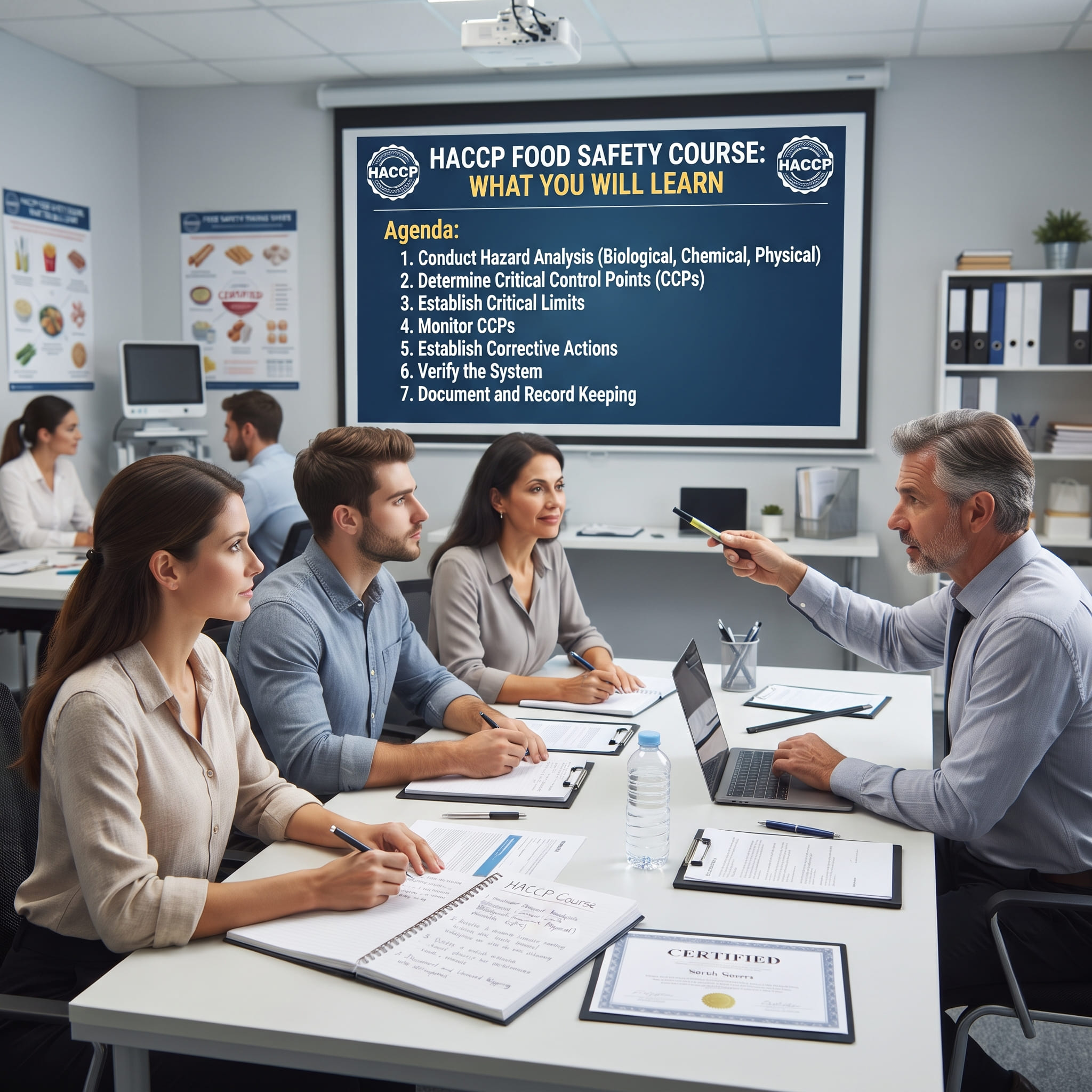
If you work in a restaurant, café, hotel, takeaway, catering company, bakery, supermarket or food production business, you may need to complete a HACCP food safety course. HACCP is an important part of food safety management because it provides a structured way to identify hazards and establish controls to help keep food safe.
But what will you actually learn during a HACCP food safety course?
A good course should go beyond simply explaining what the acronym HACCP means. It should help learners understand food safety hazards, contamination, hygiene, Critical Control Points, temperature control, monitoring and corrective actions. The level of detail should also be appropriate to the learner's role and responsibilities.
This guide explains the main subjects you can expect to study and how HACCP knowledge can be applied in an Irish food workplace.
What Is HACCP?
HACCP stands for Hazard Analysis and Critical Control Points.
It is a systematic approach to identifying and controlling hazards that could make food unsafe.
Potential food safety hazards include:
- Biological hazards
- Chemical hazards
- Physical hazards
- Allergen-related hazards
- Cross-contamination
- Incorrect temperature control
- Unsafe storage
The Food Safety Authority of Ireland (FSAI) describes HACCP as a system that helps food businesses identify what could go wrong, establish ways of preventing problems and ensure that controls are being followed.
A HACCP food safety course introduces learners to these principles and explains how they relate to food handling and food safety management.
1. Food Safety Fundamentals
One of the first things you will learn is why food safety matters.
Food can become unsafe at different stages, including:
- Receiving
- Storage
- Preparation
- Cooking
- Cooling
- Transportation
- Service
Understanding where hazards can occur is essential before learning how HACCP controls them.
A course may introduce basic concepts such as food contamination, foodborne illness and the responsibilities of food handlers.
This provides the foundation for understanding the rest of the training.
2. Biological Hazards
Biological hazards are a major subject in HACCP training.
These include microorganisms such as:
- Bacteria
- Viruses
- Parasites
- Fungi
Some microorganisms can cause foodborne illness if they are allowed to contaminate food or multiply to unsafe levels.
A HACCP food safety course can explain how factors such as temperature, time, hygiene and cross-contamination influence biological hazards.
For food handlers, understanding these risks helps explain why everyday procedures such as handwashing, refrigeration and appropriate cooking controls matter.
3. Chemical Hazards
You will also learn about chemical hazards.
Chemical contamination can occur when substances that should not be present in food enter the food supply.
Examples include:
- Cleaning chemicals
- Sanitising products
- Lubricants
- Chemicals used incorrectly during food preparation
- Certain naturally occurring toxins
Training can explain how businesses control these hazards.
For example, cleaning chemicals should be stored appropriately and used according to workplace procedures so that they do not contaminate food or food-contact surfaces.
4. Physical Hazards
A HACCP food safety course will generally cover physical hazards as well.
These are foreign objects that can accidentally enter food.
Examples include:
- Glass
- Metal
- Plastic
- Stones
- Packaging materials
- Damaged equipment components
Learners can study how physical hazards may arise and what controls can be used to reduce the risk.
This can involve checking equipment, packaging, ingredients and preparation areas.
5. Allergen Awareness
Food allergens are another important part of modern food safety.
Certain ingredients can cause serious reactions in susceptible individuals, so businesses need appropriate procedures for controlling allergen risks.
Depending on the course, you may learn about:
- Identifying allergens
- Preventing allergen cross-contact
- Ingredient information
- Storage
- Preparation
- Cleaning
- Communication between staff
Food handlers should always follow their employer's specific allergen procedures.
6. Cross-Contamination
One of the most practical subjects covered by HACCP food safety training is cross-contamination.
Cross-contamination occurs when a contaminant is transferred from one food, person, surface or piece of equipment to another.
It can happen through:
- Hands
- Knives
- Cutting boards
- Utensils
- Equipment
- Work surfaces
- Storage containers
- Raw food
For example, equipment used with raw food may create a risk if it is subsequently used with ready-to-eat food without appropriate cleaning.
A HACCP course helps learners understand these risks and the controls used to prevent them.
7. Personal Hygiene
Food handlers play an important role in preventing contamination.
A HACCP food safety course may cover:
- Handwashing
- Personal cleanliness
- Suitable work clothing
- Workplace hygiene procedures
- Reporting relevant illness or symptoms
- Avoiding behaviours that could contaminate food
Good personal hygiene supports the wider food safety system.
Employees need to understand not just what they are expected to do but why these practices are important.
8. The Seven HACCP Principles
The central part of a HACCP course is usually the seven HACCP principles.
These are:
- Conduct a hazard analysis
- Determine Critical Control Points
- Establish critical limits
- Establish monitoring procedures
- Establish corrective actions
- Establish verification procedures
- Establish documentation and record keeping
These principles provide the structure for a HACCP-based food safety management system.
Let's look at what each means.
Hazard Analysis
The first step is identifying potential hazards.
Learners consider what could go wrong at different stages of a food process.
Critical Control Points
A Critical Control Point, or CCP, is a stage where control is essential to prevent, eliminate or reduce a food safety hazard to an acceptable level.
Critical Limits
Critical limits establish the boundary between acceptable and unacceptable conditions at a CCP.
Depending on the process, limits may relate to time, temperature or another measurable factor.
Monitoring
Monitoring checks whether a CCP remains under control.
This may involve taking measurements and recording results.
Corrective Actions
If a control fails or a critical limit is not met, an appropriate corrective action needs to be taken.
Verification
Verification helps confirm that the HACCP system is working effectively.
Documentation
Records provide evidence that monitoring and other food safety procedures are being carried out.
The FSAI identifies these seven principles as the foundation of HACCP-based food safety management.
9. Critical Control Points in Practice
Understanding CCPs is particularly important for learners who have responsibility for food safety controls.
A CCP is not simply any point where a food safety activity takes place.
It is a step where control is essential for managing a particular hazard.
For example, depending on the process, cooking can be an important control for certain biological hazards.
A HACCP course can teach learners how CCPs fit into the overall food safety process and why they need to be monitored.
10. Temperature Control
Temperature control is another major topic.
Depending on the food process, learners may study:
- Cooking
- Cooling
- Refrigeration
- Freezing
- Storage
- Hot holding
The specific temperature requirements depend on the food and process.
Employees should follow the procedures established by their workplace rather than relying on assumptions.
Where temperature monitoring is part of the HACCP system, employees need to understand what must be checked, how it should be recorded and what to do if there is a problem.
11. Monitoring Procedures
A HACCP system needs appropriate monitoring.
During a HACCP food safety course, you may learn why monitoring is important and how it can demonstrate that controls are working.
Monitoring can involve:
- Temperature checks
- Equipment checks
- Storage checks
- Process monitoring
- Record keeping
The exact monitoring requirements depend on the food business.
Accurate records are particularly important because they can provide evidence that food safety controls are being followed.
12. Corrective Actions
Things can sometimes go wrong in a food operation.
A refrigerator may not maintain the required temperature. A cooking process may not achieve the required control. A monitoring check may reveal that a procedure has not been followed.
This is where corrective actions become important.
A HACCP course teaches learners that there should be an appropriate response when a food safety control is not achieved.
The exact corrective action depends on the business's HACCP system and the specific situation.
Employees should follow established workplace procedures rather than improvising.
13. HACCP Documentation and Records
You will also learn about the importance of records.
Depending on the business, HACCP documentation can include records relating to:
- Temperature monitoring
- Cleaning
- Corrective actions
- Food deliveries
- Verification
- Other control measures
The amount and complexity of documentation needed can vary depending on the size and nature of the food operation.
The important principle is that records should support the effective management of food safety.
14. Cleaning and Sanitation
Cleaning is another practical area that can support HACCP controls.
Employees may need to understand how to clean:
- Work surfaces
- Utensils
- Food preparation equipment
- Storage areas
- Other food-contact surfaces
The course may also discuss the difference between cleaning and sanitising and the importance of following workplace procedures.
Chemical products should be used and stored appropriately to prevent chemical contamination.
15. Food Storage
Correct food storage is an important part of food safety.
A HACCP food safety course may cover:
- Refrigerated storage
- Frozen storage
- Dry storage
- Separation of raw and ready-to-eat foods
- Stock rotation
- Packaging
- Storage temperatures
Employees should understand the storage procedures relevant to their workplace.
Poor storage can contribute to contamination, spoilage and temperature-related risks.
16. Receiving Food Deliveries
Food safety starts before ingredients enter the kitchen or production area.
Employees involved in receiving deliveries may need to understand what to look for when food arrives.
Depending on the business, this can include:
- Packaging condition
- Product condition
- Storage requirements
- Temperature where applicable
- Dates
- Signs of contamination
Problems should be reported and handled according to the business's procedures.
HACCP Training Levels
Not everyone needs identical HACCP training.
Courses may be advertised as:
- HACCP Level 1
- HACCP Level 2
- HACCP food safety training
- HACCP supervisor training
- HACCP management training
The exact content can vary between providers.
The FSAI's Guide to Food Safety Skills uses different levels to describe food safety skills according to employee experience and responsibilities.
For example, basic food handlers may require introductory food safety knowledge, while supervisors or people responsible for HACCP procedures may need more detailed training.
Always check the syllabus before choosing a course.
Can You Complete a HACCP Food Safety Course Online?
Yes. HACCP certification online is available from many training providers.
An online course may allow you to complete:
- Learning modules
- Videos
- Knowledge checks
- Assessments
- Final examinations
You may then receive a digital HACCP certificate after successfully completing the course.
Online learning can be particularly convenient for people working shifts or those who cannot attend classroom training.
However, online training should be appropriate for the learner's role and should work alongside the food business's own procedures and supervision.
Who Should Take a HACCP Food Safety Course?
A HACCP food safety course can be relevant to many food industry workers, including:
- Food handlers
- Chefs
- Cooks
- Kitchen assistants
- Catering staff
- Restaurant employees
- Café employees
- Food production workers
- Supervisors
- Managers
- People responsible for HACCP procedures
The appropriate level depends on the employee's responsibilities.
Irish food safety guidance states that food handlers should receive appropriate food hygiene instruction or training for their activities, while people responsible for developing and maintaining HACCP-based procedures require adequate training in applying HACCP principles.
What Should You Look for in a HACCP Course?
Before enrolling, consider:
Course Content
Does it cover the subjects relevant to your role?
Level
Is it designed for food handlers, supervisors or managers?
Assessment
Is there an assessment before certification?
Certificate
What exactly does the certificate demonstrate?
Online Access
If you choose an online course, how long will you have access?
Employer Requirements
Does the course meet what your employer expects?
Training Provider
Is the provider transparent about its course, assessment and support?
Choosing a course based on these factors is more useful than simply choosing the cheapest or fastest option.
Final Thoughts
A HACCP food safety course should give learners a practical understanding of how food safety hazards are identified and controlled.
Depending on the level, you can learn about biological, chemical and physical hazards, allergens, cross-contamination, personal hygiene, temperature control, cleaning, Critical Control Points, monitoring, corrective actions, verification and documentation.
The seven HACCP principles provide the foundation, but the real value of training comes from understanding how those principles apply to everyday food operations.
Whether you choose classroom training or HACCP certification online, make sure the course is appropriate for your responsibilities and provides relevant, practical information.
A good HACCP course is not simply about obtaining a certificate. It should help you understand your role in preventing food safety hazards and maintaining safe food handling practices in the workplace.