



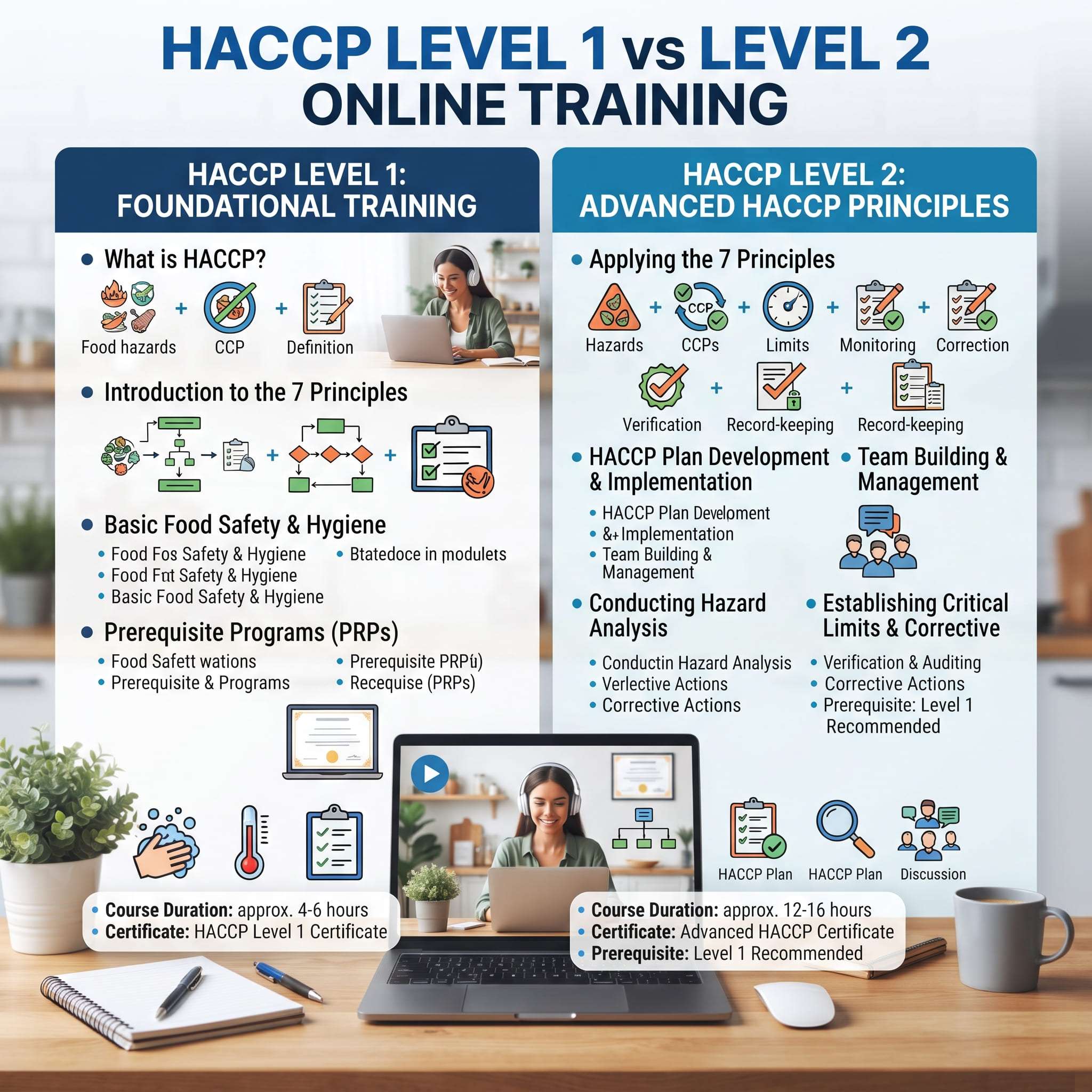
If you are looking for HACCP Level 1 and Level 2 online training, you may have noticed that different courses are available for people working in food-related roles. Choosing between HACCP Level 1 and HACCP Level 2 can be confusing, particularly if you are not sure what each level covers or which one is appropriate for your job.
Both levels are designed to provide knowledge about food safety and HACCP, but they can differ in depth, complexity and the responsibilities of the people taking the training.
This guide explains the difference between HACCP Level 1 and Level 2, what you can expect from online training, who each level may be suitable for and what to consider before choosing an online HACCP course.
What Is HACCP?
HACCP stands for Hazard Analysis and Critical Control Points.
It is a systematic approach used to identify, assess and control hazards that could affect the safety of food.
Potential hazards can include:
- Biological hazards such as harmful bacteria and viruses
- Chemical hazards such as cleaning products
- Physical hazards such as glass or metal
- Allergen-related risks
- Cross-contamination
- Poor temperature control
- Unsafe food storage
Instead of waiting until a problem occurs, a HACCP system identifies potential hazards and establishes controls to reduce the risk.
This makes HACCP an important part of food safety management within food businesses.
What Is HACCP Level 1?
HACCP Level 1 is generally designed as introductory HACCP training.
It can be suitable for people who need a basic understanding of HACCP and food safety but do not have significant responsibility for developing or managing a HACCP system.
A HACCP Level 1 course may introduce learners to:
- The meaning of HACCP
- Basic food safety principles
- Common food safety hazards
- Food contamination
- Personal hygiene
- Cross-contamination
- Temperature control
- Basic HACCP terminology
- The purpose of Critical Control Points
- The importance of following food safety procedures
The exact syllabus varies between training providers.
The main purpose is to give learners an understanding of how their everyday actions can affect food safety.
Who Might Take HACCP Level 1?
HACCP Level 1 training may be appropriate for people in entry-level or basic food handling roles.
Examples could include:
- New food handlers
- Kitchen assistants
- Catering assistants
- Restaurant staff
- Café employees
- Takeaway employees
- Food retail workers
- Employees with limited food safety responsibilities
For someone who is new to the food industry, an introductory course can provide a useful foundation.
However, the correct training should always depend on the individual's actual duties and the requirements of their employer or workplace.
What Is HACCP Level 2?
HACCP Level 2 generally provides a more detailed understanding of HACCP and food safety management.
It is often more suitable for people who have greater responsibility for food preparation, supervision or food safety procedures.
A HACCP Level 2 course can cover subjects such as:
- Food safety hazards
- Hazard analysis
- Preventive control measures
- Critical Control Points
- Critical limits
- Monitoring procedures
- Corrective actions
- Verification
- HACCP documentation
- Food safety management
- Cross-contamination
- Temperature control
- Allergen control
The learner is expected to develop a stronger understanding of how HACCP systems work rather than simply understanding basic food hygiene principles.
Who Might Take HACCP Level 2?
HACCP Level 2 training can be particularly useful for people who have greater involvement in food safety.
This may include:
- Chefs
- Cooks
- Kitchen supervisors
- Food safety supervisors
- Catering supervisors
- Restaurant managers
- Food business managers
- Experienced food handlers
- Employees responsible for monitoring HACCP procedures
Again, job title alone does not determine the appropriate training level.
A person working in a small food business may have several responsibilities, while another employee with the same job title may have very limited responsibility for food safety.
HACCP Level 1 vs Level 2
The simplest way to understand the difference is to think about depth of knowledge and responsibility.
| HACCP Level 1 | HACCP Level 2 |
|---|---|
| Introductory HACCP knowledge | More detailed HACCP knowledge |
| Suitable for basic food handling roles | Often suitable for food handlers with greater responsibility |
| Introduces common food safety hazards | Examines hazards and their controls in greater detail |
| Basic HACCP terminology | More detailed HACCP principles |
| Introduction to Critical Control Points | Greater focus on CCPs and monitoring |
| Basic understanding of food safety procedures | Greater understanding of HACCP procedures and documentation |
The exact distinction can vary between training providers, so learners should always check the individual course syllabus.
Does Level 2 Mean You Have More Responsibility?
Not automatically.
Completing HACCP Level 2 does not by itself make someone responsible for managing a company's entire HACCP system.
A certificate demonstrates completion of a particular training course. Actual responsibilities depend on the person's job, employer and role within the food business.
For example, someone may complete Level 2 training because their employer wants them to have a stronger understanding of HACCP, without making them the person responsible for designing the company's food safety management system.
What Do You Learn About Food Safety Hazards?
Both HACCP Level 1 and Level 2 online courses can introduce food safety hazards.
The difference is generally the depth of coverage.
At an introductory level, learners may learn to recognise biological, chemical and physical hazards.
At Level 2, learners may study how hazards are analysed and how specific control measures can be established and monitored.
For example, a learner may understand that harmful bacteria are a biological hazard. More detailed HACCP training can help them understand where that hazard could occur in a food process and how appropriate controls can be used.
Understanding Critical Control Points
Critical Control Points, or CCPs, are an important part of HACCP.
A CCP is a step at which control can be applied to prevent, eliminate or reduce a food safety hazard to an acceptable level.
A basic HACCP course may introduce the concept.
HACCP Level 2 training generally provides more detailed information about identifying, controlling and monitoring CCPs.
This can be particularly relevant for supervisors and employees who have responsibilities beyond simply following established food handling procedures.
Monitoring and Corrective Actions
Another important difference can be the depth of information provided about monitoring and corrective actions.
A food handler needs to understand the importance of following established procedures.
Someone responsible for monitoring a HACCP control may need to understand:
- What needs to be monitored
- How monitoring is performed
- When monitoring should take place
- What records should be maintained
- What happens when a critical limit is not met
This is why more detailed HACCP Level 2 training can be useful for employees with supervisory responsibilities.
Can You Complete HACCP Level 1 and Level 2 Online?
Yes, both HACCP Level 1 online and HACCP Level 2 online courses may be available depending on the training provider.
Online training can be convenient because learners can study remotely instead of attending a classroom.
A typical online HACCP course may include:
- Video lessons
- Written course material
- Interactive content
- Knowledge checks
- Online assessments
- Digital certification
The exact learning format varies between providers.
Before purchasing a course, check the syllabus and make sure the training is appropriate for your role.
Is HACCP Level 1 Easier Than Level 2?
Generally, HACCP Level 1 is intended to provide a more basic introduction, while Level 2 HACCP training goes into greater detail.
However, “easier” does not necessarily mean “better” or “worse.”
The right course is the one that matches the learner's responsibilities.
Someone who only needs an introduction to HACCP may not need an advanced course. On the other hand, someone supervising food safety activities may benefit from more detailed training.
Do You Need Level 1 Before Level 2?
Not necessarily.
Whether you need to complete HACCP Level 1 before taking Level 2 depends on the course provider and the structure of the training.
Some Level 2 courses may be designed to provide the necessary foundation within the course itself.
If you already have food safety experience or previous training, you may be able to take Level 2 directly.
Always check the entry requirements of the specific HACCP certification course you are considering.
How Do You Choose the Right HACCP Course?
When choosing between HACCP Level 1 and Level 2 online, start by looking at your job responsibilities.
Ask yourself:
Do I simply handle food and follow established procedures?
If so, an introductory HACCP course may be appropriate, depending on your employer's requirements.
Do I supervise other food handlers?
If you have supervisory responsibilities, more detailed HACCP training may be useful.
Do I monitor food safety controls or HACCP procedures?
A Level 2 course may be more relevant if your role involves monitoring, documentation or other food safety responsibilities.
Has my employer requested a specific level?
If your employer has specified a particular course or qualification, follow their requirements rather than choosing based solely on the course title.
What About HACCP Certification Online?
Both introductory and more advanced courses may offer HACCP certification online.
Before enrolling, check exactly what certification is provided.
Look at:
- Course title
- Training level
- Course content
- Assessment method
- Certificate details
- Course duration
- Access period
- Training provider
- Employer requirements
This is particularly important because course names and level descriptions can differ between providers.
A certificate should accurately represent the training that the learner completed.
Final Thoughts
Understanding the difference between HACCP Level 1 and Level 2 online can make it easier to choose appropriate training.
HACCP Level 1 is generally aimed at providing introductory knowledge for people who need to understand basic HACCP and food safety principles.
HACCP Level 2 generally provides more detailed training and can be particularly useful for food handlers, chefs, supervisors and others with greater food safety responsibilities.
Neither level is automatically suitable for everyone. The best option depends on your role, responsibilities, previous training and any requirements set by your employer or food business.
If you are considering an online HACCP course, compare the syllabus carefully rather than choosing based only on the words “Level 1” or “Level 2.” The most useful training is training that gives you the knowledge you need to understand food safety hazards, follow appropriate controls and contribute to a safe food environment.