



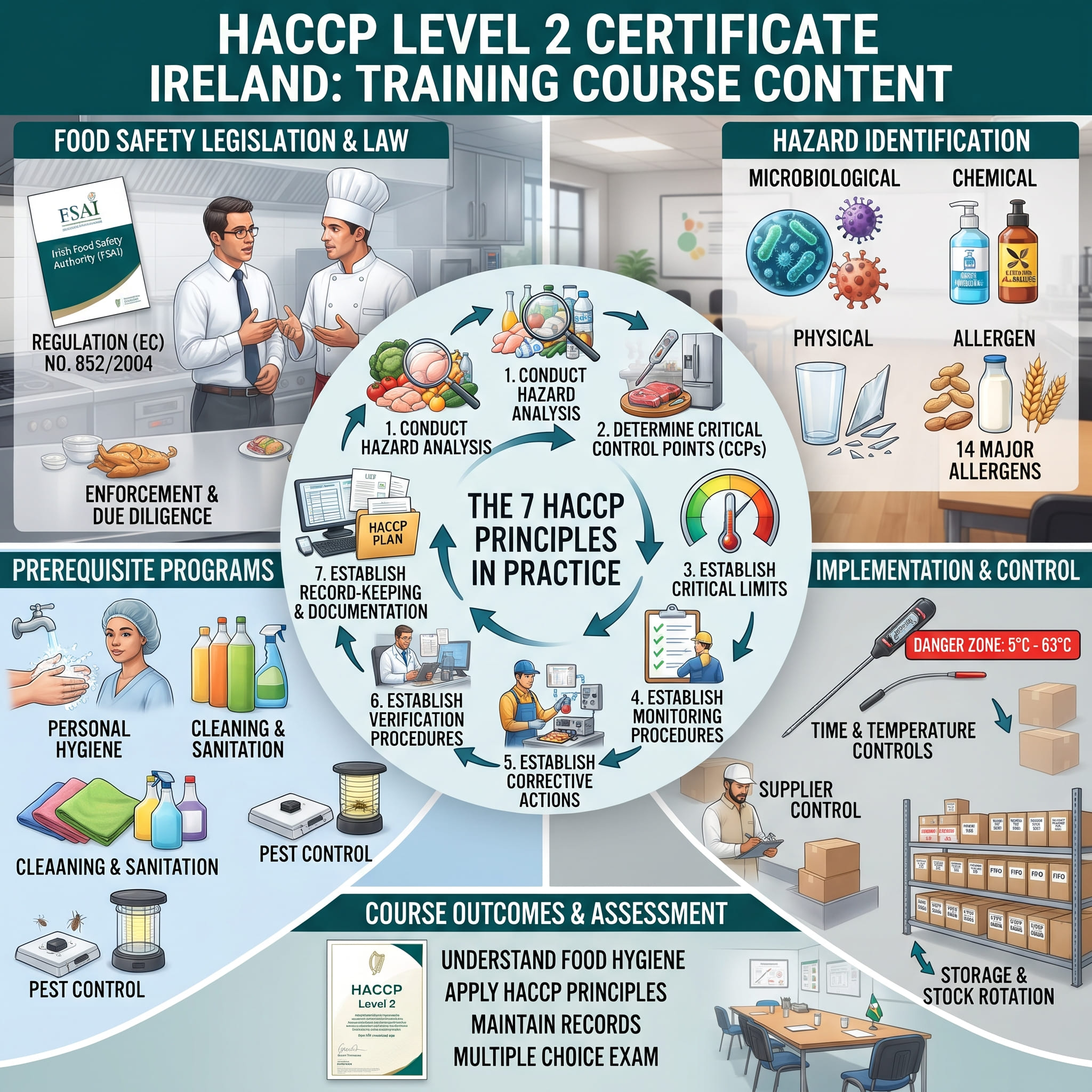
Food safety is an essential responsibility for businesses that prepare, handle, store, distribute, or serve food. Restaurants, cafés, hotels, catering companies, supermarkets, and food manufacturing facilities all need procedures to reduce contamination risks and protect consumers. Employees must understand how their daily activities can affect food safety and why established hygiene procedures must be followed consistently.
HACCP training helps learners understand how food safety hazards can be identified, assessed, and controlled. Level 2 courses are commonly designed for food handlers and other employees who need a practical understanding of food hygiene and the basic principles of HACCP. However, course titles and qualification levels can vary between training providers, so it is important to check the specific syllabus before enrolling.
If you are considering a haccp certification course in Ireland, understanding the subjects typically covered can help you decide whether the programme suits your role. This guide explains the common topics, practical skills, and learning outcomes associated with introductory and intermediate HACCP training.
1. Understanding HACCP and Its Purpose
One of the first subjects covered in a haccp food safety course is the meaning and purpose of HACCP.
HACCP stands for Hazard Analysis and Critical Control Points. It is a systematic approach to identifying food safety hazards and establishing controls to prevent, eliminate, or reduce them to acceptable levels.
Rather than relying exclusively on inspecting food after preparation, HACCP focuses on controlling risks throughout food operations. This includes receiving ingredients, storing products, preparing meals, cooking food, cooling it, and serving it to customers.
Training usually explains why food safety controls are important and how employees contribute to their effectiveness.
For example, a kitchen employee who understands HACCP should know why raw meat must be handled carefully and kept separate from ready-to-eat food. A worker responsible for chilled storage should understand why temperature checks and appropriate corrective actions matter.
A course may also explain the relationship between HACCP and prerequisite programmes, such as cleaning, personal hygiene, pest control, maintenance, and supplier management.
These basic concepts help learners understand that food safety depends on a combination of planned procedures and consistent daily practices.
2. Identifying Different Types of Food Safety Hazards
Hazard identification is a central part of HACCP. Level 2 training commonly introduces the main categories of hazards that can make food unsafe.
Biological hazards
Biological hazards include harmful bacteria, viruses, parasites, and other microorganisms. These may enter food through contaminated ingredients, poor hygiene, unsafe handling, or inadequate temperature control.
Learners may study examples involving bacteria associated with raw poultry, contaminated surfaces, or improperly stored food.
Chemical hazards
Chemical hazards can arise from cleaning products, sanitising agents, pesticides, or other substances that accidentally contaminate food.
Training may explain why chemicals should be stored separately from food and why cleaning products must be used according to their instructions.
Physical hazards
Physical hazards include foreign objects such as glass fragments, metal pieces, plastic, or other materials that could injure a consumer.
Learners may be shown how damaged equipment, unsuitable packaging, or poor handling practices can introduce these hazards.
Understanding these categories helps food handlers recognise potential problems before they affect customers.
A haccp course online may use photographs, scenarios, quizzes, or examples from food businesses to help learners practise identifying different hazards.
3. Preventing Cross-Contamination
Cross-contamination occurs when harmful microorganisms, allergens, or other contaminants transfer from one source to another. It is a common subject in food safety training because everyday handling practices can significantly influence food safety.
A haccp certification programme may explain how contamination can occur through hands, utensils, chopping boards, work surfaces, equipment, packaging, and storage areas.
Learners are generally taught the importance of separating raw and ready-to-eat foods, using appropriate cleaning procedures, and following safe food preparation practices.
Examples of good practice include:
-
Using appropriate equipment for different food types.
-
Cleaning and disinfecting food-contact surfaces when required.
-
Washing hands at suitable times during food preparation.
-
Storing raw foods to prevent drips or contact with ready-to-eat products.
-
Preventing allergens from being unintentionally transferred between foods.
-
Keeping food preparation areas clean and organised.
For example, using a utensil that has contacted raw poultry to handle cooked food without appropriate cleaning can transfer harmful microorganisms.
Training should help learners recognise these risks and understand the procedures used in their workplace to prevent contamination.
4. Personal Hygiene and Safe Food Handling
Personal hygiene is another important topic in Level 2 HACCP-related training. Food handlers can introduce contaminants into food if they do not follow appropriate hygiene practices.
Training usually covers effective handwashing, clean work clothing, suitable protective equipment where required, and the importance of keeping food preparation areas hygienic.
Learners may also be taught how to report illnesses, symptoms, or conditions that could affect food safety and when they should avoid handling food in accordance with workplace procedures.
Good hygiene practices include washing hands after handling raw ingredients, using the toilet, touching waste, cleaning equipment, or performing other activities that may contaminate hands.
Employees should also understand why cuts and wounds must be appropriately covered and why personal items should be managed in accordance with workplace rules.
HACCP training connects these personal responsibilities with the broader food safety system. Even a well-designed HACCP plan can be undermined if employees do not follow hygiene procedures consistently.
5. Temperature Control and Food Storage
Temperature control is essential for reducing the growth of harmful microorganisms in foods that require controlled storage or preparation.
A typical haccp food safety course explains the importance of appropriate refrigeration, freezing, cooking, cooling, reheating, and hot holding procedures.
The exact limits and procedures depend on the food, the process, and applicable requirements. Learners should follow their business's established food safety procedures rather than relying on general examples alone.
Common topics include:
-
Checking and recording refrigeration temperatures.
-
Storing food under appropriate conditions.
-
Monitoring cooking processes where required.
-
Cooling cooked foods safely.
-
Preventing cross-contamination during storage.
-
Checking dates, packaging, and product condition.
-
Taking appropriate action when temperature controls fail.
For example, if a refrigerator is found outside its specified operating range, an employee should report the issue and follow the workplace's corrective-action procedure. The business may need to assess the affected food, the time involved, and whether the products remain safe.
Training helps learners understand that simply moving food to another refrigerator does not necessarily resolve every food safety concern.
6. The Seven Principles of HACCP
A course that focuses specifically on HACCP should introduce the seven recognised principles used to establish and maintain a HACCP-based system.
These are generally taught as follows:
-
Conduct a hazard analysis: Identify potential food safety hazards and consider how they can be controlled.
-
Determine Critical Control Points: Identify stages where control is essential to prevent, eliminate, or reduce a significant hazard to an acceptable level.
-
Establish critical limits: Define measurable or otherwise verifiable limits that distinguish acceptable from unacceptable control at a CCP.
-
Establish monitoring procedures: Decide how and when the control measures will be checked.
-
Establish corrective actions: Specify what must happen when monitoring identifies a loss of control.
-
Establish verification procedures: Check whether the HACCP system is working as intended.
-
Establish documentation and records: Maintain appropriate evidence of procedures, monitoring, corrective actions, and verification.
The depth of coverage varies between providers. Some Level 2 courses introduce these principles at a basic level, while more advanced programmes may require learners to apply them in greater detail.
Understanding these principles helps learners see how daily food handling activities fit into a structured food safety management system.
7. Monitoring, Record Keeping, and Corrective Actions
Food safety procedures need to be followed and checked. Monitoring and record keeping help businesses identify problems and demonstrate that appropriate controls are being applied.
Level 2 training may introduce the purpose of temperature logs, cleaning schedules, delivery checks, and other records relevant to the workplace.
Learners should understand that records need to be accurate and completed according to the business's procedures. They should not record checks that have not actually been carried out.
Corrective actions are also important. If a monitoring check identifies a problem, staff must know how to report it and follow the appropriate procedure.
For example, if a delivery arrives with damaged packaging or evidence of unsuitable storage conditions, the employee should follow the business's delivery acceptance procedure and inform the responsible person.
The action taken will depend on the circumstances and the food safety risk involved.
These topics help learners understand that identifying a hazard is only the first step. Appropriate action and follow-up are also necessary.
8. Assessment and Certificate Requirements
Before enrolling in a haccp certification course, check how the training provider assesses learners and what is required to receive the certificate.
Some programmes use multiple-choice questions or online quizzes. Others may include written exercises, practical activities, or workplace-based assessments.
Assessment may cover food safety hazards, hygiene practices, contamination prevention, temperature control, and basic HACCP principles.
Before paying for a course, check:
-
Whether an assessment is included.
-
Whether a minimum pass mark applies.
-
Whether unsuccessful learners can retake the assessment.
-
What type of certificate is issued.
-
Whether the certificate can be verified.
-
Whether the course is suitable for your particular job responsibilities.
The expression “Level 2” does not necessarily mean that every provider offers the same regulated qualification or syllabus. Confirm the awarding organisation, qualification status, and learning outcomes if these details are important for your employment.
A certificate may demonstrate successful course completion, but it does not automatically prove that a person has practical competence in every food handling task or that an employer's food safety obligations have been fulfilled.
9. Choosing HACCP Training in Ireland
When comparing haccp training providers in Ireland, review the syllabus, course duration, delivery method, assessment process, learner support, and certificate arrangements.
An online programme may suit employees who need flexible access to learning materials. Classroom training or supervised practical instruction may be more appropriate where the role requires hands-on demonstrations or detailed workplace-specific learning.
Under applicable EU food hygiene rules, food businesses must ensure that food handlers receive appropriate instruction or training in food hygiene in line with their work. People responsible for developing and maintaining HACCP-based procedures must also receive adequate training in applying HACCP principles.
The appropriate training depends on the person's duties and the nature of the business. Do not assume that every introductory course meets the requirements of every role.
Conclusion
A Level 2 HACCP-related course in Ireland commonly introduces food safety hazards, cross-contamination prevention, personal hygiene, temperature control, food storage, monitoring, corrective actions, and the basic principles of HACCP. The exact syllabus and qualification status depend on the training provider and programme.
Before choosing haccp certification, review the course content and confirm that it matches your responsibilities. A suitable haccp food safety course should help you understand how to identify hazards, follow workplace procedures, and contribute to safer food handling.
Whether you choose classroom learning or a haccp course online, pay attention to the quality of the learning materials, assessment requirements, and the meaning of the certificate.
By selecting appropriate haccp training and applying what you learn consistently, you can strengthen your understanding of food safety and support effective hygiene practices in your workplace.