



HACCP is one of the most important food safety management approaches used by food businesses. Restaurants, cafés, hotels, catering companies, bakeries, supermarkets and food manufacturers all need effective systems for identifying and controlling hazards that could make food unsafe.
Understanding the HACCP principles is therefore important for anyone involved in food safety.
HACCP stands for Hazard Analysis and Critical Control Points. Rather than relying only on checking finished food, HACCP focuses on identifying potential hazards throughout the food process and establishing controls to prevent, eliminate or reduce those hazards.
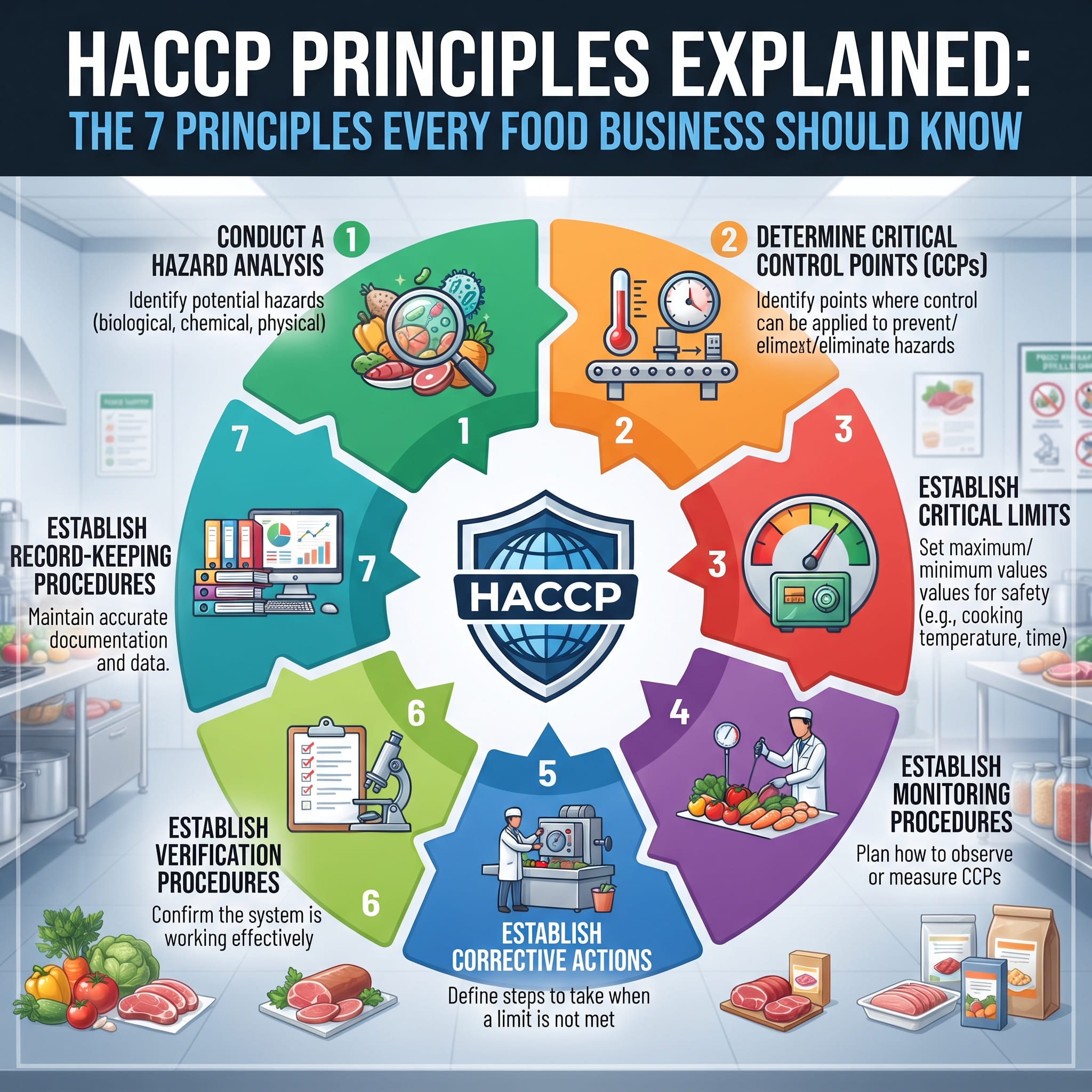
The system is based on seven HACCP principles. Together, these principles provide a structured framework for managing food safety.
In this guide, we explain each principle, why it matters and how it can be applied in a food business.
What Is HACCP?
HACCP is a systematic approach to food safety based on identifying hazards and controlling them at appropriate stages of a food process.
Potential hazards can include:
- Biological hazards
- Chemical hazards
- Physical hazards
- Allergens
- Cross-contamination
- Temperature-related hazards
The Food Safety Authority of Ireland (FSAI) describes HACCP as a systematic approach that helps food businesses identify what could go wrong, establish ways to prevent problems and ensure that controls are being followed.
The seven principles provide the foundation for developing and maintaining a HACCP-based food safety system.
Principle 1: Conduct a Hazard Analysis
The first of the HACCP principles is to conduct a hazard analysis.
This means identifying potential hazards that could occur during each stage of a food process.
A food business may consider processes such as:
- Receiving ingredients
- Storage
- Preparation
- Cooking
- Cooling
- Serving
- Transportation
At each stage, the business considers what could go wrong.
For example, during storage, potential hazards might include:
- Incorrect temperature
- Cross-contamination
- Damaged packaging
During preparation, hazards could include:
- Contamination from equipment
- Poor hand hygiene
- Allergen cross-contact
The purpose of hazard analysis is to identify risks before they cause a food safety problem.
Why Is Hazard Analysis Important?
Without identifying hazards, a business cannot determine what needs to be controlled.
Hazard analysis therefore provides the foundation for the rest of the HACCP system.
The business should consider the hazards relevant to its own activities rather than assuming that every food business has exactly the same risks.
Principle 2: Determine Critical Control Points
The second principle is determining Critical Control Points, commonly called CCPs.
A Critical Control Point is a step where control is essential to prevent, eliminate or reduce a food safety hazard to an acceptable level.
Not every stage of a food process is necessarily a CCP.
For example, depending on the particular food process, cooking may be a CCP because it can be an important control for certain biological hazards.
The HACCP team needs to determine which steps require critical control.
Why Are CCPs Important?
Identifying CCPs allows a business to focus attention on the stages where controlling a particular hazard is essential.
This prevents HACCP from becoming simply a long list of general food safety activities.
The objective is to identify the controls that are critical to food safety.
Principle 3: Establish Critical Limits
Once CCPs have been identified, the third of the HACCP principles is to establish critical limits.
A critical limit defines the boundary between acceptable and unacceptable conditions at a CCP.
Depending on the process, a critical limit may relate to factors such as:
- Temperature
- Time
- pH
- Other measurable conditions
For example, a food business may have a defined temperature requirement associated with a particular control step.
The critical limit should be based on appropriate food safety information and be suitable for the specific process.
Why Are Critical Limits Important?
Without a defined limit, employees may not know when a process has moved outside acceptable conditions.
Critical limits provide a measurable basis for determining whether a CCP is under control.
Principle 4: Establish Monitoring Procedures
The fourth principle is establishing monitoring procedures.
Monitoring means carrying out planned observations or measurements to determine whether a CCP is under control.
Depending on the business, monitoring could involve:
- Taking temperature readings
- Checking equipment
- Observing processes
- Recording results
- Checking storage conditions
The monitoring procedure should clearly establish what needs to be checked and how often.
Employees responsible for monitoring should understand the procedure and know how to report problems.
Example of Monitoring
Imagine a food business has a temperature control procedure.
An employee may be required to:
- Check the temperature using appropriate equipment.
- Record the result.
- Compare the result with the established requirement.
- Report or act on an unacceptable result according to the HACCP procedure.
Monitoring therefore provides ongoing information about whether the food safety control is working.
Principle 5: Establish Corrective Actions
Even well-designed systems can experience problems.
This is why the fifth of the HACCP principles is establishing corrective actions.
Corrective actions define what should happen when monitoring shows that a critical limit has not been met.
For example, a problem might occur when:
- A required temperature is not achieved
- Equipment stops working correctly
- A monitoring check identifies a failure
- A food safety procedure is not followed
The business should have an appropriate response.
Corrective actions may involve addressing the immediate problem and determining what should happen to affected food.
The exact action depends on the hazard, process and HACCP system.
Why Are Corrective Actions Important?
A HACCP system would be incomplete if it only identified problems without establishing what should happen next.
Corrective actions help the business respond systematically rather than leaving employees to guess what to do.
Principle 6: Establish Verification Procedures
The sixth principle is verification.
Verification is used to determine whether the HACCP system is working effectively.
This is different from routine monitoring.
Monitoring checks whether a particular control is operating as required.
Verification looks more broadly at whether the HACCP system itself is effective.
Verification activities may include:
- Reviewing records
- Checking procedures
- Reviewing monitoring results
- Checking equipment
- Auditing processes
- Assessing whether controls remain effective
The exact verification procedures depend on the food business.
Why Is Verification Important?
A HACCP system should not simply be created and forgotten.
Food businesses can change over time.
They may introduce:
- New products
- New ingredients
- New equipment
- New suppliers
- New processes
These changes can introduce new hazards or alter existing risks.
Verification and review help ensure that the HACCP system continues to be appropriate.
Principle 7: Establish Documentation and Record Keeping
The seventh HACCP principle is documentation and record keeping.
Records provide evidence that food safety controls are being monitored and that procedures are being followed.
Depending on the business, records may include:
- Temperature monitoring
- Cleaning records
- Corrective actions
- Delivery checks
- Verification activities
- Other food safety monitoring
The amount of documentation required depends on the nature and complexity of the business.
A small café will not necessarily require the same level of documentation as a large food manufacturing facility.
Why Are Records Important?
Accurate records can help a business:
- Demonstrate that controls are being monitored
- Identify recurring problems
- Review the effectiveness of procedures
- Investigate food safety incidents
- Support verification activities
Employees responsible for completing records should record information accurately.
Records should reflect what actually happened rather than what employees expected to happen.
How the Seven HACCP Principles Work Together
The 7 HACCP principles are not seven unrelated rules.
They form a connected system.
The process can be understood as:
Identify hazards → identify critical control points → establish limits → monitor controls → take corrective action when necessary → verify the system → maintain records.
Each stage supports the next.
For example, if a business identifies a biological hazard during a particular process, it may determine that the process contains a CCP.
The business then establishes an appropriate critical limit.
Employees monitor that limit.
If monitoring shows that the limit has not been achieved, corrective action is taken.
The business then uses verification and records to assess whether the overall system is working effectively.
This is what makes HACCP a systematic approach rather than simply a collection of food hygiene rules.
HACCP Principles and Food Handlers
Not every employee in a food business will be responsible for designing the HACCP system.
However, food handlers should understand the procedures relevant to their work.
For example, a food handler may need to know:
- How to prevent cross-contamination
- How to follow temperature procedures
- How to maintain personal hygiene
- How to complete monitoring records
- What to do when a control fails
- Who to report problems to
A person responsible for developing or maintaining HACCP procedures requires a deeper understanding of the principles.
The FSAI states that people responsible for developing and maintaining HACCP-based procedures must have adequate training in applying HACCP principles.
HACCP Training and the Seven Principles
A HACCP course can help employees and managers understand how these principles work.
Depending on the level of training, a course may cover:
- Food safety hazards
- Hazard analysis
- Critical Control Points
- Critical limits
- Monitoring
- Corrective actions
- Verification
- Documentation
- Personal hygiene
- Cross-contamination
- Temperature control
Introductory HACCP training may focus on helping food handlers understand the basic principles and follow workplace procedures.
More advanced HACCP training may be appropriate for supervisors, managers or people responsible for implementing and maintaining the HACCP system.
Common Mistakes When Applying HACCP
Understanding the principles is important, but implementation also matters.
Common problems can include:
Treating Every Step as a CCP
Not every food safety activity is necessarily a Critical Control Point.
Inadequate Monitoring
A control cannot be considered effective if it is not monitored appropriately.
Poor Record Keeping
Incomplete or inaccurate records can make it difficult to determine whether controls were actually followed.
Ignoring Corrective Actions
Identifying a problem is not enough. Employees need to know what action should be taken.
Failing to Review the System
A HACCP system should remain appropriate when the business changes.
Training the Wrong People
Training should reflect employees' responsibilities.
A person managing HACCP procedures may need more detailed knowledge than someone who simply follows established food handling procedures.
Why Every Food Business Should Understand HACCP Principles
The seven principles give food businesses a structured way to manage food safety.
They help businesses move from simply reacting to problems toward identifying hazards and controlling them proactively.
For employees, understanding the principles can make workplace procedures easier to understand.
For supervisors, HACCP knowledge can help with monitoring and corrective actions.
For managers and HACCP team members, understanding the principles is essential for developing, implementing and maintaining an effective HACCP-based system.
The FSAI's guidance emphasises the importance of appropriate food safety skills and training according to the role and responsibilities of individuals within food businesses.
Final Thoughts
The HACCP principles provide the foundation for a structured approach to food safety.
The seven principles are:
- Conduct a hazard analysis
- Determine Critical Control Points
- Establish critical limits
- Establish monitoring procedures
- Establish corrective actions
- Establish verification procedures
- Establish documentation and record keeping
Together, these principles help food businesses identify hazards, establish appropriate controls and verify that those controls continue to work.
Whether you are a food handler, supervisor, manager or someone responsible for HACCP procedures, understanding the principles can help you recognise how your role contributes to food safety.
A HACCP food safety course can provide a useful introduction to these concepts, while more advanced HACCP training may be appropriate for people with greater responsibility.
Most importantly, HACCP should not be viewed simply as a certificate or a set of forms. Its purpose is to provide a practical, systematic approach to preventing food safety hazards and protecting consumers.