



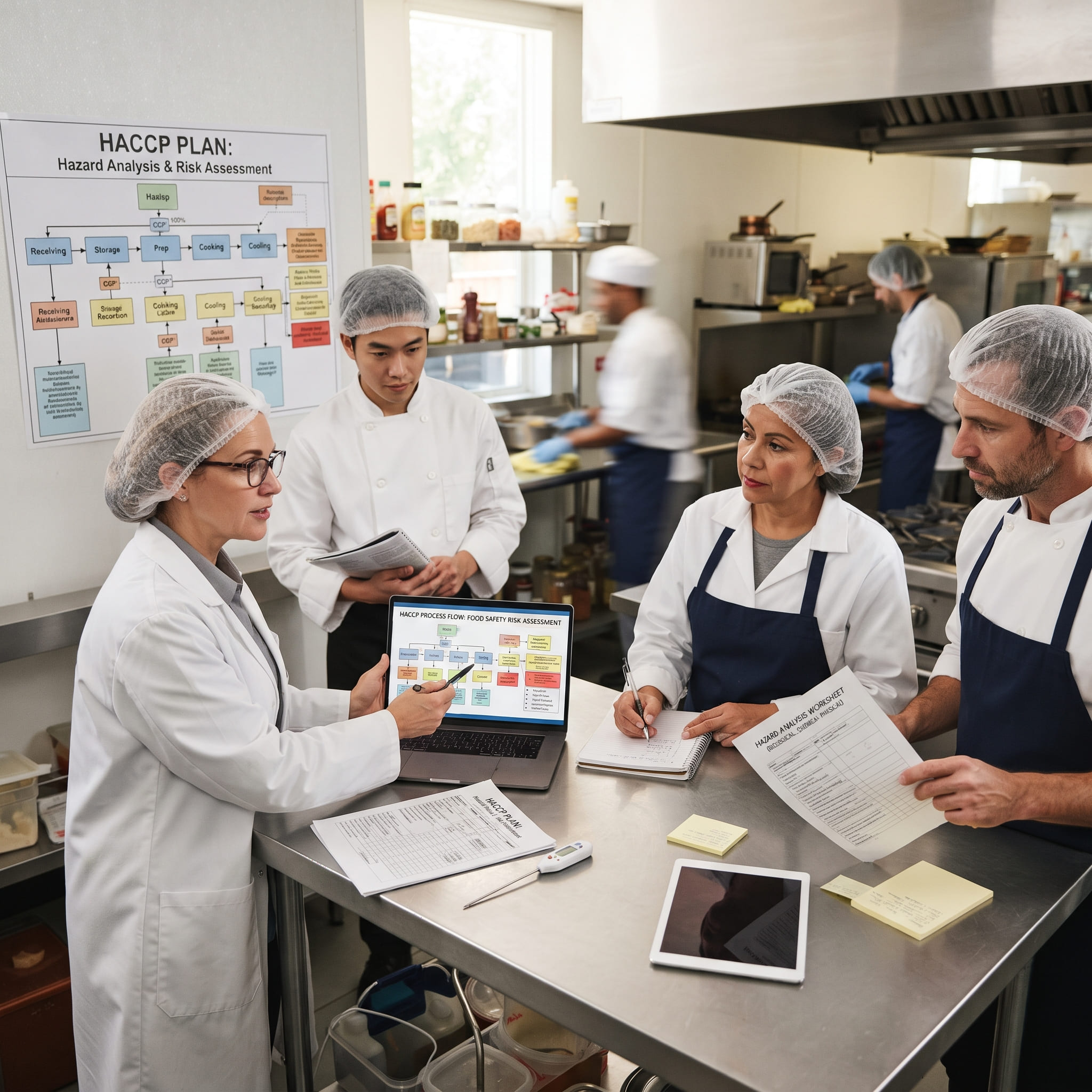
HACCP risk assessment is an important part of developing an effective food safety management system. Food businesses need to understand what could make food unsafe, determine which hazards are significant and establish appropriate controls.
For food businesses in Ireland, understanding how to identify and assess food safety risks is particularly important for anyone involved in food preparation, supervision or HACCP management.
A HACCP course Ireland programme can introduce learners to hazard analysis, risk assessment, Critical Control Points and monitoring procedures. Understanding these concepts helps employees see why specific food safety controls are required in the workplace.
This article explains what HACCP risk assessment means, how food businesses identify food safety risks and how the results can be used to develop an effective HACCP system.
What Is a HACCP Risk Assessment?
A HACCP risk assessment is a systematic process used to identify potential food safety hazards and evaluate their significance.
The process considers questions such as:
- What could go wrong?
- Where could the hazard occur?
- How likely is it to occur?
- How serious could the consequences be?
- What controls are already in place?
- Is additional control required?
The purpose is to identify hazards that require effective control.
HACCP stands for Hazard Analysis and Critical Control Points, and hazard analysis is the first of the seven HACCP principles. The Food Safety Authority of Ireland (FSAI) identifies hazard analysis as the process of identifying hazards that need to be prevented, eliminated or reduced to acceptable levels.
Hazard vs Risk: What Is the Difference?
The terms hazard and risk are sometimes used interchangeably, but they describe different concepts.
A hazard is something that has the potential to cause harm.
A risk considers the likelihood and potential severity of that harm occurring.
For example:
Hazard: Harmful bacteria in food.
Risk: The possibility that the bacteria could survive or multiply to a level that could make the food unsafe.
Another example:
Hazard: Cleaning chemical.
Risk: The possibility that the chemical could contaminate food and cause harm.
Understanding this difference is useful when completing HACCP training in Ireland.
Why Is HACCP Risk Assessment Important?
Food businesses deal with many potential hazards every day.
These can arise during:
- Receiving
- Storage
- Preparation
- Cooking
- Cooling
- Packaging
- Transportation
- Service
Without a systematic assessment, important hazards could potentially be overlooked.
A risk-based approach allows the business to focus its attention on significant food safety hazards.
For example, a restaurant may identify several hazards during food preparation but determine that certain controls are particularly important because losing control could result in food becoming unsafe.
The Main Types of Food Safety Hazards
During a HACCP risk assessment, food businesses generally consider several categories of hazards.
Biological Hazards
These include:
- Bacteria
- Viruses
- Parasites
- Fungi
Biological hazards can arise from contaminated ingredients, poor hygiene, cross-contamination, inadequate cooking or inappropriate storage.
Chemical Hazards
Chemical hazards can include:
- Cleaning chemicals
- Sanitising products
- Lubricants
- Pesticide residues
- Other harmful substances
Businesses need controls to prevent chemicals from contaminating food.
Physical Hazards
Physical hazards involve foreign objects that could enter food.
Examples include:
- Glass
- Metal
- Plastic
- Stones
- Packaging materials
- Broken equipment components
Allergen Hazards
Food businesses must also consider allergens and the risk of allergen cross-contact.
Potential risks can occur through:
- Ingredients
- Shared equipment
- Poor cleaning
- Incorrect labelling
- Storage
- Food preparation
The exact controls depend on the business and its food processes.
Step 1: Understand the Food Business
The first step in assessing food safety risks is understanding the operation.
The HACCP team should consider:
- Products
- Ingredients
- Suppliers
- Equipment
- Employees
- Premises
- Storage
- Preparation methods
- Cooking processes
- Distribution
- Intended use
A small café will have different risks from a large food manufacturing facility.
Therefore, the HACCP system should be based on the actual operation.
Step 2: Create a Process Flow
A process flow diagram helps identify where hazards could occur.
For example:
Receiving → Storage → Preparation → Cooking → Cooling → Service
The flow should reflect what actually happens in the business.
Once the process has been mapped, the HACCP team can examine each stage and consider potential hazards.
Step 3: Identify Potential Hazards
At each stage, the team asks:
What could go wrong?
For example, during receiving:
- Could ingredients be contaminated?
- Could packaging be damaged?
- Could storage requirements already have been compromised?
During storage:
- Could food be stored incorrectly?
- Could cross-contamination occur?
- Could temperature create a food safety risk?
During preparation:
- Could raw food contaminate ready-to-eat food?
- Could allergens be transferred?
- Could equipment introduce physical contamination?
During cooking:
- Could a biological hazard survive?
These questions help create a comprehensive hazard analysis.
Step 4: Assess the Significance of Each Hazard
Once hazards have been identified, the HACCP team needs to determine which ones are significant.
A common approach is to consider:
Likelihood
How likely is the hazard to occur?
Severity
How serious could the consequences be if it occurred?
A hazard that is both reasonably likely to occur and potentially serious may require particular attention.
However, risk assessment should not rely on a mathematical score alone.
The HACCP team should use appropriate food safety knowledge and consider the specific process.
A Simple Risk Assessment Example
Imagine a restaurant preparing cooked chicken.
The HACCP team identifies survival of harmful microorganisms as a potential biological hazard during cooking.
They may consider:
Likelihood: Could inadequate cooking occur?
Severity: Could consuming inadequately cooked chicken result in foodborne illness?
Control: Is there a validated or appropriate cooking process that controls the hazard?
The team can then determine how the cooking process should be controlled and whether it represents a Critical Control Point.
This is a simplified example rather than a complete HACCP assessment.
Step 5: Identify Control Measures
After assessing the hazard, the business determines how it can be controlled.
Possible control measures include:
- Temperature control
- Cooking
- Refrigeration
- Cleaning
- Personal hygiene
- Separation of raw and ready-to-eat food
- Supplier controls
- Equipment maintenance
- Allergen controls
The appropriate control depends on the hazard.
For example, temperature control may be important for certain biological hazards, while chemical storage procedures may be used to prevent chemical contamination.
Step 6: Determine Critical Control Points
Once hazards and control measures have been identified, the HACCP team considers whether particular stages are Critical Control Points (CCPs).
A CCP is a step where control is essential to prevent, eliminate or reduce a food safety hazard to an acceptable level.
Not every hazard and not every control measure represents a CCP.
For example, cooking may be a CCP for a particular food process if it is essential for controlling a significant biological hazard.
The determination needs to be based on the specific HACCP system.
Step 7: Establish Critical Limits
If a process is identified as a CCP, the business needs to establish appropriate critical limits.
A critical limit separates acceptable conditions from unacceptable conditions.
Depending on the process, critical limits can relate to:
- Temperature
- Time
- pH
- Other measurable conditions
The limits should be appropriate for controlling the identified hazard.
Step 8: Establish Monitoring Procedures
The next stage is to determine how the business will monitor each CCP.
Monitoring procedures should specify:
- What is checked
- How it is measured
- When it is checked
- Who checks it
- What result is acceptable
- What happens if the limit is exceeded
Monitoring records can then provide evidence that the control is being maintained.
Step 9: Establish Corrective Actions
What happens if the risk control fails?
The HACCP system should already provide an answer.
For example, if a critical limit is exceeded, the corrective action procedure may require the business to:
- Identify the deviation
- Restore control
- Assess affected food
- Take appropriate action
- Record the problem
- Investigate the cause
- Prevent recurrence
The exact action depends on the hazard and the business's HACCP procedures.
Step 10: Verify the HACCP System
Risk assessment is not necessarily a one-time exercise.
A food business can change significantly over time.
For example:
- New ingredients may be introduced.
- Equipment may change.
- Recipes may change.
- Suppliers may change.
- Production methods may change.
These changes can affect food safety risks.
The HACCP system should therefore be reviewed and verified when appropriate.
HACCP Risk Assessment Example
Consider a café producing sandwiches.
| Process | Potential Hazard | Risk Consideration | Possible Control |
|---|---|---|---|
| Receiving | Contaminated ingredients | Depends on supplier/product | Supplier controls |
| Storage | Microbial growth | Depends on storage conditions | Temperature control |
| Preparation | Cross-contamination | Can occur through handling | Hygiene/separation |
| Assembly | Allergen cross-contact | Depends on ingredients/process | Allergen controls |
| Service | Contamination | Depends on handling | Hygiene controls |
This example demonstrates how a business can systematically consider risks.
The actual assessment needs to be specific to the business.
HACCP Risk Assessment vs Workplace Risk Assessment
It is important not to confuse HACCP risk assessment with a general workplace health and safety risk assessment.
A workplace risk assessment may focus on hazards affecting employees, such as:
- Slips
- Trips
- Manual handling
- Machinery
- Workplace chemicals
A HACCP risk assessment focuses primarily on food safety hazards and the potential for food to become unsafe.
A food business may need both systems.
HACCP Training and Risk Assessment in Ireland
Understanding risk assessment is an important part of HACCP training Ireland.
A suitable HACCP course in Ireland may cover:
- Food safety hazards
- Hazard analysis
- Risk assessment
- Critical Control Points
- Critical limits
- Monitoring
- Corrective actions
- Verification
- Documentation
Employees who handle food need to understand the procedures relevant to their roles.
Supervisors and HACCP team members may require more detailed training.
The FSAI states that people responsible for developing and maintaining HACCP-based procedures need adequate training in applying HACCP principles.
HACCP Certificate and Certification
If you are looking for a HACCP certificate Ireland, it is important to consider what the course actually teaches.
Training options may include:
- HACCP training Ireland
- HACCP course Ireland
- HACCP certification Ireland
- HACCP certificate Ireland
- HACCP training certificate
- HACCP certification course
- HACCP Level 1 training
- HACCP Level 2 training
The appropriate level depends on your responsibilities.
A certificate confirms completion of a particular training course, but it does not automatically mean the certificate holder is responsible for developing a complete HACCP system.
Online HACCP Training
Online HACCP training can provide a flexible way to learn about food safety risk assessment.
An online HACCP course Ireland programme may cover:
- Food safety hazards
- HACCP principles
- Hazard analysis
- Critical Control Points
- Monitoring
- Corrective actions
- Verification
Online learning can be particularly convenient for food workers who need to complete training around their work schedules.
However, employees should also understand their employer's specific HACCP procedures.
Common HACCP Risk Assessment Mistakes
Food businesses should avoid several common problems.
Identifying Hazards Without Assessing Them
Simply listing hazards does not explain which ones require greater control.
Using a Generic HACCP Plan
The assessment should reflect the actual business.
Ignoring Allergens
Allergen risks should be appropriately considered.
Creating Too Many CCPs
Not every food safety control is a CCP.
Failing to Review Changes
New products, equipment or processes can introduce new risks.
Poor Documentation
The reasoning behind important food safety decisions should be documented appropriately.
Final Thoughts
HACCP risk assessment helps food businesses systematically identify and evaluate food safety hazards.
The process involves understanding the food operation, mapping the process, identifying hazards, considering their significance, establishing controls and determining where Critical Control Points may be necessary.
The key stages include:
- Understand the food business.
- Create a process flow.
- Identify potential hazards.
- Assess their significance.
- Establish control measures.
- Determine Critical Control Points.
- Establish critical limits.
- Establish monitoring procedures.
- Establish corrective actions.
- Verify and review the HACCP system.
For food businesses in Ireland, appropriate HACCP training can help employees understand how these principles are applied in practice.
If you are choosing a HACCP course Ireland, HACCP certificate Ireland, HACCP training Ireland or HACCP certification course, consider the course level, content, assessment and intended audience.
Ultimately, effective HACCP risk assessment is about identifying food safety problems before they happen, understanding which risks require control and establishing procedures that help keep food safe throughout the entire food process.