



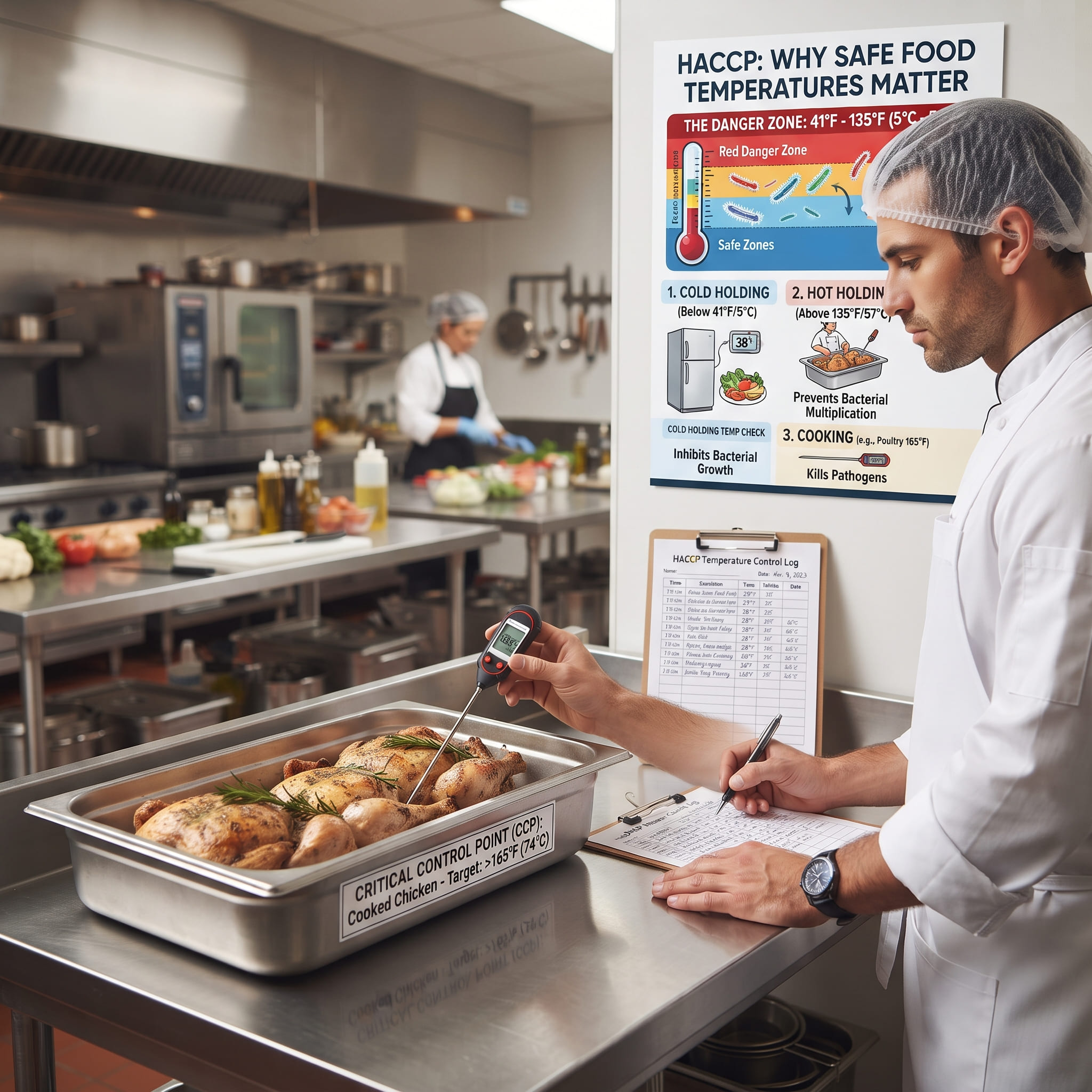
HACCP temperature control is one of the most important aspects of food safety for many food businesses. Temperature can influence whether harmful microorganisms survive, grow or are controlled during food preparation, storage and service.
For restaurants, cafés, takeaways, catering businesses and other food operations in Ireland, employees need to understand why temperature monitoring matters and how it fits into the business's HACCP system.
A HACCP course Ireland can help food handlers and supervisors understand the relationship between temperature, food safety hazards, monitoring, Critical Control Points and corrective actions.
However, temperature control is not simply about memorising a list of numbers. Staff need to understand the procedures established by their food business and know what to do when a temperature check produces an unacceptable result.
This guide explains why temperature control matters and how food businesses can manage it as part of an effective HACCP system.
Why Does Temperature Matter in Food Safety?
Many microorganisms can grow under suitable conditions.
Temperature is one factor that can affect microbial growth.
If potentially hazardous food is kept under inappropriate conditions for too long, microorganisms may multiply and food can become unsafe.
Temperature control can therefore be used to:
- Slow microbial growth
- Control certain food safety hazards
- Support safe storage
- Control cooking processes
- Manage cooling
- Maintain appropriate hot holding
The exact controls depend on the food, process and HACCP system.
What Is HACCP Temperature Control?
HACCP temperature control refers to the procedures used to monitor and manage temperatures where temperature is important for controlling a food safety hazard.
A HACCP system may identify temperature control during:
- Refrigerated storage
- Frozen storage
- Cooking
- Cooling
- Hot holding
- Food transportation
Not every temperature check is automatically a Critical Control Point.
The HACCP team must determine which steps require control based on the specific hazards and processes involved.
Temperature and Biological Hazards
Temperature is particularly relevant to biological hazards.
These can include:
- Bacteria
- Viruses
- Parasites
- Fungi
Some microorganisms can multiply when food is kept under favourable conditions.
Cooking can be used to control certain biological hazards, while appropriate refrigeration can help slow microbial growth.
This is why food businesses need procedures that control temperature at appropriate stages.
Refrigerated Food Storage
Refrigeration is widely used by food businesses to help control the growth of microorganisms.
Restaurants, cafés and takeaways may store:
- Meat
- Poultry
- Fish
- Dairy products
- Prepared foods
- Salads
- Sandwich ingredients
- Desserts
Employees should know the business's procedures for checking refrigerated storage.
Monitoring may include:
- Checking refrigerator temperatures
- Recording readings
- Reporting problems
- Taking corrective action when required
Businesses should follow the relevant requirements and their own HACCP procedures rather than relying on assumptions.
Freezer Temperature Control
Freezing is another important storage method.
Freezers may be used for:
- Meat
- Fish
- Vegetables
- Prepared foods
- Desserts
- Other frozen ingredients
Staff should understand how frozen storage is monitored and what to do if equipment is not operating correctly.
A freezer problem may require immediate attention, particularly if food safety could be affected.
The business should have procedures explaining how affected food is assessed and what corrective action is required.
Cooking Temperature Control
Cooking may be an important control measure for certain biological hazards.
For some processes, cooking may be identified as a Critical Control Point (CCP).
A CCP is a step where control is essential to prevent, eliminate or reduce a significant food safety hazard to an acceptable level.
If cooking is identified as a CCP, the HACCP system should establish:
- A critical limit
- Monitoring procedure
- Corrective action
- Verification procedure
- Appropriate records
Employees responsible for cooking checks need to understand exactly what the procedure requires.
Critical Limits
A critical limit is a criterion that separates acceptable conditions from unacceptable conditions at a CCP.
For a temperature-controlled CCP, the critical limit may involve a specified temperature, time or combination of conditions.
It is important that employees understand the difference between:
A general food safety recommendation
and
The critical limit established in the HACCP system.
Staff should follow the limits established by their business's food safety procedures and applicable requirements.
Monitoring Temperature
Temperature control only works if temperatures are monitored appropriately.
A monitoring procedure should identify:
- What temperature is being checked
- How it is measured
- When it is measured
- How frequently it is checked
- Who performs the check
- What result is acceptable
- What happens if the result is unacceptable
For example, a business may require employees to monitor refrigeration equipment at specified intervals.
The employee should record the actual result rather than simply marking a box as "OK."
Using a Food Thermometer
Where temperature measurement is required, staff need to know how to use the equipment correctly.
Depending on the type of thermometer, this can include:
- Ensuring the thermometer is suitable for the task
- Keeping the probe clean
- Using the thermometer correctly
- Taking the measurement at the appropriate point
- Cleaning and sanitising the probe as required
- Checking or calibrating equipment according to the business's procedures
An incorrect measurement can create a false impression that food is safe.
Preventing Cross-Contamination When Measuring
A thermometer can come into contact with food.
Therefore, the probe needs to be managed appropriately.
Employees should follow procedures for:
- Cleaning the probe
- Sanitising it where required
- Preventing transfer of contamination
- Storing the thermometer correctly
For example, using the same contaminated probe between different foods without appropriate cleaning could transfer microorganisms.
Temperature control should therefore be combined with good hygiene practices.
Cooling Food Safely
Cooling can be an important temperature-control stage in some food businesses.
Restaurants and catering businesses may prepare food in advance and cool it before refrigeration.
The HACCP system should establish an appropriate procedure where cooling represents a significant food safety hazard.
Staff should know:
- Which foods need controlled cooling
- How cooling should be performed
- What needs to be monitored
- What records should be completed
- What corrective action is required if the process fails
The exact procedure depends on the food and the business's HACCP system.
Hot Holding
Some businesses hold cooked food at controlled temperatures before serving it.
Examples can include:
- Cooked meat
- Soups
- Sauces
- Prepared meals
- Buffet foods
Where hot holding is part of the food safety system, employees should understand:
- What needs to be monitored
- How frequently checks are required
- What limits apply
- How results are recorded
- What happens when the required condition is not achieved
Temperature Control During Transportation
Food safety controls may also apply when food is transported.
For example, a catering business may deliver prepared food to:
- Offices
- Events
- Schools
- Care facilities
- Private customers
The business may need procedures covering appropriate temperature control during transportation.
These procedures should be based on the type of food, transportation conditions and applicable food safety requirements.
What Happens If a Temperature Is Too High or Too Low?
An important part of HACCP temperature training is understanding corrective actions.
Suppose an employee checks a refrigerator and obtains an unacceptable reading.
The employee should not simply ignore it.
The business's procedure may require the employee to:
- Record the result.
- Inform the responsible person.
- Check the equipment.
- Assess potentially affected food.
- Take appropriate action.
- Restore control.
- Investigate the cause where necessary.
The appropriate action depends on the situation.
This is why HACCP procedures need to be specific to the food business.
HACCP Temperature Records
Temperature records provide evidence that monitoring has been carried out.
A record may include:
| Date | Equipment/Process | Time | Temperature | Employee | Action |
|---|---|---|---|---|---|
| Monday | Refrigerator | Morning | Recorded reading | Initials | None |
| Monday | Refrigerator | Afternoon | Recorded reading | Initials | None |
This is only an example of how a business might structure a record.
The actual format, frequency and limits should come from the business's HACCP procedures.
Employees should record actual measurements accurately.
Why Reviewing Temperature Records Matters
Keeping records is only useful if they are reviewed appropriately.
Managers can look for patterns such as:
- Repeated refrigerator problems
- Gradually increasing temperatures
- Missed checks
- Frequent corrective actions
- Equipment failures
For example, if the same refrigerator repeatedly produces unacceptable readings, the problem may require maintenance rather than simply repeated adjustments.
Temperature records can therefore support HACCP verification and continuous improvement.
Temperature Control and HACCP Training Ireland
HACCP training Ireland can help food workers understand why temperature control is important.
Training may cover:
- Food safety hazards
- Temperature control
- Critical Control Points
- Critical limits
- Monitoring
- Corrective actions
- Verification
- Documentation
The Food Safety Authority of Ireland states that people responsible for developing and maintaining HACCP-based procedures need adequate training in applying HACCP principles.
The depth of training should reflect the employee's responsibilities.
HACCP Level 1 and Level 2 Training
You may see HACCP Level 1 and HACCP Level 2 courses advertised.
The exact content can vary between providers.
An introductory course may explain basic food safety and HACCP principles.
A more detailed HACCP Level 2 training course may cover topics such as:
- Hazard analysis
- CCPs
- Critical limits
- Monitoring
- Corrective actions
- Verification
- Documentation
If an employer requires a HACCP Level 2 certificate, check the course syllabus and certificate details before enrolling.
HACCP Certificate Ireland
People searching for a HACCP certificate Ireland may encounter several different types of courses.
These can include:
- HACCP course Ireland
- HACCP training Ireland
- HACCP certification Ireland
- HACCP certification course
- HACCP training certificate
- HACCP Level 2 certificate
- HACCP food safety training
When choosing a course, consider:
- Course content
- Training level
- Intended audience
- Assessment
- Certificate
- Employer requirements
A training certificate confirms completion of a course but does not replace workplace-specific HACCP procedures.
Online HACCP Training
Online HACCP training can be a convenient way for food workers to learn HACCP principles.
An online HACCP course Ireland programme may cover temperature control alongside:
- Hazard analysis
- Critical Control Points
- Monitoring
- Corrective actions
- Verification
- Documentation
Online learning can be particularly useful for people who need flexible training around work.
However, employees still need to understand the specific temperature procedures used by their employer.
Common Temperature Control Mistakes
Food businesses should avoid several common mistakes.
Guessing Temperatures
Employees should measure temperatures where monitoring is required.
Recording Results From Memory
Records should reflect actual checks.
Ignoring Unacceptable Results
A failed check should be addressed according to the corrective action procedure.
Poor Thermometer Hygiene
The probe should be managed appropriately to avoid cross-contamination.
Failing to Maintain Equipment
Repeated temperature problems may indicate equipment or maintenance issues.
Using Generic Limits
Employees should follow the relevant limits established by the business's HACCP system and applicable requirements.
Final Thoughts
HACCP temperature control is an important part of food safety for many restaurants, cafés, takeaways, catering businesses and other food operations.
Temperature can be relevant during:
- Refrigerated storage
- Frozen storage
- Cooking
- Cooling
- Hot holding
- Transportation
However, effective temperature control involves more than memorising numbers.
Employees need to understand what to measure, how to measure it, when to perform the check, how to record the result and what to do when a control fails.
For businesses in Ireland, appropriate HACCP training Ireland can help food workers understand how temperature monitoring fits into the wider HACCP system.
If you are looking for a HACCP course Ireland, HACCP certificate Ireland, HACCP certification course, HACCP Level 2 training, HACCP training certificate or online HACCP training, check that temperature control and monitoring are relevant parts of the course content.
Ultimately, temperature control works best when it is part of a complete food safety system. When employees understand the risks, follow established procedures, use monitoring equipment correctly and respond appropriately to unacceptable results, temperature becomes an effective tool for helping food businesses maintain safe food throughout the production and service process.