



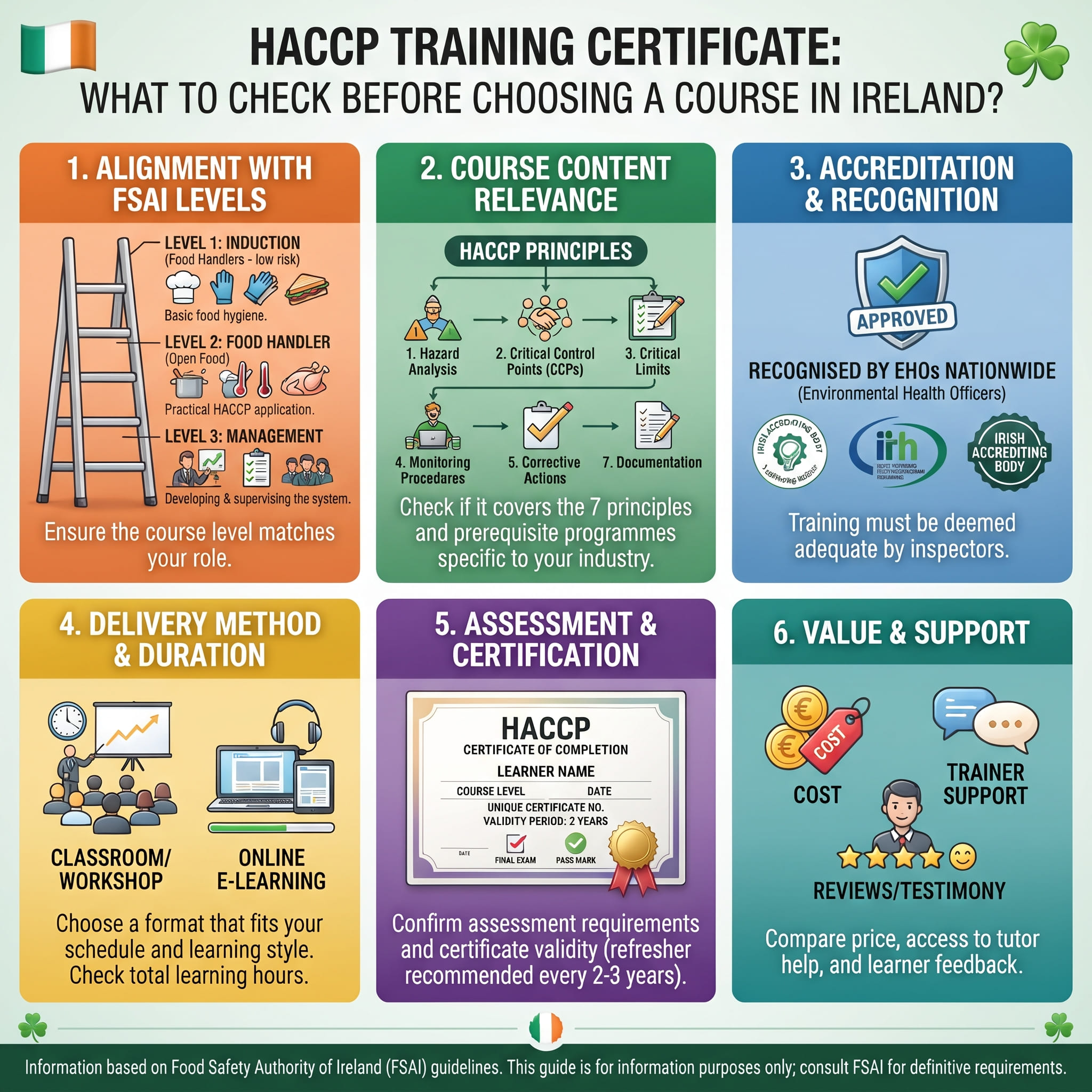
Food safety is an essential responsibility for businesses that prepare, store, transport, or serve food. Restaurants, cafés, hotels, catering companies, food manufacturers, supermarkets, and other food-related businesses must take appropriate steps to prevent contamination and protect consumers. Understanding Hazard Analysis and Critical Control Points (HACCP) is an important part of this process.
For employees and employers, choosing suitable haccp training can help develop the knowledge needed to identify food safety hazards, follow hygiene procedures, and understand how risks are controlled throughout food operations. However, not every course offers the same content, teaching methods, or assessment process.
Before enrolling in a haccp certification course, it is important to understand what the course covers, whether it matches your job responsibilities, how learning is assessed, and what the certificate actually demonstrates.
If you are looking for haccp certification in Ireland, taking time to review these details can help you choose a course that supports your professional development and workplace food safety responsibilities.
1. Check What the HACCP Course Covers
The first thing to examine is the course syllabus. A useful haccp food safety course should explain the main principles of HACCP and show how they apply to real food-handling activities.
HACCP is a systematic approach to identifying, evaluating, and controlling food safety hazards. It focuses on preventing problems rather than relying only on checking the finished product.
Look for a course that covers topics such as:
-
The meaning and purpose of HACCP.
-
Biological, chemical, and physical food safety hazards.
-
Food contamination and cross-contamination.
-
The importance of cleaning and disinfection.
-
Temperature control and safe food storage.
-
Monitoring procedures and record keeping.
-
Critical Control Points (CCPs).
-
Corrective actions when food safety limits are not met.
-
Verification and review of food safety procedures.
These subjects help learners understand how food safety systems operate in practice.
For example, a learner working in a restaurant should understand why raw poultry must be kept separate from ready-to-eat food. Someone working in food manufacturing may need a deeper understanding of process controls, monitoring records, and corrective actions.
Choose a course with content appropriate to your role rather than relying on the course title alone.
2. Make Sure the Training Matches Your Job Responsibilities
Different food businesses face different hazards. A course suitable for a café employee may not provide all the knowledge required by a HACCP team member responsible for monitoring a food production process.
Before selecting haccp training, consider your current position and the responsibilities you may take on in the future.
Food handlers may need to understand personal hygiene, contamination prevention, cleaning procedures, and safe food temperatures. Supervisors may also need to understand monitoring records, corrective actions, and how to ensure staff follow established procedures.
Managers and people responsible for developing or reviewing HACCP plans may require more advanced training that covers hazard analysis, identifying CCPs, setting critical limits, and verifying that controls are effective.
Ask yourself the following questions:
-
Is the course intended for food handlers, supervisors, or managers?
-
Does it cover the risks associated with my workplace?
-
Will it help me understand the procedures I am expected to follow?
-
Does it provide enough detail for my level of responsibility?
A well-matched haccp certification course should have clearly stated learning objectives and explain who the training is designed for.
3. Understand What the Certificate Actually Means
A certificate can demonstrate that a learner has completed a training programme or met specified assessment requirements. However, the meaning of a certificate depends on the provider, course structure, and assessment process.
Before purchasing haccp certification, check what the provider promises to issue after successful completion.
Find out whether the certificate confirms attendance, course completion, or successful completion of an assessment. These are not necessarily the same thing.
You should also check:
-
The name of the organisation issuing the certificate.
-
Whether the learner's name appears on the document.
-
Whether the course title and completion date are included.
-
Whether the certificate can be independently verified.
-
Whether there are any stated renewal or refresher recommendations.
-
Whether an employer or relevant organisation has specific training requirements.
Be cautious if a provider makes broad claims such as guaranteeing that every employer will accept its certificate or suggesting that an online certificate automatically satisfies every workplace requirement.
In Ireland, the suitability of training depends on the circumstances, the person's responsibilities, and applicable food safety requirements. A certificate should not be treated as automatic proof that a business has a complete or effective HACCP system.
4. Review the Provider's Credibility and Transparency
The organisation offering the course should provide clear information about its business, instructors, learning materials, and certification process.
When comparing providers, look for a website that explains the course in detail rather than relying on promotional statements. The course page should identify the intended audience, learning outcomes, syllabus, price, assessment method, and certificate arrangements.
Consider checking the following:
-
Does the provider clearly identify the organisation delivering the training?
-
Is there a reliable way to contact the provider if you have questions?
-
Are the instructor's relevant qualifications or experience explained?
-
Are the course terms, refund policy, and privacy information available?
-
Does the provider explain who issues the certificate and what it represents?
In Ireland, the Food Safety Authority of Ireland (FSAI) provides guidance on food safety training and explains the training responsibilities of food businesses. You can consult its official website at https://www.fsai.ie/ before selecting a provider.
Do not assume that a course is officially approved simply because it uses the words HACCP, food safety, or certification in its title. If a provider claims recognition, accreditation, or approval, ask for specific evidence and check whether that status applies to the particular course.
5. Decide Whether an Online Course Is Suitable
Online learning can be a practical option for people who need to study around work schedules, family responsibilities, or other commitments. A haccp course online may allow learners to access lessons from home or another suitable location without attending a classroom.
However, convenience should not be the only deciding factor. Examine how the online course presents information and whether it helps learners understand how HACCP principles apply to their work.
A useful online course may include:
-
Clearly organised learning modules.
-
Written explanations and visual examples.
-
Workplace scenarios involving common food safety hazards.
-
Knowledge checks or quizzes.
-
A final assessment, where appropriate.
-
Access to course materials for review.
-
Instructions for obtaining the certificate after meeting the course requirements.
For example, a lesson might explain what to do when a refrigerator temperature check indicates that food has not been stored within the required limits. Learners should understand that the appropriate response depends on the food, the duration and extent of the temperature deviation, and the business's established procedures.
Before paying for a haccp course online, check the estimated study time, technical requirements, assessment rules, and availability of learner support.
Online training can develop knowledge, but it does not automatically demonstrate that someone can perform every food safety task correctly in a workplace. Employers should provide appropriate supervision and practical instruction as needed.
6. Check the Assessment Method
An assessment helps determine whether learners have understood the course material. Before choosing a haccp certification course, check how the provider evaluates learning and what is required to complete the programme successfully.
Some courses use multiple-choice questions, while others may include written exercises, case studies, or more detailed assessments.
For introductory training, quizzes can help learners check their understanding of food hygiene, contamination prevention, temperature control, and basic HACCP concepts.
For people with greater responsibility, more detailed scenarios can be particularly useful. For example, a supervisor might be asked to identify a hazard in a food preparation process, explain how it should be monitored, and describe the corrective action required when a control limit is not met.
Ask whether:
-
An assessment is included in the course price.
-
A minimum passing score is required.
-
Learners can retake the assessment if necessary.
-
The provider explains incorrect answers.
-
The certificate is issued only after the stated completion requirements have been met.
A clear assessment process provides greater transparency than a course that promises a certificate without explaining what learners must do to earn it.
7. Confirm That the Course Reflects Irish Food Safety Requirements
If you work in Ireland, the course should provide information relevant to Irish food businesses and their food safety responsibilities.
Under EU food hygiene rules applicable in Ireland, food business operators must ensure that food handlers receive appropriate hygiene instruction or training in line with their work. People responsible for developing and maintaining HACCP-based procedures must also receive adequate training in applying HACCP principles.
The FSAI provides guidance on food safety management systems and the application of HACCP principles. When reviewing a haccp food safety course, look for explanations of how these principles apply to everyday food operations, including:
-
Receiving deliveries and checking ingredients.
-
Storing chilled, frozen, and dry goods appropriately.
-
Preventing cross-contamination during preparation.
-
Managing allergens and avoiding unintended allergen transfer.
-
Controlling cooking, cooling, reheating, and food display processes.
-
Recording required checks and reporting problems.
-
Following established corrective-action procedures.
A good course should also help learners understand their own responsibilities. Food handlers need to follow the procedures relevant to their work, while supervisors and managers may have additional responsibilities for training, monitoring, and maintaining the food safety management system.
The exact training required will depend on the person's duties and the nature of the food business. Avoid choosing a course solely because it claims to be suitable for everyone.
8. Compare Course Prices, Duration, and Support
Price is an important consideration, particularly for small businesses training several employees. However, the cheapest option may not provide the most suitable learning experience.
When comparing haccp certification options, consider the total value of the training rather than looking at the price alone.
Check whether the advertised price includes all learning materials, assessments, certificate issuance, and any necessary retakes. For workplace training, also consider whether the provider offers discounts for multiple learners.
Course duration is another factor. A short introductory course may suit someone who needs to understand basic food safety procedures, while a supervisor responsible for a HACCP system may require more detailed instruction.
There is no single course duration that automatically makes a programme suitable for every learner. The important consideration is whether the training provides sufficient depth for the person's responsibilities.
It is also useful to check whether learner support is available. If you do not understand a topic, can you contact the provider? Are technical issues addressed promptly? Can you review lessons before completing the assessment?
For employers, these details can make it easier to organise training and maintain records of staff development.
9. Check Certificate Verification and Record Keeping
After completing a course, learners and employers may need to retain evidence of training. Before enrolling, find out how the certificate is delivered and how its authenticity can be checked.
A well-presented certificate should normally identify the learner, training provider, course completed, and completion date. Depending on the programme, it may also include a certificate number or another verification method.
If you are purchasing a haccp certification course for employment purposes, check whether your employer requires a particular training provider, course level, or certificate format before paying.
Employers should maintain appropriate training records and ensure that certificates correspond to the training actually completed. A certificate alone does not replace the need to supervise staff, assess their practical skills, or ensure that food safety procedures are followed.
Keep a copy of your certificate and any relevant course documentation. If your role changes, your employer introduces new food processes, or procedures are updated, additional instruction or refresher training may be appropriate.
10. Use FSAI Guidance When Making Your Decision
The Food Safety Authority of Ireland provides resources that can help learners and businesses understand food safety responsibilities and training needs.
These resources are useful when evaluating whether a course covers the topics relevant to your work.
Remember that completing an online course and receiving a certificate does not automatically mean that a food business meets all its legal obligations. The business must have appropriate food safety controls in place, and staff must understand and follow the procedures applicable to their responsibilities.
Using official guidance alongside a careful review of the training provider can help you make a more informed decision.
Conclusion
Choosing the right HACCP course in Ireland involves more than finding an affordable certificate. You should review the course syllabus, confirm that its content matches your responsibilities, understand the assessment process, and check the provider's transparency and certificate arrangements.
Whether you choose classroom instruction or a haccp course online, the aim should be to develop practical knowledge that supports safe food handling and effective hazard control.
Before enrolling in haccp training, verify that the course reflects relevant Irish food safety requirements and that its learning outcomes are appropriate for your role. If you are responsible for managing food safety procedures, make sure the programme provides adequate training in applying HACCP principles.
A carefully selected haccp food safety course can help build confidence, improve awareness of workplace risks, and support ongoing food safety development. By checking the details before making a purchase, you can choose a course that offers meaningful learning rather than focusing on the certificate alone.
Ultimately, haccp certification should be viewed as one part of a broader commitment to food safety, supported by practical skills, appropriate supervision, accurate records, and consistent workplace procedures.