



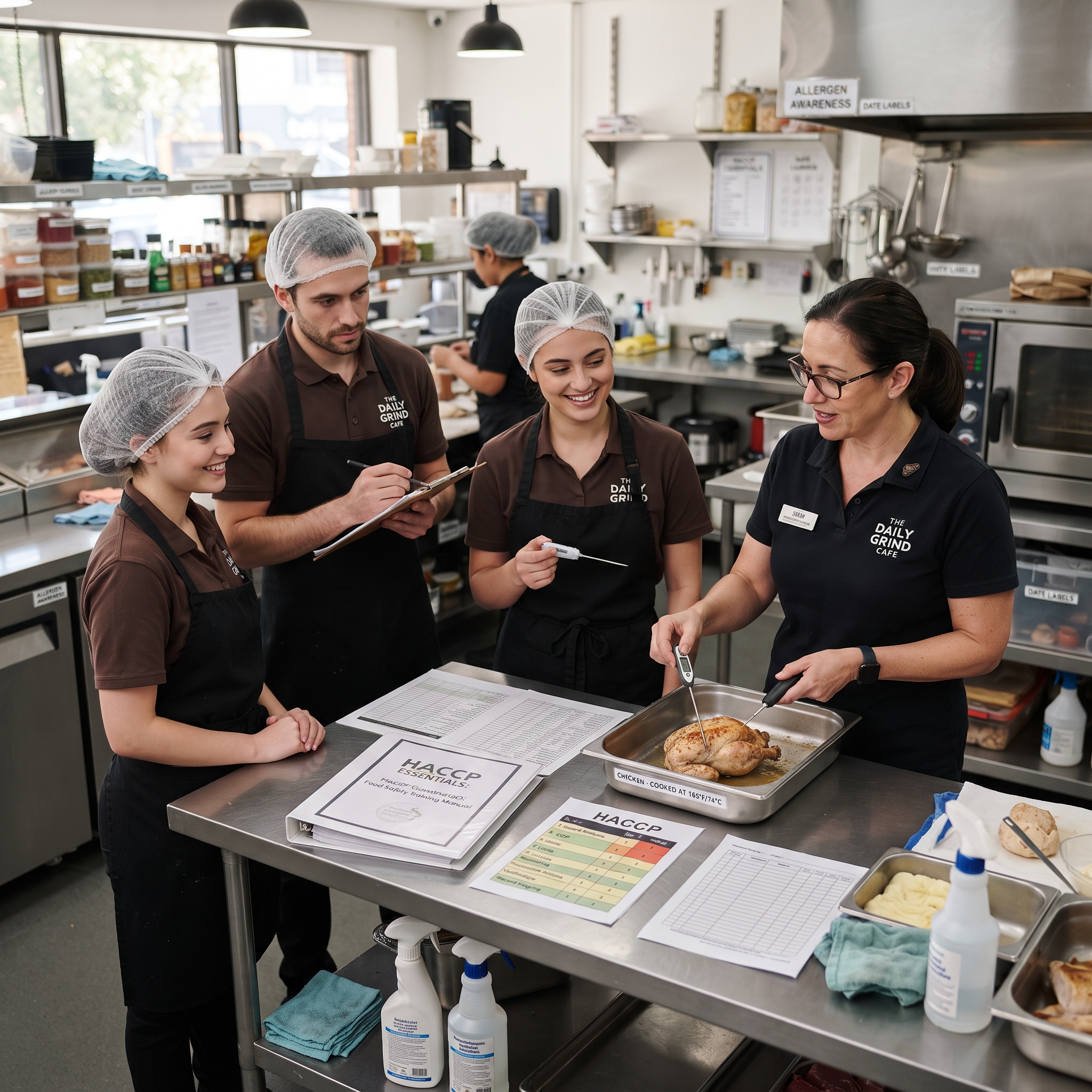
HACCP training for cafés and takeaways is an important part of helping food workers understand how to identify and control food safety hazards. Cafés and takeaway businesses may operate in smaller kitchens than restaurants, but they can still handle a wide range of ingredients, prepare ready-to-eat foods and serve large numbers of customers.
From receiving ingredients and storing chilled food to preparing sandwiches, cooking hot food and managing allergens, staff need to follow appropriate food safety procedures throughout the working day.
For businesses in Ireland, HACCP training Ireland can help food handlers, supervisors and managers understand the principles behind their workplace food safety procedures.
This article explains the essential food safety practices that cafés and takeaways should understand and how HACCP can help businesses manage food safety risks.
What Is HACCP?
HACCP stands for Hazard Analysis and Critical Control Points.
It is a systematic approach to identifying, evaluating and controlling food safety hazards.
Instead of waiting for a food safety problem to occur, HACCP encourages businesses to identify where problems could arise and establish controls to prevent, eliminate or reduce significant hazards.
The seven HACCP principles are:
- Conduct a hazard analysis.
- Determine Critical Control Points.
- Establish critical limits.
- Establish monitoring procedures.
- Establish corrective actions.
- Establish verification procedures.
- Establish documentation and record keeping.
The Food Safety Authority of Ireland (FSAI) describes HACCP as a systematic approach to identifying and controlling food safety hazards.
Why Do Cafés and Takeaways Need HACCP Training?
Cafés and takeaways may handle many different types of food during a single shift.
For example, staff might work with:
- Raw meat
- Cooked meat
- Dairy products
- Eggs
- Fresh vegetables
- Bread and bakery products
- Ready-to-eat foods
- Sauces
- Desserts
- Allergen-containing ingredients
Each stage of handling food creates potential food safety considerations.
Staff need to understand how contamination can occur and what controls are used by the business.
HACCP training helps employees understand not just what they should do, but why those procedures are important.
Food Safety Hazards in Cafés and Takeaways
HACCP training should introduce staff to the main categories of food safety hazards.
Biological Hazards
These include:
- Bacteria
- Viruses
- Parasites
- Fungi
Biological hazards can be associated with contaminated ingredients, inadequate cooking, poor hygiene and inappropriate storage.
Chemical Hazards
Chemical hazards can include:
- Cleaning products
- Sanitising chemicals
- Chemicals used incorrectly
- Other substances capable of contaminating food
Cleaning products should be managed according to the business's procedures so they do not contaminate food.
Physical Hazards
Physical hazards involve foreign objects entering food.
Examples include:
- Glass
- Metal
- Plastic
- Packaging
- Broken equipment components
Good maintenance, handling and inspection procedures can help reduce these risks.
Allergen Hazards
Cafés and takeaways frequently handle ingredients containing allergens.
Allergen risks can arise through:
- Ingredients
- Shared utensils
- Preparation surfaces
- Storage
- Incorrect information
- Cross-contact
Employees need to understand their workplace's allergen procedures and should never guess when answering customer questions about allergens.
Personal Hygiene for Café and Takeaway Staff
Personal hygiene is a fundamental part of food safety.
Staff should follow appropriate procedures relating to:
- Hand washing
- Clean clothing
- Hair control where required
- Personal cleanliness
- Covering cuts or wounds
- Reporting relevant illness or symptoms according to workplace procedures
Employees should understand when hand washing is required and how it should be carried out.
Good personal hygiene helps reduce the risk of transferring contamination to food.
Hand Washing
Hands can easily transfer contamination between food, equipment and surfaces.
Café and takeaway staff should understand when they need to wash their hands.
Examples include:
- Before handling food
- After handling raw food
- After using the toilet
- After handling waste
- After touching potentially contaminated surfaces
- When changing tasks
Hand washing procedures should be followed consistently.
Businesses should provide appropriate facilities and ensure employees understand the workplace requirements.
Preventing Cross-Contamination
Cross-contamination occurs when a hazard is transferred from one food, surface, piece of equipment or person to another.
This can be particularly important in cafés and takeaways where different foods may be prepared in close proximity.
For example, raw chicken could potentially contaminate ready-to-eat salad through:
- Hands
- Knives
- Cutting boards
- Worktops
- Containers
Controls can include:
- Separating raw and ready-to-eat foods
- Appropriate cleaning
- Hand hygiene
- Suitable storage
- Using equipment appropriately
Staff should understand the specific procedures used by their workplace.
Food Storage
Appropriate food storage is another important part of food safety.
Cafés and takeaways may have:
- Refrigerators
- Freezers
- Dry storage
- Display refrigerators
- Hot holding equipment
Employees should understand the business's procedures for:
- Temperature control
- Food separation
- Stock rotation
- Labelling
- Storage containers
- Allergen management
Raw foods should be stored appropriately to reduce the possibility of contamination.
Temperature Control
Temperature control can be an important part of a café or takeaway's HACCP system.
Depending on the food process, staff may need to monitor:
- Refrigeration
- Frozen storage
- Cooking
- Cooling
- Hot holding
The HACCP system should establish the relevant monitoring requirements.
Employees responsible for checks need to understand:
- What needs to be measured
- How it should be measured
- When it should be checked
- What result is acceptable
- What to do if the result is outside the required limit
Cooking as a Critical Control Point
Cooking may be identified as a Critical Control Point (CCP) for certain foods and processes.
A CCP is a step where control is essential to prevent, eliminate or reduce a significant food safety hazard to an acceptable level.
For example, a café or takeaway preparing certain meat products may identify cooking as an important control for biological hazards.
If cooking is designated as a CCP, the HACCP system should establish appropriate:
- Critical limits
- Monitoring procedures
- Corrective actions
- Verification procedures
Staff should follow the established process rather than relying on assumptions.
Cooling Food
Some cafés and takeaways prepare food in advance and cool it before storage or later service.
Cooling can present food safety risks if it is not properly controlled.
Where controlled cooling forms part of the HACCP system, staff should understand:
- Which foods require controlled cooling
- What procedure should be followed
- What needs to be monitored
- What records need to be completed
- What action is required if the procedure is not achieved
The specific requirements depend on the business's HACCP system.
Managing Ready-to-Eat Food
Ready-to-eat foods require particular attention because they may not receive another cooking step before being consumed.
Examples can include:
- Sandwiches
- Salads
- Prepared desserts
- Cooked foods served without further cooking
Staff should understand procedures designed to prevent contamination during preparation, storage and service.
Good hand hygiene, appropriate equipment cleaning and separation from raw foods can all be important controls.
Allergen Management
Allergen awareness is particularly important in cafés and takeaways.
Customers may ask whether a food contains a particular allergen.
Employees should know:
- Where allergen information is stored
- Which ingredients contain allergens
- How allergen information is communicated
- How cross-contact is controlled
- Who to ask if they are unsure
Staff should never guess about allergen information.
If they do not know the answer, they should follow the business's established procedure.
Cleaning and Sanitation
Cleaning is another important food safety practice.
Café and takeaway staff may be responsible for cleaning:
- Worktops
- Cutting boards
- Utensils
- Food preparation equipment
- Display areas
- Refrigerators
- Food-contact surfaces
The business should have appropriate procedures explaining:
- What needs to be cleaned
- When it should be cleaned
- Which products should be used
- How cleaning should be performed
- How cleaning is checked
Cleaning supports the HACCP system but is not automatically a Critical Control Point.
Receiving Food Deliveries
Receiving procedures can help businesses identify problems before ingredients enter the food preparation process.
Staff responsible for deliveries may need to check:
- Product condition
- Packaging
- Delivery information
- Temperature where relevant
- Dates
- Supplier details
If a delivery does not meet the business's requirements, employees should follow the established procedure.
This may include reporting the issue or rejecting unsuitable products where appropriate.
HACCP Monitoring Procedures
Monitoring allows a business to determine whether important food safety controls are operating correctly.
Monitoring may involve:
- Checking temperatures
- Observing procedures
- Checking equipment
- Recording CCP results
- Verifying storage conditions
A monitoring procedure should specify:
- What is checked
- How it is checked
- When it is checked
- Who performs the check
- What result is acceptable
- What happens if the result is unacceptable
What Happens When Something Goes Wrong?
Staff should know what to do when a food safety control fails.
For example, if a monitoring check identifies that a critical limit has not been achieved, the employee should follow the established corrective action procedure.
This may involve:
- Identifying the problem.
- Informing the responsible person.
- Restoring control.
- Assessing affected food.
- Taking the required action.
- Recording the incident.
- Investigating the cause where necessary.
The exact response depends on the business's HACCP procedures.
HACCP Records for Cafés and Takeaways
Food businesses may need to maintain records relating to:
- Temperature monitoring
- CCP checks
- Corrective actions
- Cleaning
- Deliveries
- Equipment checks
- Verification
- Staff training
Records should accurately reflect what actually happened.
Employees should not complete a record based on an assumed result or copy an earlier reading.
Accurate documentation can help management identify recurring food safety problems.
HACCP Training in Ireland
HACCP training Ireland can help café and takeaway employees understand their food safety responsibilities.
Depending on the course, training may cover:
- Food safety hazards
- Hazard analysis
- Critical Control Points
- Critical limits
- Monitoring
- Corrective actions
- Verification
- HACCP records
The FSAI states that people responsible for developing and maintaining HACCP-based procedures need adequate training in applying HACCP principles.
Training requirements may therefore differ depending on an employee's responsibilities.
HACCP Level 1 and Level 2
Cafés and takeaways may encounter courses described as HACCP Level 1 and HACCP Level 2.
Course content can vary between providers, so it is important to check the syllabus.
Introductory training may cover fundamental HACCP and food safety concepts.
More detailed HACCP Level 2 training may be appropriate for people with additional responsibilities.
If your employer requires a particular HACCP Level 2 certificate, check the course details before enrolling.
HACCP Certificate for Café and Takeaway Staff
If you are looking for a HACCP certificate Ireland, consider whether the course is appropriate for your role.
Courses may be described as:
- HACCP training Ireland
- HACCP course Ireland
- HACCP certificate Ireland
- HACCP certification Ireland
- HACCP certification course
- HACCP training certificate
- HACCP Level 2 certificate
- HACCP food safety training
A certificate demonstrates completion of a particular course, but workplace-specific food safety procedures still need to be followed.
Online HACCP Training
Online HACCP training can be a convenient option for café and takeaway employees.
An online HACCP course Ireland programme may cover:
- Food safety hazards
- HACCP principles
- Critical Control Points
- Monitoring
- Corrective actions
- Documentation
- Verification
Online learning can make training easier to complete around working hours.
However, employees should still receive instruction on the specific HACCP procedures used by their employer.
Common Food Safety Mistakes in Cafés and Takeaways
Several mistakes can create unnecessary food safety risks.
Poor Hand Hygiene
Employees may transfer contamination through their hands.
Cross-Contamination
Raw and ready-to-eat foods may be handled incorrectly.
Incorrect Storage
Food may not be stored according to the business's established procedures.
Incomplete Monitoring
Required checks may be missed or recorded incorrectly.
Guessing About Allergens
Staff should never provide uncertain allergen information.
Ignoring Failed Checks
An unacceptable monitoring result should trigger the appropriate corrective action.
Outdated Procedures
The HACCP system should be reviewed when significant changes occur.
Final Thoughts
HACCP training for cafés and takeaways helps employees understand the practical food safety controls that support safe food handling.
Important areas include:
- Personal hygiene
- Hand washing
- Cross-contamination prevention
- Food storage
- Temperature control
- Cooking
- Cooling
- Allergen management
- Cleaning
- Delivery checks
- Monitoring
- Corrective actions
- Record keeping
Every café and takeaway is different, so its HACCP system should reflect its actual products, processes, equipment and food safety hazards.
For businesses in Ireland, appropriate HACCP training Ireland can help staff understand their responsibilities and follow the procedures established by the business.
If you are looking for a HACCP course Ireland, HACCP certificate Ireland, HACCP certification course, HACCP Level 2 training or online HACCP training, check the course content and intended audience before enrolling.
Ultimately, HACCP is not just about completing a certificate or keeping paperwork. It is about applying food safety principles consistently during everyday operations. When café and takeaway staff understand the hazards they work with, follow appropriate hygiene procedures, monitor important controls and respond correctly when something goes wrong, they help create a safer food environment for customers and employees.