



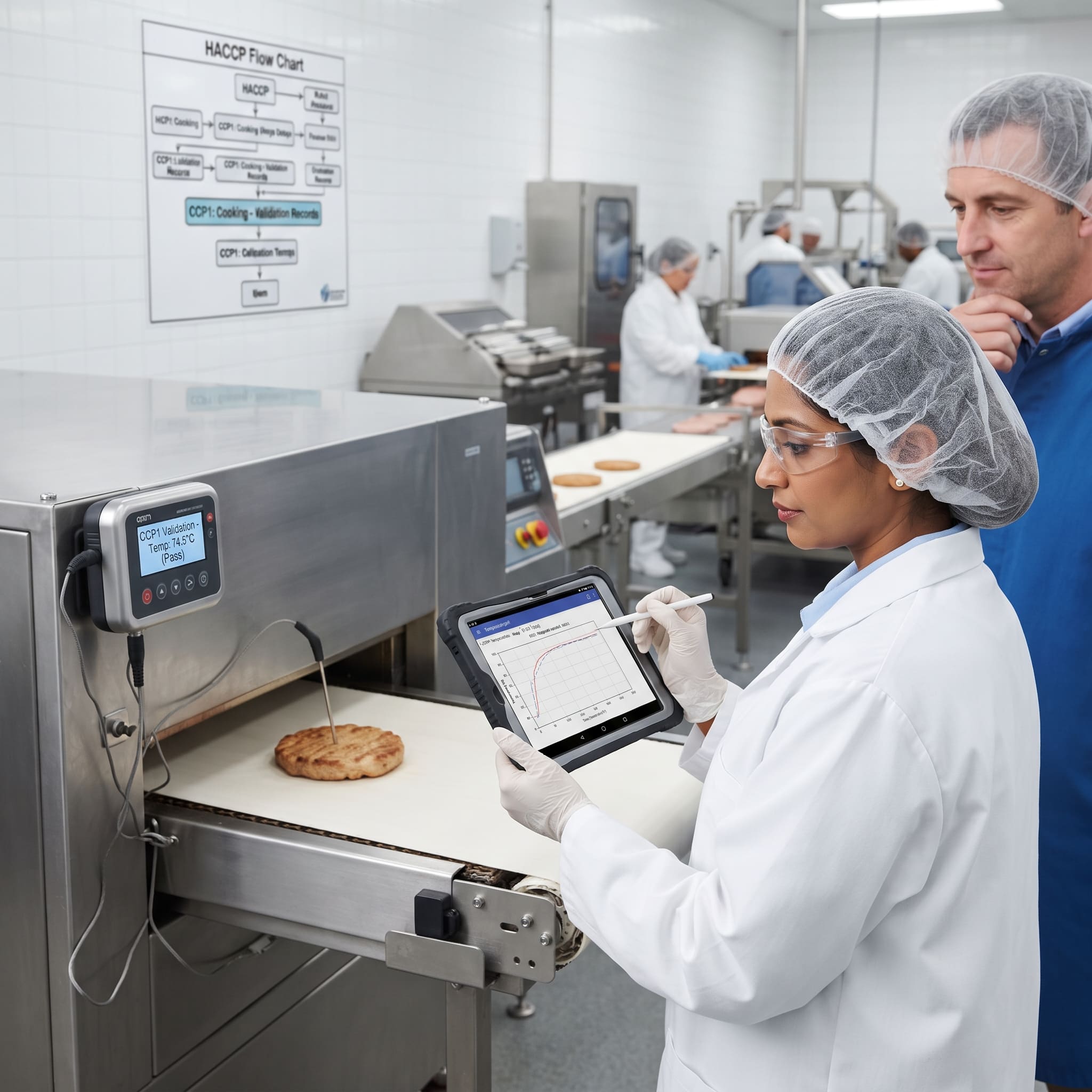
HACCP validation is an important part of developing an effective food safety management system. A food business may have procedures for cooking, refrigeration, cleaning, allergen control or other food safety measures, but how does the business know that those controls are actually capable of controlling the hazards they are designed to manage?
This is where validation becomes important.
Validation involves obtaining evidence that a particular control measure is capable of effectively controlling a food safety hazard. It is different from monitoring and verification. Monitoring checks whether a control is being applied, while verification checks whether the HACCP system is operating as intended. Validation asks an earlier and fundamental question: Will this control actually work?
For food businesses in Ireland, understanding validation is particularly relevant to anyone involved in developing or maintaining HACCP procedures. Appropriate HACCP training Ireland can help food safety personnel understand how validation fits into the wider HACCP system.
What Is HACCP Validation?
HACCP validation is the process of obtaining evidence that a control measure, or combination of control measures, is capable of effectively controlling a significant food safety hazard.
For example, a food business may identify a biological hazard associated with a particular cooking process.
The business cannot simply assume that its cooking procedure is sufficient.
It needs an appropriate scientific or technical basis for believing that the process can achieve the required food safety outcome.
Validation may involve:
- Scientific information
- Regulatory guidance
- Technical standards
- Published research
- Expert advice
- Historical evidence
- Appropriate testing
- Process-specific evidence
The appropriate approach depends on the hazard and the control being assessed.
Why Is Validation Important?
A HACCP system is based on controlling hazards.
If a control measure is ineffective, the entire food safety system can be weakened even if employees follow the procedure perfectly.
For example, imagine a business establishes a cooking procedure intended to control a biological hazard.
Employees follow the procedure exactly.
However, if the procedure has never been demonstrated to achieve the required level of control, there is a fundamental problem.
The issue is not employee compliance.
The issue is whether the control itself is effective.
This is why HACCP validation is an important concept.
Validation, Verification and Monitoring
These three terms are often confused.
Monitoring
Monitoring involves checking a control at the required point.
For example:
An employee measures a cooking process and records the result.
Verification
Verification involves checking that the HACCP system is being implemented and working as intended.
For example:
A manager reviews cooking records and observes employees carrying out the procedure.
Validation
Validation provides evidence that the control measure is capable of controlling the hazard.
For example:
Scientific or technical evidence demonstrates that the cooking process can achieve the required food safety outcome when correctly applied.
A simple way to remember the difference is:
Validation = Will the control work?
Monitoring = Is the control being applied?
Verification = Is the HACCP system working as intended?
When Does HACCP Validation Take Place?
Validation is particularly important when a HACCP system is being developed or when significant changes are made.
For example, validation may be considered when:
- Developing a new HACCP system
- Introducing a new product
- Introducing a new cooking process
- Changing equipment
- Changing ingredients
- Changing processing conditions
- Introducing a new control measure
- Evidence indicates that an existing control may not be effective
A business should not wait until a food safety failure occurs before considering whether its controls are effective.
Validating Cooking Controls
Cooking is one example where validation can be particularly important.
A food business may use cooking to control a biological hazard.
The business needs to establish an appropriate process based on reliable evidence.
Factors that may need consideration include:
- Type of food
- Product size
- Cooking method
- Starting temperature
- Equipment
- Cooking time
- Temperature
- Product characteristics
The objective is to establish that the selected process can achieve the intended food safety outcome.
The business should use appropriate evidence rather than simply choosing a temperature or time because it appears reasonable.
Validating Temperature Controls
Temperature control can be relevant at several stages of food handling.
For example:
- Refrigerated storage
- Cooking
- Cooling
- Hot holding
- Transportation
Validation may be needed where a temperature control is being relied upon to manage a significant food safety hazard.
A business needs an appropriate basis for its chosen limits and procedures.
This is one reason why HACCP training should cover more than simply recording temperatures.
Food safety personnel need to understand why a particular control exists and what evidence supports it.
Validating Cooling Processes
Cooling can create food safety risks if it is not properly controlled.
A business that prepares food in advance may need a defined process for cooling certain foods before refrigerated storage.
The business should consider whether its cooling procedure is capable of controlling relevant hazards.
Validation may consider factors such as:
- Food type
- Quantity
- Container size
- Cooling equipment
- Starting temperature
- Cooling method
- Environmental conditions
The procedure should be based on appropriate evidence and should reflect what actually happens in the business.
Validating Allergen Controls
Validation is not limited to temperature.
Allergen controls can also require careful consideration.
For example, a food business may establish a cleaning procedure intended to reduce allergen residues between different production activities.
The business needs an appropriate basis for determining whether that procedure is suitable for its intended purpose.
Potential evidence may include:
- Supplier information
- Cleaning specifications
- Technical information
- Appropriate testing
- Expert advice
The exact approach depends on the food process and allergen risk.
Validating Cleaning Controls
Cleaning is another area where businesses need to understand the difference between having a procedure and demonstrating that the procedure is effective.
A cleaning schedule might state:
Clean equipment after use.
However, a HACCP system may require much more detail.
The business may need to establish:
- What is cleaned
- How it is cleaned
- Which cleaning method is used
- How frequently it is cleaned
- What level of cleanliness is required
- How effectiveness is assessed
Validation can help establish that the selected cleaning process is suitable for its intended purpose.
Scientific and Technical Evidence
Validation should be based on reliable evidence.
Depending on the control measure, this may include:
- Scientific publications
- Food safety guidance
- Industry standards
- Technical literature
- Regulatory guidance
- Equipment specifications
- Supplier information
- Expert advice
- Appropriate laboratory testing
The type of evidence required depends on the specific hazard and control.
A small food business does not necessarily need to conduct complex scientific research itself. Existing reliable evidence may already provide an appropriate basis for a control.
HACCP Validation for Small Food Businesses
Small businesses sometimes assume that HACCP validation is only relevant to large food manufacturers.
That is not necessarily the case.
Restaurants, cafés, takeaways and catering businesses may also rely on important food safety controls.
For example, a restaurant may rely on:
- Cooking
- Refrigeration
- Cooling
- Allergen controls
- Cleaning
The business should understand the basis for the controls included in its HACCP system.
The approach can be proportionate to the size and complexity of the operation.
What Happens If Validation Shows a Control Is Not Effective?
If evidence indicates that a control measure cannot adequately control the hazard, the HACCP team needs to reconsider the process.
Possible actions could include:
- Changing the control measure
- Adjusting the process
- Establishing a different critical limit
- Introducing an additional control
- Changing equipment
- Changing ingredients
- Obtaining additional evidence
- Reviewing the hazard analysis
The important point is that the business should not continue relying on a control that it knows is ineffective.
Validation and Critical Control Points
Validation is closely connected with Critical Control Points (CCPs).
When a HACCP team identifies a CCP, it needs confidence that the control applied at that point can manage the significant hazard.
For example, if cooking is identified as a CCP, the business needs an appropriate basis for its cooking control.
The HACCP system should then establish:
- The hazard
- The control measure
- The critical limit
- Monitoring procedures
- Corrective actions
- Verification procedures
Validation provides the evidence supporting the effectiveness of the control measure.
Reviewing Existing Validation
Validation should not necessarily be considered a one-time activity.
A business should consider whether previous validation remains applicable when circumstances change.
For example, a business may change:
- Equipment
- Recipes
- Ingredients
- Product size
- Cooking method
- Processing time
- Storage arrangements
A change could affect whether an existing control remains effective.
The HACCP system should therefore be reviewed when significant changes occur.
Validation Records
Businesses should maintain appropriate evidence supporting their HACCP controls.
Depending on the business, this may include:
- Scientific references
- Technical guidance
- Supplier documentation
- Equipment specifications
- Testing results
- Expert assessments
- Validation reports
- Review records
Documentation helps demonstrate why a particular control has been selected.
It can also make future HACCP reviews easier.
HACCP Training Ireland and Validation
HACCP training Ireland can help food safety personnel understand the different components of a HACCP system, including validation.
Training may cover:
- Hazard analysis
- Control measures
- Critical Control Points
- Critical limits
- Monitoring
- Corrective actions
- Verification
- Validation
- Documentation
The Food Safety Authority of Ireland states that people responsible for developing and maintaining HACCP-based procedures need adequate training in applying HACCP principles.
This means that people with responsibility for HACCP systems need an appropriate understanding of how HACCP principles are applied in practice.
HACCP Level 1 and Level 2 Training
Food businesses may encounter courses described as HACCP Level 1 and HACCP Level 2.
The content can vary between training providers.
An introductory HACCP Level 1 course may focus on:
- Basic food safety
- Food hazards
- Hygiene
- HACCP principles
- Food handling responsibilities
A more detailed HACCP Level 2 training course may cover:
- Hazard analysis
- CCPs
- Critical limits
- Monitoring
- Corrective actions
- Verification
- Validation
- Documentation
If your employer requires a HACCP Level 2 certificate, check the syllabus carefully to ensure the course covers the topics relevant to your role.
HACCP Certificate Ireland
People searching for a HACCP certificate Ireland may find several different types of food safety courses.
Training may be advertised as:
- HACCP course Ireland
- HACCP training Ireland
- HACCP certification Ireland
- HACCP certification course
- HACCP training certificate
- HACCP Level 2 certificate
- HACCP food safety training
When selecting a course, consider the level of responsibility involved.
Someone who works as a food handler may need a different level of HACCP knowledge from a person responsible for developing, maintaining or reviewing a HACCP system.
Online HACCP Training
Online HACCP training can provide a flexible way to learn about HACCP principles.
An online HACCP course Ireland programme may explain:
- Food safety hazards
- Hazard analysis
- CCPs
- Critical limits
- Monitoring
- Corrective actions
- Verification
- Validation
- Documentation
Online training can be convenient for employees and managers who need to study around work commitments.
However, general training should be combined with workplace-specific procedures so employees understand how HACCP controls operate in their own business.
Common HACCP Validation Mistakes
Food businesses should avoid several common mistakes when considering validation.
Assuming a Control Works
A procedure should have an appropriate evidence-based basis.
Confusing Validation With Monitoring
Recording a temperature does not by itself prove that the selected temperature is an effective control.
Confusing Validation With Verification
Checking records does not establish whether a control was originally capable of controlling the hazard.
Using Outdated Evidence
Changes in products or processes may mean that previous evidence needs to be reviewed.
Ignoring Process Changes
New equipment, recipes or production methods can affect the effectiveness of existing controls.
Failing to Document the Basis
Businesses should maintain appropriate evidence supporting important HACCP decisions.
Practical HACCP Validation Checklist
A food business can ask:
- What significant hazard is being controlled?
- What control measure has been selected?
- Why was this control selected?
- What evidence demonstrates that it can work?
- Is the evidence reliable and relevant?
- Is the critical limit appropriate?
- Is the control suitable for the actual process?
- Are employees monitoring the control correctly?
- Are verification procedures in place?
- Has anything changed that could affect the control?
- Is appropriate validation evidence documented?
These questions can help businesses assess the strength of their HACCP system.
Final Thoughts
HACCP validation is about demonstrating that food safety controls are capable of doing what they are intended to do.
A business should not simply assume that a cooking procedure, temperature limit, cleaning process or other control is effective. Appropriate evidence should support significant food safety decisions.
Validation works together with monitoring and verification:
- Validation asks whether the control can work.
- Monitoring checks whether the control is being applied.
- Verification checks whether the HACCP system is operating effectively.
For food businesses in Ireland, appropriate HACCP training Ireland can help employees and managers understand these distinctions and apply HACCP principles more effectively.
If you are looking for a HACCP course Ireland, HACCP certificate Ireland, HACCP certification course, HACCP Level 2 training, HACCP training certificate or online HACCP training, check that the course content matches the responsibilities associated with your role.
Ultimately, an effective HACCP system needs controls that are not only documented but also supported by appropriate evidence. By validating important food safety controls, reviewing them when processes change and combining them with effective monitoring and verification, food businesses can build a stronger and more reliable approach to managing food safety hazards.