



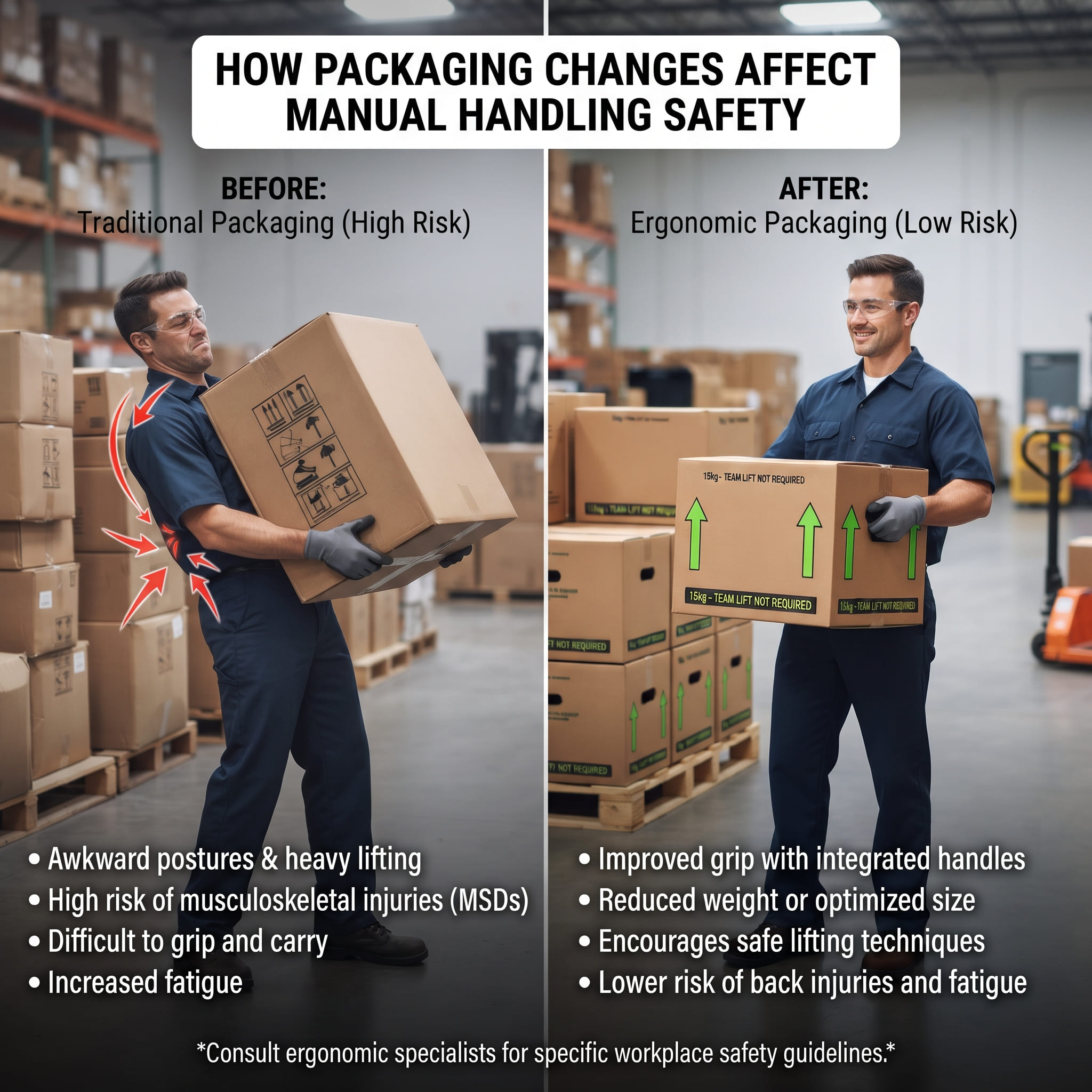
Product packaging plays an important role in protecting goods during storage, transportation, and delivery. However, packaging changes can also affect how employees lift, carry, push, pull, stack, and move products throughout the working day. A package that was previously easy to handle may become more difficult to control after a change in its size, shape, material, or contents.
These changes can occur for several reasons, including efforts to reduce packaging costs, improve product protection, meet sustainability targets, or accommodate new production methods. Although these changes may benefit a business in other ways, they can introduce new manual handling hazards if their effects on workers are not considered.
For example, a redesigned box may be taller and harder to grip, while a new container may hold more product and become significantly heavier. Even small changes can affect balance, visibility, and the amount of physical effort needed to move an item.
Understanding these risks is an important part of Manual Handling Training Ireland, helping employers and employees recognise when familiar handling tasks need to be reassessed.
1. Heavier Packaging Can Increase Physical Strain
One of the most important packaging changes is an increase in the weight of an individual product or package. This may happen when manufacturers increase the quantity of goods in a container, change the packaging material, or redesign products for bulk distribution.
Heavier loads generally require greater physical effort to lift and move. When employees repeatedly handle them throughout a shift, the cumulative demands can contribute to fatigue and musculoskeletal discomfort.
The risk may be greater when heavier packages must be lifted from floor level, placed on high shelves, or carried over long distances.
Employers should not assume that a package remains safe to handle simply because it has the same product name or external appearance as before.
Practical steps include:
-
Checking the weight of newly introduced or redesigned packages.
-
Comparing the new packaging with the previous version.
-
Assessing whether existing handling methods remain suitable.
-
Considering smaller package sizes where practical.
-
Using suitable handling equipment for heavier loads.
-
Reviewing the frequency and duration of lifting tasks.
Where a package becomes too heavy for an employee to handle safely, the task should be changed rather than relying on workers to exert more effort.
2. Larger Packages Can Restrict Movement
Packaging may become larger even when its weight stays the same. Manufacturers sometimes use additional protective materials, increase container dimensions, or redesign packaging to improve storage efficiency.
However, larger packages can be harder to hold close to the body. They may extend beyond an employee's natural reach, obstruct their view, or make it difficult to move through narrow aisles and doorways.
When a load must be held further away from the body, the physical demands on the back and shoulders can increase. Workers may also need to adopt awkward postures to position the package on shelves or inside vehicles.
Businesses should assess the dimensions of new packaging before introducing it into normal operations.
Consider whether employees can grip the package securely, maintain a stable posture, and move it through the available space. If the package blocks their view, an alternative handling method or suitable equipment may be necessary.
The size of a package matters just as much as its weight when evaluating manual handling risks.
3. Changes to Packaging Materials Can Affect Grip
A packaging redesign may change the surface texture or material of a container. For example, a cardboard box may be replaced with smooth plastic, a glossy coating, or flexible wrapping.
These materials can affect how securely an employee can hold a product. Smooth surfaces may be slippery, while thin packaging can tear or deform when gripped firmly. Flexible bags may also shift shape as their contents move.
Poor grip can cause a worker to compensate by gripping harder, changing hand positions, or holding the load awkwardly. If the package slips unexpectedly, the employee may make a sudden movement to prevent it from falling.
To reduce these risks, employers should assess the grip provided by new packaging and consider suitable alternatives where necessary.
Possible measures include:
-
Choosing packaging with practical handholds.
-
Avoiding unnecessary smooth or slippery external surfaces.
-
Using appropriate containers for loose or shifting contents.
-
Checking whether packaging remains secure during handling.
-
Providing suitable handling aids when a secure grip is difficult.
-
Training employees to recognise damaged or unsuitable packaging.
Gloves may be appropriate for particular workplace hazards, but they should not be treated as a universal solution to poor packaging design. The packaging and handling method should be assessed together.
4. Uneven Weight Distribution Can Make Loads Unstable
Some packaging changes affect how weight is distributed within a container. A redesigned box may have a different internal layout, or a larger package may contain several products that can move independently.
If the contents shift during lifting, the load's centre of gravity may change unexpectedly. Employees may find it more difficult to maintain control, especially when turning, carrying, or placing the package.
This problem can occur with boxes containing multiple items, liquid containers, bags of loose materials, and products that are not secured inside their packaging.
Before lifting, employees should check whether the package appears damaged, unusually flexible, or unstable. Where possible, they should establish whether the contents can move and whether the container is suitable for the intended handling task.
Employers can reduce the risk by using appropriate internal dividers, secure closures, suitable containers, and packaging designed to keep contents stable.
Loads that are leaking, damaged, or likely to shift dangerously should be assessed before they are moved. Workers should not attempt to handle an unstable package using an improvised technique simply to keep work moving.
5. Reduced Handholds Can Make Lifting More Difficult
Packaging manufacturers may remove handles, grip openings, or other features to reduce material use or simplify production. Although these changes may reduce packaging costs, they can make products harder for employees to lift.
Without suitable handholds, workers may need to grip the bottom edges of a box, hold a container against their body, or use their fingertips to support part of the load. These positions may reduce control and increase discomfort in the hands, wrists, arms, and shoulders.
The problem can be particularly noticeable when employees handle large quantities of the same product.
Businesses should consider whether new packaging allows workers to establish a secure grip before lifting. Where it does not, suitable alternatives may include different packaging designs, reusable containers, or mechanical handling equipment.
Employees should also be encouraged to report packaging that repeatedly causes difficulty. Their experience can help purchasing and operations teams identify problems that may not be obvious during product selection.
6. Packaging Changes Can Affect Repetitive Handling Tasks
Even when individual packages remain reasonably light, changes in their design can increase the demands of repetitive work.
For example, smaller packages may require employees to handle more individual units to move the same quantity of stock. Larger packages may reduce the number of lifts but increase the effort required for each movement.
Both situations can create risks, depending on the task and working environment.
Repeated lifting, carrying, reaching, and placing can contribute to fatigue, particularly when workers have limited recovery time or perform the same movements throughout a shift.
When packaging changes, employers should review not only the weight of individual items but also how many times workers must handle them.
Useful controls include improving the layout of workstations, positioning frequently handled products within convenient reach, using suitable conveyors or trolleys, and organising tasks to reduce unnecessary movements.
Where appropriate, work schedules and task allocation should also be reviewed to manage excessive physical demands.
7. Different Packaging Dimensions Can Create Stacking Hazards
Changes in package dimensions can affect how products are stored and transported. If new boxes do not fit securely with existing stock, stacks may become uneven or unstable.
Packages that overhang shelves or pallets can be more difficult to retrieve safely. Workers may need to reposition other items before accessing the product they require, creating additional lifting and carrying tasks.
Unstable stacks can also collapse or cause items to fall when a package is removed from the bottom or middle of a pile.
To reduce these hazards, businesses should review storage and stacking arrangements whenever packaging dimensions change.
Employees should follow appropriate stacking procedures, respect shelf and pallet load limits, and avoid creating piles that may shift or fall. Heavier items should generally be placed lower where suitable, provided the arrangement does not create difficult floor-level lifting tasks.
Storage systems should be suitable for the actual dimensions, weights, and shapes of the products being handled.
8. Changes to Sustainable Packaging Require Safety Assessment
Many businesses are moving towards recyclable, reusable, or reduced-material packaging. These changes can support environmental objectives, but the new materials may behave differently during handling.
For instance, thinner cardboard may be more likely to bend under load, while reusable containers may be heavier than the disposable packaging they replace. Flexible packaging may also be more difficult to grip or stack consistently.
The important point is not that sustainable packaging is inherently unsafe. Rather, each new design should be assessed according to how it performs in the workplace.
Employers should consider whether the packaging remains strong enough for its contents, whether it provides adequate grip, and whether it can be lifted, stacked, and transported safely.
Where a reusable container is heavier, the overall handling method may need to change. A trolley or other suitable handling aid may help reduce the physical effort required to move it.
Safety and sustainability objectives should be considered together when selecting new packaging.
9. Review Manual Handling Procedures Before Introducing New Packaging
A packaging change should trigger a review of the relevant handling procedures, particularly if it affects weight, size, grip, stability, or the frequency of lifting.
Employers should involve the people who receive, store, pick, pack, and deliver the products. These workers can often identify practical problems before they lead to injuries or operational delays.
A suitable review may include:
-
Comparing the new packaging with the previous design.
-
Checking weight, dimensions, grip, and load stability.
-
Observing how the product is handled during normal work.
-
Identifying any new lifting, reaching, twisting, or carrying demands.
-
Reviewing the available storage space and handling equipment.
-
Updating risk assessments and safe working procedures where necessary.
-
Informing and training employees about relevant changes.
Testing should take place under controlled conditions using an appropriate assessment method. Workers should not be asked to demonstrate whether a load is manageable by attempting a lift that could put them at risk.
10. Provide Relevant Manual Handling Training
Employees need to understand that familiar products can present different hazards when their packaging changes. A package that was previously straightforward to handle may require a new approach after a redesign.
A Manual Handling Course Ireland can help workers develop awareness of load assessment, safe handling principles, awkward postures, and the importance of planning movements before lifting.
Training should explain why workers need to assess each task rather than relying exclusively on previous experience. Employees should know when to stop, report a problem, use suitable equipment, or seek assistance.
A Manual Handling Certificate Ireland may provide evidence that an employee has completed a training course. However, a certificate alone does not make an unsuitable load safe to handle. Employers must also provide appropriate risk controls, equipment, and working arrangements.
Ongoing communication is particularly important when new products or packaging formats are introduced. Briefings, updated procedures, and feedback from employees can help ensure that changes are understood and managed effectively.
Conclusion
Changes in product packaging can affect manual handling safety in several ways. Increased weight, larger dimensions, slippery materials, reduced handholds, unstable contents, and altered stacking arrangements can all make everyday tasks more demanding.
Businesses should assess packaging changes before introducing them into routine operations. Reviewing load characteristics, observing handling tasks, improving storage arrangements, providing suitable equipment, and consulting employees can help identify risks early.
Effective Manual Handling Training Ireland supports these measures by helping workers recognise hazards and understand when a different handling method is needed. By treating packaging design as part of workplace risk assessment, employers can protect employees while maintaining efficient storage, distribution, and delivery operations.