



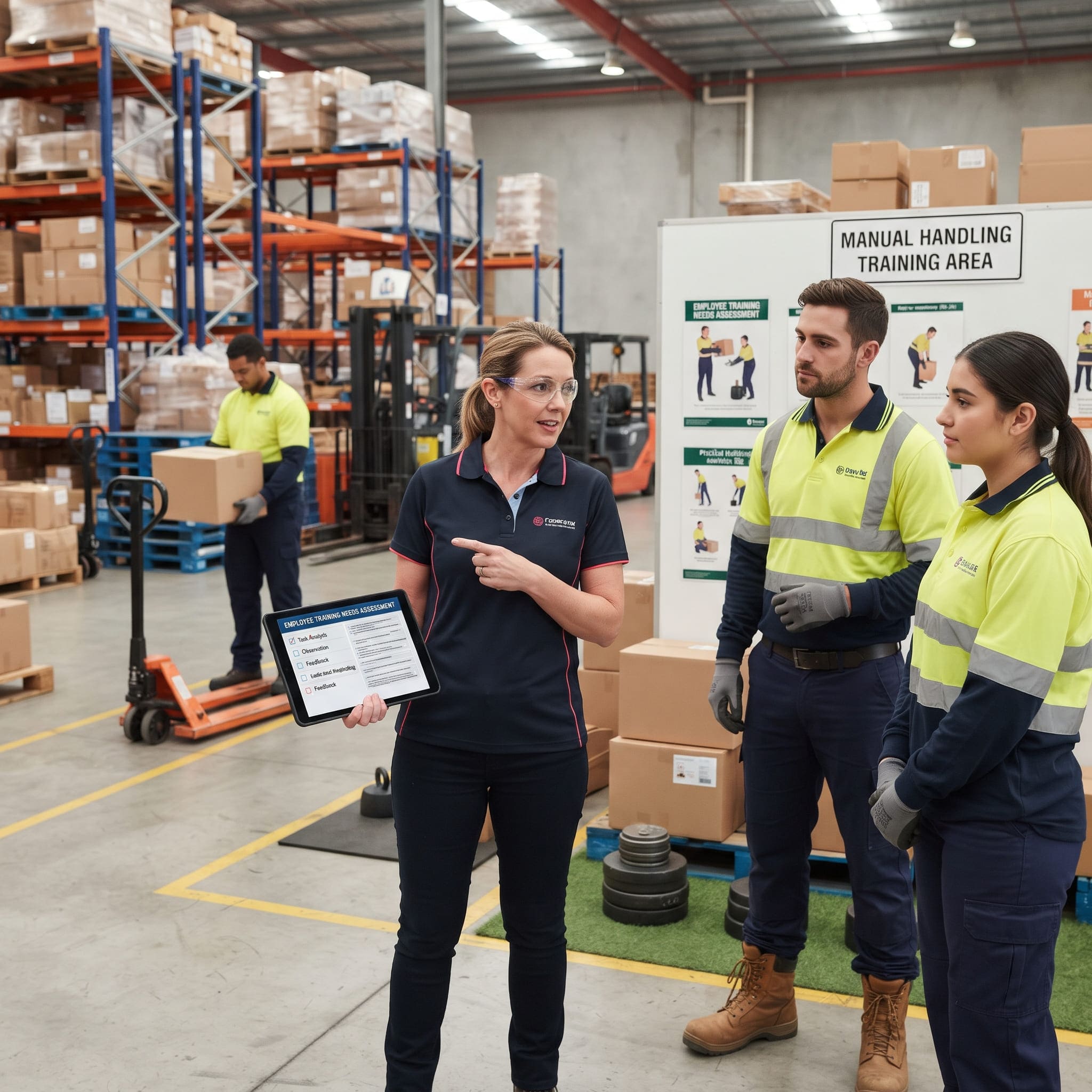
Manual handling is a routine activity in many Irish workplaces, including warehouses, retail stores, construction sites, healthcare facilities, offices, hotels and manufacturing environments. Employees may regularly lift, carry, push, pull, lower or move objects as part of their daily responsibilities. Without appropriate risk controls and knowledge, these activities can contribute to back pain, muscle strains and other musculoskeletal injuries.
Employers play an important role in identifying manual handling risks and determining what training employees need. However, providing the same training to every worker without considering their duties may not address the hazards present in a particular workplace.
Evaluating training needs allows employers to identify knowledge gaps, recognise high-risk activities and select suitable training based on actual working conditions. Effective Manual Handling Training Ireland should complement workplace risk assessments, appropriate equipment and safe working procedures rather than being treated as a standalone solution.
1. Identify the Manual Handling Tasks Employees Perform
The first step in evaluating training needs is to understand which manual handling activities take place throughout the organisation. Different jobs involve different physical demands, so employers should examine the tasks employees perform during a normal working day.
For example, warehouse employees may lift boxes from pallets, while healthcare workers may assist with patient movement. Retail staff may replenish shelves, and office employees may move furniture, files or equipment.
Employers should identify activities such as:
-
Lifting and lowering objects.
-
Carrying materials between work areas.
-
Pushing and pulling trolleys or equipment.
-
Repetitive handling of products or components.
-
Moving bulky or awkwardly shaped loads.
-
Handling objects at floor level or above shoulder height.
-
Loading and unloading delivery vehicles.
Observing these activities helps employers determine which skills and safety procedures employees need to understand.
It is also important to consider occasional tasks. An employee who rarely moves heavy equipment may still require appropriate instruction and controls before carrying out that activity.
2. Conduct a Manual Handling Risk Assessment
A manual handling risk assessment helps employers identify hazards associated with particular tasks and determine how those hazards should be controlled.
Under Irish workplace safety requirements, employers should seek to avoid manual handling where reasonably practicable and assess unavoidable handling activities that may present a risk of injury. Appropriate controls should be implemented to reduce those risks.
When assessing a task, employers should consider four main areas:
The task: Does it involve repetitive lifting, excessive reaching, twisting, bending or prolonged carrying?
The individual: Does the worker have the necessary capability, instruction and experience to perform the task safely?
The load: Is the object heavy, unstable, difficult to grip, bulky or unevenly balanced?
The working environment: Are floors slippery, walkways restricted or storage areas poorly arranged?
The findings can help employers decide whether employees need additional instruction in load assessment, safer movement techniques, equipment use or workplace procedures.
Training should not be used as a substitute for practical improvements. If a task can be made safer by introducing a trolley, redesigning storage arrangements or reducing the weight of individual loads, employers should consider these measures as part of their risk-control strategy.
3. Review Employees' Existing Knowledge and Skills
Employees may have different levels of manual handling knowledge depending on their previous training, work experience and current responsibilities.
Employers should review whether workers understand how to recognise hazards, assess loads and follow the handling procedures relevant to their jobs.
Useful evaluation methods include:
-
Asking employees about the manual handling risks they encounter.
-
Observing workers carrying out routine tasks.
-
Reviewing their understanding of workplace safety procedures.
-
Checking relevant training records.
-
Asking supervisors to identify recurring difficulties.
-
Using practical demonstrations to assess competence where appropriate.
For example, an employee may understand general lifting principles but struggle to move a large box through a narrow storage area without twisting. This may indicate a need for task-specific instruction or changes to the working environment.
Evaluating practical performance is particularly useful because completing a course does not automatically demonstrate that an employee can apply the information safely in every situation.
4. Consider Employees' Roles and Responsibilities
Training needs should reflect the work each employee performs. A single approach may not be suitable for all departments, particularly in organisations where employees handle different materials or use different equipment.
Warehouse employees may require instruction on moving stock, handling pallets and using appropriate transport aids. Healthcare employees may need training relevant to their patient-handling duties, including specialist procedures where applicable. Hospitality employees may need guidance on moving food supplies, beverage containers, laundry and cleaning equipment.
Supervisors may also need additional instruction on identifying hazards, monitoring working practices and reporting unsafe conditions.
Employers should consider whether employees need general manual handling awareness, task-specific instruction or specialist training for particular activities. Training arrangements should be proportionate to the risks and aligned with the employee's actual duties.
A suitable Manual Handling Course Ireland can provide a foundation in handling principles, but workplace-specific instruction may still be necessary.
5. Examine Workplace Injuries and Near Misses
Incident records can provide valuable information about where manual handling training may be needed.
Employers should review relevant injury reports, near misses, complaints of discomfort and recurring problems involving lifting or moving loads. These records can help identify patterns that might otherwise go unnoticed.
For example, repeated reports of employees experiencing back discomfort while replenishing low shelves may indicate that the storage layout or working method needs to be reviewed.
Similarly, several incidents involving dropped boxes could suggest problems with packaging, load stability, grip or handling procedures.
When reviewing incidents, employers should consider whether the main issue relates to employee knowledge, unsuitable equipment, poor task design, excessive workloads or a combination of factors.
The aim should be to identify underlying causes and implement effective controls, not simply to assign blame or arrange another training session without addressing the problem.
6. Ask Employees and Supervisors for Feedback
Employees often have direct knowledge of the difficulties associated with their daily tasks. Consulting them can help employers identify training needs that may not be obvious during a brief workplace inspection.
Employers can gather feedback through team meetings, short questionnaires, one-to-one discussions and safety consultations.
Questions might include:
-
Which manual handling tasks are most difficult to complete safely?
-
Are any loads awkward, unstable or difficult to grip?
-
Is suitable handling equipment available when needed?
-
Have employees received clear instructions for unusual tasks?
-
Are there situations in which workers feel pressured to rush?
-
Would additional practical instruction help address specific concerns?
Supervisors can contribute by explaining where employees need additional guidance and whether established procedures are being followed.
Employee feedback should be considered alongside risk assessments, incident records and direct observation. This combined approach provides a more complete picture of the organisation's manual handling training needs.
7. Evaluate Changes in Equipment, Processes and Workloads
Training needs can change when workplace conditions change. Employers should therefore review training requirements when introducing new equipment, modifying storage systems, changing production methods or assigning employees different responsibilities.
For example, a business may introduce larger product containers that require different handling methods. A warehouse may reorganise its shelving, resulting in more frequent lifting above shoulder height. Seasonal increases in deliveries may also lead to more repetitive handling and time pressure.
In these situations, employers should reassess the relevant hazards and determine whether workers need updated information, additional instruction or revised procedures.
New employees should receive suitable information and instruction before undertaking manual handling activities that could expose them to risk. Existing employees should also receive appropriate guidance when their duties or working conditions change.
Regular review helps ensure that training remains relevant rather than relying exclusively on certificates issued in the past.
8. Determine the Appropriate Type of Training
After identifying the main risks and knowledge gaps, employers should decide what training arrangements are appropriate.
Depending on the findings, these may include:
General manual handling training: Covers common hazards, risk awareness, load assessment and principles for safer handling.
Task-specific instruction: Explains how to perform particular activities safely using the equipment, loads and procedures found in the workplace.
Equipment training: Helps employees understand the safe use of relevant handling aids, subject to the equipment involved and applicable requirements.
Refresher training: Addresses identified knowledge gaps, changes in working practices or concerns arising from observations and incidents.
Specialist instruction: May be necessary for activities such as patient handling or other tasks requiring specific techniques and expertise.
A Manual Handling Certificate Ireland may provide evidence that an employee has completed a particular course. Employers should nevertheless check the course content, assessment arrangements and relevance to the work being performed rather than relying on the certificate alone.
The objective is to ensure employees receive appropriate instruction for the risks they actually face.
9. Establish a Training Plan and Keep Records
Once training needs have been identified, employers should develop a practical plan setting out the required actions, priorities and review arrangements.
A training plan may record employee roles, identified risks, required instruction, completion dates and any outstanding training needs.
Employers should also maintain relevant records of training and review whether the instruction has improved workplace practices.
A simple training matrix can help businesses track which employees have completed relevant training and identify where additional instruction is required.
Records should be reviewed when employees change roles, new hazards emerge or workplace procedures are updated. However, documentation should support effective safety management rather than become an administrative exercise that replaces practical supervision.
10. Measure Whether Training Is Effective
Evaluating training needs does not end when a course has been completed. Employers should check whether employees can apply what they have learned and whether the identified risks are being controlled effectively.
Possible evaluation methods include workplace observations, discussions with employees, practical assessments where appropriate and reviews of incident trends.
Employers should look for improvements in employees' ability to identify unsafe loads, select suitable handling aids, follow procedures and report hazards.
If problems continue, the organisation should investigate the reasons. Additional training may be useful, but changes to equipment, staffing, workload, storage arrangements or task design may also be necessary.
This ongoing review helps employers make informed decisions about future training and workplace improvements.
Conclusion
Evaluating manual handling training needs is an important part of maintaining workplace safety in Ireland. Employers should begin by identifying handling tasks, assessing risks and reviewing employees' existing knowledge. They should then consider incident records, employee feedback, job responsibilities and changes in working conditions.
The findings should guide the selection of appropriate training and practical risk controls. Regular monitoring can help establish whether employees are applying safe working practices and whether further improvements are necessary.
By combining effective risk assessment, relevant Manual Handling Training Ireland, appropriate equipment and ongoing evaluation, employers can better address manual handling hazards and support safer working environments for their employees.