



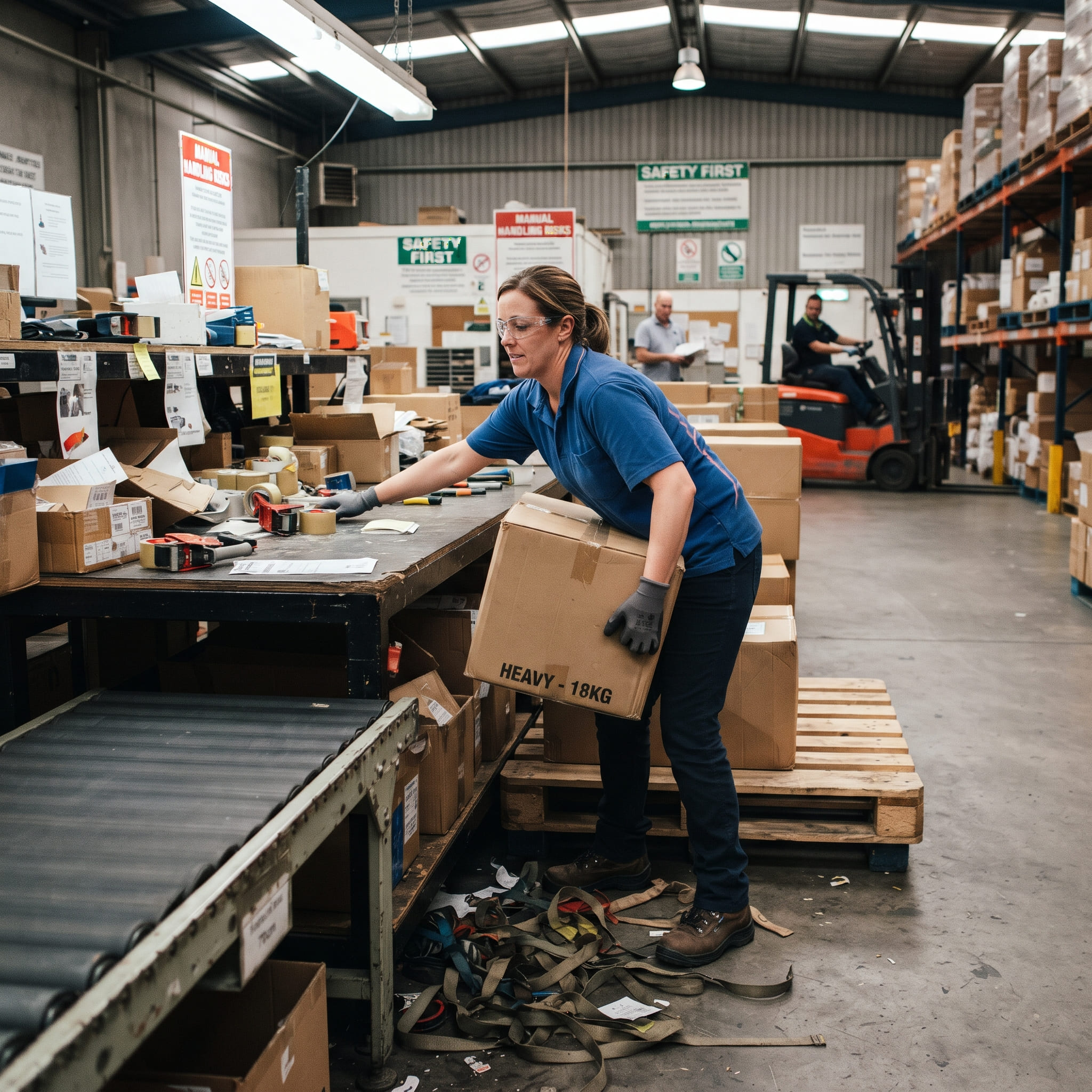
Workstation design plays an important role in workplace safety. Whether employees work in warehouses, offices, manufacturing facilities, retail stores, or food preparation areas, the arrangement of equipment, materials, and working surfaces can influence how safely they perform everyday tasks.
When a workstation is poorly designed, employees may need to reach too far, lift items from floor level, repeatedly twist their bodies, or carry materials between separate work areas. These movements can increase physical demands, particularly when tasks are repeated throughout a shift.
For example, a warehouse employee may repeatedly lift boxes from a low pallet because no suitable lifting platform is available. A production worker may need to stretch across a workbench to retrieve components, while a kitchen employee may carry heavy containers because storage is positioned too far from the preparation area.
These problems are not always caused by employee behaviour. In many cases, the layout of the workstation makes safe handling more difficult than necessary.
Effective Manual Handling Training Ireland helps workers identify common hazards and understand safer handling practices. However, training should be supported by suitable workstation design, appropriate equipment, and effective workplace risk assessments.
1. Poor Working Heights Can Increase Physical Strain
One of the most common workstation design problems is placing materials at unsuitable heights.
When employees repeatedly lift items from floor level, they may need to bend their backs and knees to reach the load. When materials are stored too high, workers may have to stretch their arms or reach above shoulder height.
Both situations can make handling more physically demanding, particularly when loads are heavy, bulky, or handled frequently.
For example, an employee working at a packing station may need to transfer products from low containers onto a high work surface. Repeating this movement throughout the day can create unnecessary physical demands.
Employers should assess the working heights used for common tasks and consider whether adjustments could make handling easier.
Possible improvements include using adjustable work surfaces, raising suitable containers, installing lift tables, and positioning frequently handled items at accessible heights.
The appropriate height depends on the task, the load, and the employee's needs. A workstation should support comfortable access without forcing workers into awkward positions.
2. Poor Storage Layouts Can Lead to Excessive Reaching
Workstations may become difficult to use when tools, materials, and equipment are stored outside comfortable reach.
Employees may repeatedly stretch forward, lean sideways, or reach across other objects to retrieve items. These movements can become particularly demanding when workers are also lifting or holding a load.
For example, a production employee might need to reach across a workbench to collect components before placing them into a machine. An office worker may repeatedly move boxes of paper from a low cabinet positioned beneath a crowded desk.
Employers should organise workstations so that frequently used items are accessible without excessive reaching.
Practical measures include:
-
Placing commonly used materials close to the employee's normal working position.
-
Keeping heavier items in suitable, accessible locations.
-
Removing unnecessary objects from work surfaces.
-
Providing sufficient space to approach and handle loads.
-
Positioning tools and equipment according to the order in which they are used.
Improving access can reduce unnecessary movement and help employees maintain better control when handling materials.
3. Restricted Space Can Encourage Awkward Movements
A workstation with insufficient space may force employees to twist, bend sideways, or manoeuvre loads around obstacles.
Restricted movement can be especially problematic when handling bulky boxes, containers, equipment, or long materials. Employees may struggle to position themselves close to a load or turn safely while carrying it.
For example, a stockroom employee may need to remove a carton from a shelf while standing between other boxes and a trolley. The lack of space may make it difficult to establish a secure grip or move the carton away from the shelf.
Workstation layouts should provide enough room for employees to approach loads, change position, and move materials safely.
Employers should keep access routes clear, avoid unnecessary storage around work areas, and position equipment so that it does not obstruct common handling tasks.
Where space is limited, the organisation should consider whether alternative storage arrangements, smaller containers, or suitable handling equipment could reduce the need for awkward movements.
4. Poor Equipment Placement Can Increase Carrying Distances
The distance between equipment, storage areas, and workstations can influence how much manual handling employees perform.
When materials are stored far from where they are needed, workers may have to carry them repeatedly between locations. This can increase the total physical workload and create additional opportunities for slips, trips, and collisions.
For example, an employee may collect components from one end of a workshop and carry them to a production bench several times during a shift. Another worker may need to transport waste containers across a busy kitchen because the designated collection point is poorly positioned.
Employers should examine how materials move through the workplace and identify opportunities to reduce unnecessary carrying.
Positioning supplies closer to their point of use, improving the layout of production areas, and using suitable trolleys can help reduce the physical demands of these tasks.
Workstation planning should consider the entire process rather than focusing only on the immediate work surface.
5. Repetitive Handling Can Become More Demanding
Poor workstation design can make repetitive handling tasks harder than necessary.
When employees repeatedly lift, move, or reposition the same materials, small design problems can affect every movement. An unsuitable work surface, awkward storage position, or poorly positioned container may contribute to unnecessary bending and reaching throughout a shift.
The risk depends on several factors, including the load's weight, the frequency of handling, the duration of the task, the employee's capabilities, and opportunities for recovery.
Employers should observe repetitive tasks and identify whether the workstation can be adjusted to reduce unnecessary physical effort.
For example, raising a container to a suitable working height may reduce repeated bending. Providing a conveyor or adjustable platform may also reduce the need to lift products between different levels.
Task rotation and rest breaks may help manage physical demands where appropriate, but they should not replace improvements to a workstation that is making handling unnecessarily difficult.
6. Unstable Work Surfaces Can Create Handling Hazards
Workstations should provide suitable, stable surfaces for placing and handling materials.
Damaged benches, uneven platforms, overcrowded work surfaces, and unsuitable storage containers can make it difficult to control loads. Items may slide, tip, or fall, requiring employees to make sudden movements to prevent them from dropping.
For example, a worker transferring products between containers may be forced to balance packages on an overcrowded bench. Another employee may need to handle a heavy object on a surface that is not designed to support its weight.
Employers should inspect work surfaces and ensure they are suitable for the tasks performed.
Materials should be positioned securely, and unnecessary objects should be removed from areas where lifting and handling take place.
Where loads need to be transferred between different working heights, suitable equipment should be considered to reduce awkward lifting and improve stability.
Employees should report damaged surfaces, unstable equipment, or recurring problems with load placement.
7. Poor Workstation Design Can Affect Visibility
Visibility is another important factor in manual handling safety.
Equipment, shelving, monitors, stacked packages, or poorly positioned materials may obstruct an employee's view of the load or the route ahead. When workers cannot see where they are moving an item, the likelihood of collisions or misplaced loads may increase.
For example, an employee carrying a large box from a packing station may struggle to see obstacles directly ahead. A worker retrieving materials from a crowded workstation may also find it difficult to identify hazards around their feet.
Employers should organise work areas so that employees can see the loads they are handling and the routes they need to use.
This may involve reducing excessive stacking, repositioning equipment, improving lighting, and keeping walkways free from obstructions.
If a load blocks the view ahead, workers should consider using suitable handling equipment or obtaining assistance rather than attempting to move it blindly.
8. Inadequate Space for Mechanical Handling Equipment
Some workstations are designed without considering how employees can use handling aids effectively.
Even when a business provides trolleys, lift tables, or other equipment, these may offer limited benefit if aisles are too narrow or there is insufficient room to position them near the load.
Employees may then resort to manual lifting because using the available equipment appears difficult or time-consuming.
Employers should ensure that the layout supports the safe use of the handling equipment selected for the task.
This includes allowing enough space to approach the load, manoeuvre the equipment, and position materials securely. Equipment should also be suitable for the load dimensions, floor conditions, and working environment.
Employees need appropriate instruction on using equipment, and defects should be reported promptly.
A well-designed workstation makes safer handling methods practical rather than simply making equipment available in theory.
9. Review Workstation Design Through Risk Assessments
Workstation design should be reviewed as part of the employer's approach to managing manual handling risks.
A practical assessment should examine how employees actually perform their duties, including the positions they adopt, the loads they handle, and the frequency of repeated movements.
Employers should consider:
-
Whether employees must bend, stretch, or twist repeatedly.
-
Whether loads are stored at suitable heights.
-
Whether the workstation provides enough space.
-
Whether materials are positioned close to their point of use.
-
Whether handling equipment can be used effectively.
-
Whether lighting and visibility are adequate.
-
Whether workers report discomfort or difficulty completing tasks.
Employees can provide valuable information because they often know which tasks create the greatest difficulties.
When problems are identified, employers should prioritise measures that eliminate unnecessary handling or reduce physical demands. Changes should then be reviewed to determine whether they have improved the working conditions.
10. Provide Relevant Manual Handling Training
Employees need to understand how workstation design affects their handling tasks and what to do when the layout creates avoidable risks.
A Manual Handling Course Ireland can help workers recognise hazards associated with lifting heights, reaching distances, repetitive movements, awkward postures, and restricted access.
Training can also encourage employees to assess loads before moving them, use suitable equipment, keep routes clear, and report workstation problems.
For example, employees should understand that repeatedly reaching across a workbench is not necessarily an unavoidable part of the job. The placement of tools or materials may need to be changed to make the task safer.
A Manual Handling Certificate Ireland may provide a record of course completion, but it does not replace a suitable risk assessment or the need to improve unsafe workstation arrangements.
Training is most effective when employers combine it with practical workplace changes, supervision, and regular communication with employees.
11. Encourage Employees to Report Design Problems
Employees should feel comfortable reporting workstation problems before they contribute to an incident or injury.
Common warning signs include repeated discomfort, difficulty reaching materials, frequent dropped items, awkward lifting positions, and the need to move equipment simply to access routine supplies.
Supervisors should investigate these concerns rather than assuming that employees need to adapt to the existing layout.
For example, if several workers report difficulty moving containers from a low shelf, the employer should review the storage height and consider suitable alternatives.
Regular feedback helps identify recurring problems and allows businesses to make practical improvements based on actual working conditions.
Conclusion
Poorly designed workstations can increase manual handling risks by forcing employees to bend, stretch, twist, carry loads over unnecessary distances, or repeat physically demanding movements. Limited space, unstable work surfaces, poor visibility, and unsuitable equipment placement can make everyday tasks more difficult and less safe.
Employers can reduce these risks by reviewing workstation layouts, improving storage heights, positioning materials within comfortable reach, providing sufficient working space, and making suitable handling equipment accessible.
Effective Manual Handling Training Ireland helps employees recognise these hazards and understand safer working practices. However, training must be supported by appropriate risk assessments and practical improvements to the working environment.
By designing workstations around the tasks employees perform, businesses can reduce unnecessary physical effort, improve handling efficiency, and support safer working conditions throughout the working day.