



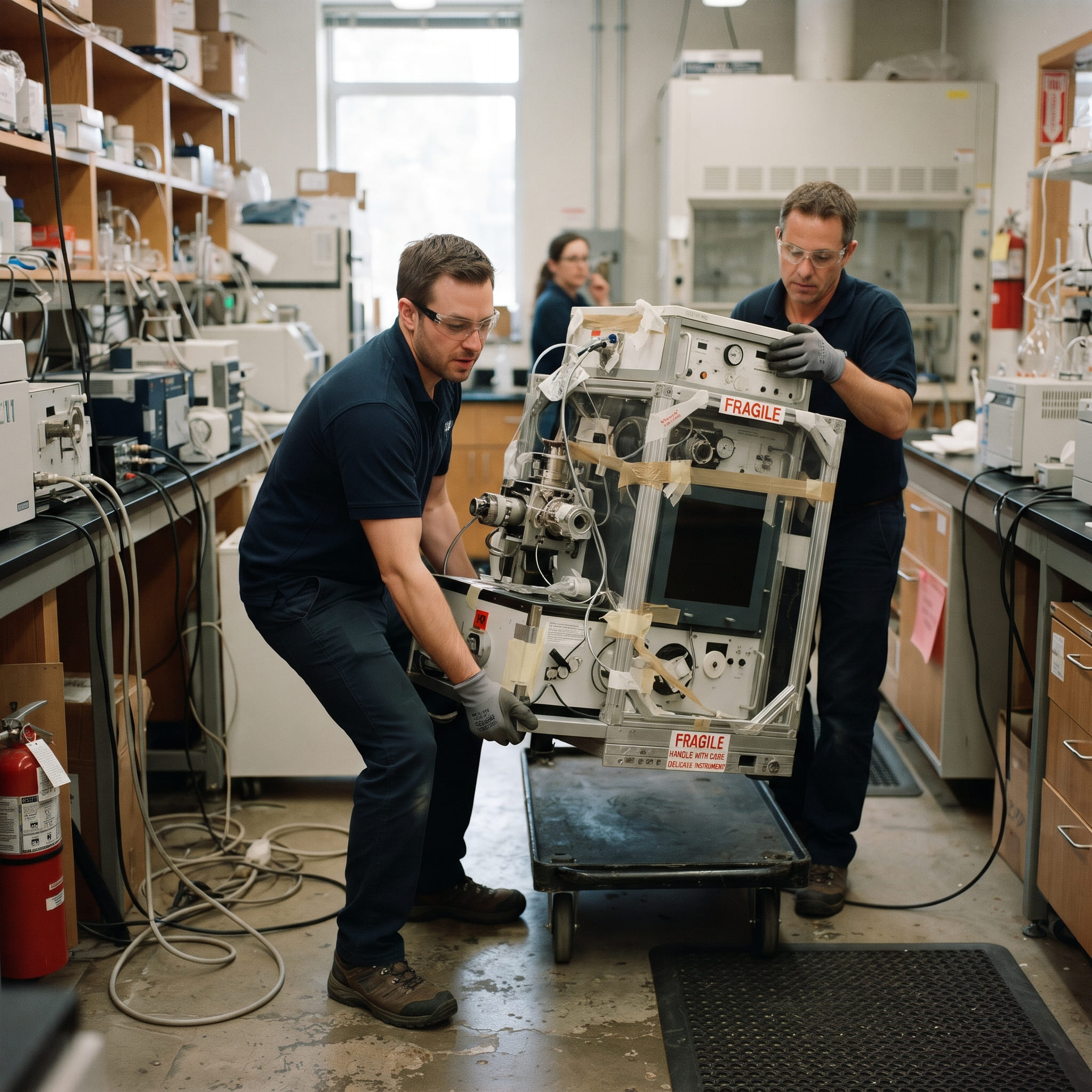
Moving fragile or delicate equipment is a common task in offices, laboratories, healthcare facilities, workshops, warehouses, and industrial workplaces. Items such as computer monitors, laboratory instruments, electronic devices, precision tools, and specialist machinery may require extra care during lifting, carrying, and positioning.
Although some delicate equipment appears lightweight, it can still present significant manual handling challenges. Unusual shapes, limited handholds, sensitive components, and awkward dimensions can make items difficult to grip or control. Employees may also concentrate so heavily on preventing damage that they overlook their own posture, balance, and physical safety.
A dropped or damaged item can result in financial losses, operational disruption, and potential safety hazards. However, protecting equipment should never come at the expense of employee wellbeing.
Businesses should therefore consider both the physical demands of moving delicate items and the precautions needed to prevent damage. Effective Manual Handling Training Ireland can help employees recognise these risks and understand how to prepare for handling tasks safely.
1. Assess the Equipment Before Moving It
The first challenge is understanding the characteristics of the equipment. Fragile items vary considerably in weight, shape, construction, and sensitivity to movement.
A small electronic device may be easy to lift but difficult to grip securely. A larger piece of specialist equipment may be heavy, unbalanced, or contain components that make it unsuitable for conventional lifting.
Before moving an item, employees should establish:
-
Its approximate weight and dimensions.
-
Whether it contains delicate or moving components.
-
Whether there are designated lifting points or handles.
-
Whether the load is balanced and secure.
-
Whether the equipment needs to remain upright.
-
Whether it requires disconnection from cables, pipes, or other services.
-
Whether specialist instructions or handling equipment are necessary.
Employees should not assume that equipment can be lifted safely simply because it has been moved in the past.
Where the weight, stability, or handling requirements are uncertain, workers should seek guidance from a supervisor or the equipment manufacturer. Equipment that is too heavy or awkward to manage safely should be moved using an appropriate alternative method.
2. Protecting Equipment Can Lead to Awkward Postures
Workers often handle delicate items cautiously because they want to avoid scratches, impacts, or damage to sensitive components. However, excessive concern about protecting an item can lead to poor lifting positions.
For example, an employee may hold a monitor at arm's length to avoid touching the screen. Another worker may bend over a machine to protect exposed components while lifting it from a low surface.
Holding a load away from the body can increase the physical demands on the back and shoulders. Bending, twisting, and reaching can also make the task more difficult to control.
To reduce these risks, employees should plan how they will grip and support the item before lifting. They should use designated handles or suitable supporting points where available and keep the load close to the body when practical, without compromising the equipment's stability.
If protecting a delicate surface makes a secure grip difficult, the handling method should be changed. Suitable protective packaging, lifting aids, or a second trained person may be needed.
Equipment protection and employee safety should be addressed together rather than treated as competing priorities.
3. Poor Grip and Unusual Shapes Increase Handling Difficulties
Fragile equipment is not always designed with manual handling in mind. Smooth surfaces, rounded edges, narrow bases, and irregular shapes can make items difficult to hold securely.
Some equipment may also have exposed buttons, connectors, glass panels, or other sensitive areas that employees must avoid gripping.
When a load has no suitable handholds, workers may compensate by using their fingertips, gripping too tightly, or placing their hands in awkward positions. These actions can increase discomfort and reduce control.
Practical precautions include:
-
Checking for designated handles or lifting points.
-
Identifying stable areas that can safely support the equipment.
-
Using suitable protective cases or containers where appropriate.
-
Avoiding grips that place pressure on delicate components.
-
Keeping hands dry and ensuring the handling route is prepared.
-
Using suitable equipment when the item cannot be gripped securely.
Gloves should only be used where appropriate for the task and material being handled. They should not be relied upon to solve a fundamentally unsuitable grip or handling method.
If employees cannot establish a secure hold, they should not attempt to lift the item until a safer approach has been arranged.
4. Fragile Equipment May Have Uneven Weight Distribution
Some delicate items contain heavy internal components, batteries, motors, glass assemblies, or other parts that affect their balance.
As a result, the centre of gravity may not be where an employee expects it to be. A device that looks symmetrical may become difficult to control when lifted or tilted.
Unexpected movement can place additional demands on the arms and back. It can also cause the equipment to collide with nearby surfaces or become unstable during carrying.
Employees should check available handling instructions and identify any parts that can move or shift. Where possible, detachable components should be secured or removed according to the manufacturer's guidance before transportation.
When moving larger equipment, workers should consider how the load will behave during lifting, turning, and lowering. The route should provide enough space to maintain control without sudden changes in direction.
If the item cannot be balanced or supported safely by hand, an appropriate trolley, lifting platform, or other suitable handling aid may be required.
5. Plan the Route Before Lifting
A clear route is particularly important when moving delicate equipment. Narrow doorways, crowded corridors, uneven floors, stairs, and unexpected obstacles can increase the difficulty of carrying an item safely.
Workers who discover an obstacle while already holding a fragile load may attempt to step around it, twist their bodies, or change their grip suddenly. These movements can increase physical strain and the chance of dropping the equipment.
Before starting, employees should inspect the route from the collection point to the final destination.
They should check for:
-
Boxes, cables, and other trip hazards.
-
Wet, slippery, or uneven flooring.
-
Doorways and corners that restrict movement.
-
Changes in floor level.
-
Other people using the route.
-
Suitable space to place the equipment safely at the destination.
Doors should be opened in advance where possible, and the destination should be ready to receive the item.
If the equipment blocks the carrier's view, an alternative method should be considered. A suitable trolley or a planned team movement may provide better visibility and control than carrying the item by hand.
6. Avoid Rushing and Sudden Movements
Fragile equipment often requires controlled movements during lifting, carrying, and placement. Rushing can increase the likelihood of sudden changes in direction, loss of balance, or accidental impact.
Employees may feel pressure to move equipment quickly during office relocations, production changes, maintenance work, or urgent repairs. However, completing a task faster is not beneficial if it increases the risk of injury or damage.
Workers should establish a stable position before lifting and avoid sudden pulling or jerking movements. When changing direction, they should move their feet rather than twisting their torso while holding the load.
Lowering the equipment also requires care. Employees should identify a stable surface before moving the item and ensure that their fingers will not become trapped between the load and the surface.
Where precise positioning is required, workers should communicate clearly and move at a controlled pace. If a task becomes difficult or unstable, they should stop and reassess rather than attempting to recover the movement abruptly.
7. Use Suitable Handling Equipment and Protective Packaging
Appropriate equipment can reduce the physical demands of moving fragile items while helping prevent damage.
Depending on the item and workplace, useful options may include padded trolleys, equipment carts, lifting platforms, wheeled cases, protective containers, and purpose-designed transport frames.
The equipment must be suitable for the load's weight, dimensions, centre of gravity, and sensitivity. A trolley that is too small or unstable may introduce additional risks instead of reducing them.
Before use, employees should check that the equipment is in suitable condition and that the load can be secured safely. Protective packaging should prevent unnecessary movement without creating an awkward or unstable package.
For example, a monitor may be safer to transport in a suitable protective case than to carry by its frame through a busy workplace. A precision instrument may require manufacturer-approved packaging to protect sensitive components.
Employees should follow relevant handling and transport instructions and avoid improvising supports that may fail under the load.
8. Determine When Team Handling Is Necessary
Some delicate items are too large, heavy, or awkward for one person to move safely. Team handling may be appropriate when a load requires coordinated support or when a single worker cannot maintain control.
However, asking two people to lift an item does not automatically make the task safe. Workers need sufficient space, clear communication, and an agreed method of movement.
Before starting, the team should decide who will lead the movement, where each person will hold the load, and how the item will be lifted and lowered. They should also confirm the route and destination.
Team members should be able to communicate throughout the task. If one person loses their grip or encounters an obstacle, everyone needs to know how the movement will be stopped safely.
Where the equipment is particularly heavy or sensitive, a mechanical handling method may be more appropriate than manual team lifting.
The decision should be based on a task-specific assessment rather than an assumption that additional people will always resolve the problem.
9. Consider the Working Environment and Destination
The destination can create handling risks even when the lifting and carrying stages are well planned.
Placing equipment on a high shelf, under a desk, inside a cabinet, or onto a crowded workstation may require awkward reaching, bending, or twisting. Delicate items can also become unstable if the receiving surface is uneven or unsuitable.
Before moving the equipment, employees should prepare the destination and make sure there is enough space to place it securely.
Where possible, heavy or frequently accessed equipment should be positioned at a practical working height. The receiving surface should be stable and capable of supporting the load.
Workers should avoid leaning over other equipment or stretching across workstations while holding a delicate item. If positioning requires an awkward posture, they should consider adjusting the workspace or using a suitable lifting aid.
After placement, the item should be checked for stability before the employee releases it completely.
10. Provide Appropriate Manual Handling Training
Employees who move delicate equipment need to understand both the physical risks of handling loads and the additional challenges created by fragile components.
A Manual Handling Course Ireland can help workers understand load assessment, safer lifting principles, route planning, posture, and the importance of selecting suitable handling methods.
Training should reflect the equipment and tasks found in the workplace. Employees who move computers may face different challenges from workers handling laboratory instruments, medical devices, or industrial machinery.
A Manual Handling Certificate Ireland may provide evidence that an employee has completed a training course. However, training alone cannot eliminate risks associated with excessive weight, poor equipment design, restricted space, or unsuitable lifting arrangements.
Employers should combine training with risk assessments, suitable equipment, clear procedures, and appropriate supervision. Employees should also know how to report damaged packaging, missing handles, unsafe lifting points, or equipment that cannot be moved safely.
Regular reviews are important when new equipment is introduced or existing work practices change.
Conclusion
Moving fragile or delicate equipment requires careful planning because the load may be difficult to grip, unevenly balanced, sensitive to impact, or awkward to position. Employees may also adopt unsafe postures when concentrating too heavily on preventing equipment damage.
Businesses can reduce these risks by assessing loads before lifting, preparing clear routes, using suitable handling aids, coordinating team movements, and ensuring the destination is ready. Workers should avoid rushing, twisting under load, or attempting to move equipment that cannot be controlled safely.
Effective Manual Handling Training Ireland supports these precautions by helping employees recognise hazards and make informed decisions about handling methods. By protecting both workers and equipment through appropriate risk controls, businesses can improve safety and reduce avoidable damage and disruption.