



Manual handling is a routine part of daily work across countless industries in Ireland. Whether employees work in healthcare, warehousing, logistics, manufacturing, retail, hospitality, construction, or education, there is a strong likelihood they will be required to lift, carry, push, pull, or move loads at some point during their working day.
While these activities may seem straightforward, manual handling continues to be one of the leading causes of workplace injuries. Many accidents occur not because tasks are particularly difficult, but because workers unknowingly make small mistakes that place unnecessary strain on their bodies. Over time, these errors can lead to back injuries, muscle strains, joint problems, and long-term health issues.
A professional manual handling course Ireland helps employees identify these common mistakes and teaches practical techniques for avoiding them. Through comprehensive manual handling training Ireland, workers gain the knowledge needed to handle loads safely, reduce risks, and improve workplace safety. A manual handling certificate Ireland demonstrates an understanding of these important principles and supports a safer working environment.
This article explores some of the most common manual handling mistakes seen in workplaces across Ireland and explains how employees can avoid them through proper training and awareness.
Why Manual Handling Mistakes Matter
Many workplace injuries develop gradually rather than resulting from a single incident.
Poor manual handling practices can lead to:
- Back pain
- Neck strain
- Shoulder injuries
- Joint problems
- Muscle fatigue
- Repetitive strain injuries
Even seemingly minor mistakes can have significant consequences when repeated over time.
Professional manual handling Ireland training helps employees recognize unsafe habits before they result in injury.
Mistake 1: Lifting Without Assessing the Load
One of the most common mistakes employees make is attempting to lift a load without first evaluating it.
Workers may assume an object is lighter or easier to handle than it actually is.
Before lifting, employees should consider:
- Weight
- Size
- Shape
- Stability
- Ease of grip
A quick assessment helps determine whether assistance or equipment may be required.
A quality manual handling course Ireland teaches employees to make load assessment a routine part of every task.
Mistake 2: Relying on Strength Instead of Technique
Many people believe that physical strength alone is enough to move heavy objects safely.
In reality, proper technique is often far more important.
Using strength without proper body mechanics can increase pressure on:
- The lower back
- Shoulders
- Knees
- Joints
Professional manual handling training Ireland focuses on safe movement techniques that reduce strain regardless of an employee's physical strength.
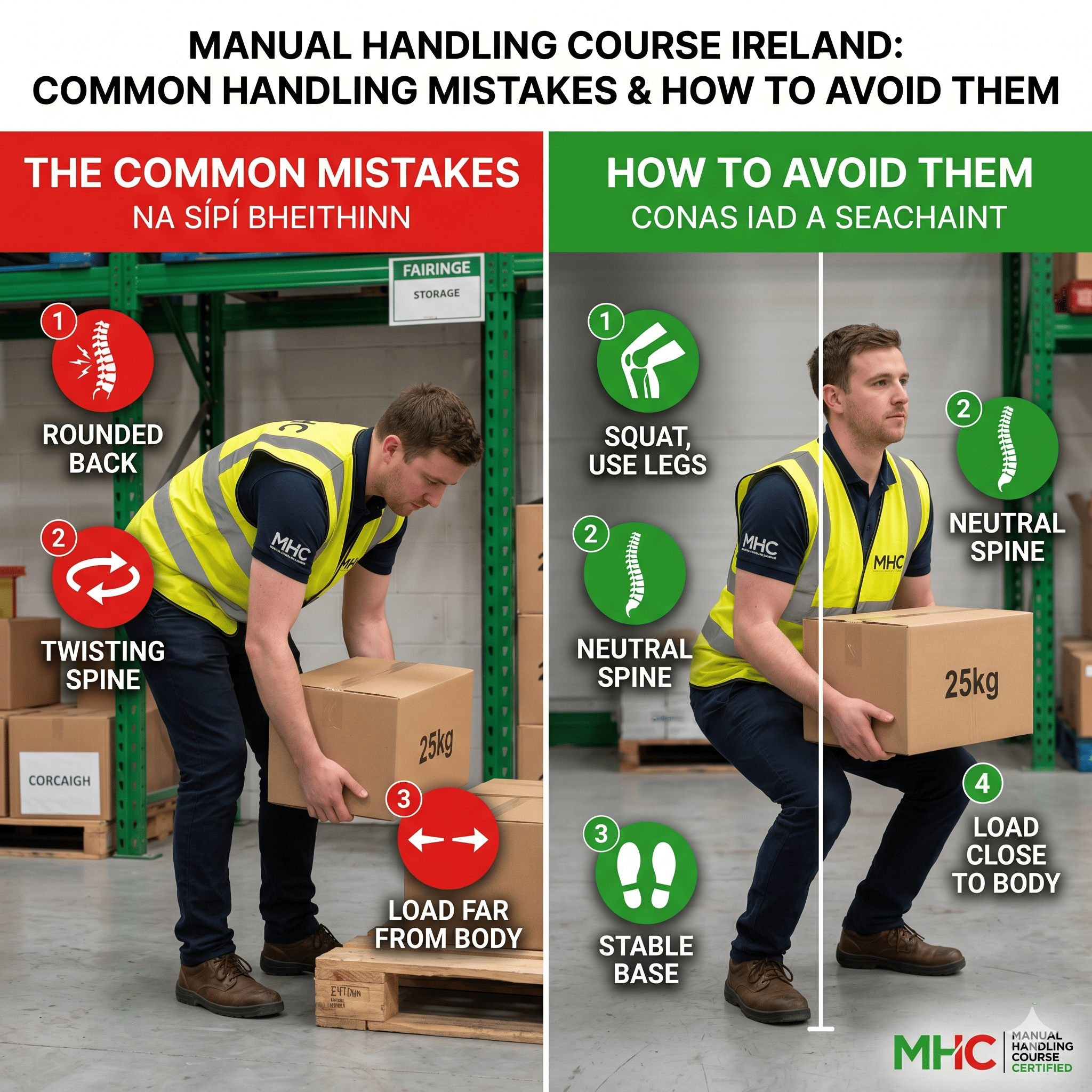
Mistake 3: Bending from the Waist
A common lifting error involves bending forward from the waist while keeping the legs straight.
This places significant stress on the lower back.
Instead, employees should:
- Bend their knees
- Keep their back in a neutral position
- Use leg muscles during lifting
A professional manual handling course Ireland teaches correct lifting posture that protects the spine and improves stability.
Mistake 4: Holding Loads Too Far from the Body
Carrying loads away from the body increases physical effort and places additional strain on muscles and joints.
Employees should keep loads:
- Close to the torso
- Balanced
- Securely gripped
Holding objects close to the body helps maintain control and reduces pressure on the back.
Strong manual handling Ireland practices emphasize load positioning as a key safety principle.
Mistake 5: Twisting While Lifting
Twisting during a lift is one of the most common causes of manual handling injuries.
Employees sometimes lift a load and rotate their upper body at the same time.
This movement places excessive stress on the spine.
Instead, workers should:
- Move their feet
- Turn their entire body
- Maintain alignment throughout the lift
Professional manual handling training Ireland teaches safer movement techniques that help reduce injury risks.
Mistake 6: Rushing Through Tasks
Busy workplaces can create pressure to complete tasks quickly.
Unfortunately, rushing often leads to:
- Poor judgment
- Unsafe lifting techniques
- Missed hazards
- Increased accident risks
Taking a few extra seconds to assess a task and use proper techniques is often far safer than attempting to save time through shortcuts.
A quality manual handling course Ireland encourages employees to prioritize safety over speed.
Mistake 7: Ignoring Personal Limitations
Employees sometimes attempt tasks that exceed their physical capabilities.
Examples include:
- Lifting loads that are too heavy
- Working while fatigued
- Refusing assistance
Recognizing personal limitations is an important aspect of workplace safety.
Professional manual handling Ireland training teaches employees when to seek help and how to make responsible decisions.
Mistake 8: Failing to Use Mechanical Aids
Many workplaces provide equipment designed to reduce physical effort.
Examples include:
- Trolleys
- Hoists
- Pallet trucks
- Lift-assist devices
Some employees avoid using these tools because they believe manual effort will be faster.
However, mechanical aids often improve both safety and efficiency.
A professional manual handling course Ireland teaches workers how and when to use these resources effectively.
Mistake 9: Poor Route Planning
Employees sometimes focus entirely on lifting the load while neglecting to plan where it will be moved.
Potential issues may include:
- Obstructed pathways
- Uneven flooring
- Tight spaces
- Workplace traffic
Planning the route before moving a load helps prevent accidents and improves task efficiency.
Strong manual handling training Ireland reinforces the importance of preparation.
Mistake 10: Carrying Loads That Block Visibility
Employees occasionally carry large objects that prevent them from seeing where they are going.
This can increase the risk of:
- Trips
- Slips
- Collisions
- Falls
Whenever possible, loads should be positioned to maintain a clear line of sight.
If visibility is limited, assistance may be required.
Mistake 11: Ignoring Workplace Hazards
Even proper lifting techniques may not prevent injuries if workplace hazards are overlooked.
Examples include:
- Wet floors
- Loose cables
- Poor lighting
- Cluttered walkways
Employees should assess the environment as well as the load itself.
Professional manual handling Ireland programs encourage workers to remain aware of their surroundings at all times.
Mistake 12: Poor Communication During Team Lifts
Some loads require more than one person to move safely.
Problems often arise when employees fail to communicate clearly.
Team lifts should involve:
- Agreed lifting procedures
- Clear instructions
- Coordinated movements
- Ongoing communication
A quality manual handling course Ireland teaches the importance of teamwork and coordination during shared tasks.
Mistake 13: Repeating Poor Techniques Daily
One incorrect lift may not immediately cause an injury.
However, repeating poor techniques day after day can create cumulative strain.
Over time, this may lead to:
- Chronic pain
- Reduced mobility
- Long-term musculoskeletal disorders
Professional manual handling training Ireland helps employees develop safer habits that support long-term health.
How Training Helps Prevent Mistakes
Many manual handling errors occur because employees have never received formal instruction.
A professional manual handling course Ireland helps workers:
- Understand workplace risks
- Learn proper techniques
- Improve awareness
- Build safer habits
- Increase confidence
Training transforms safety knowledge into practical workplace skills.
Benefits for Employees
Employees who avoid common manual handling mistakes often experience:
- Reduced injury risks
- Improved comfort
- Greater confidence
- Better physical health
- Increased workplace satisfaction
Safe handling techniques support both short-term performance and long-term well-being.
Benefits for Employers
Organizations that invest in manual handling Ireland training often benefit from:
- Fewer workplace injuries
- Lower absenteeism
- Improved productivity
- Better morale
- Stronger safety culture
Preventing common mistakes can significantly improve operational performance.
Conclusion
Manual handling tasks are a normal part of working life in many industries, but common mistakes can quickly lead to injuries and operational disruptions. Errors such as poor lifting posture, twisting movements, rushing tasks, ignoring hazards, and failing to use available equipment can all increase workplace risks.
A professional manual handling course Ireland helps employees recognize and avoid these mistakes through practical instruction and real-world safety guidance. Comprehensive manual handling training Ireland develops safer habits, improves awareness, and supports better decision-making during everyday tasks. A manual handling certificate Ireland demonstrates this knowledge and reinforces a commitment to workplace safety.
By understanding common handling mistakes and learning how to avoid them, employees and employers can work together to create safer, healthier, and more productive workplaces across Ireland.