



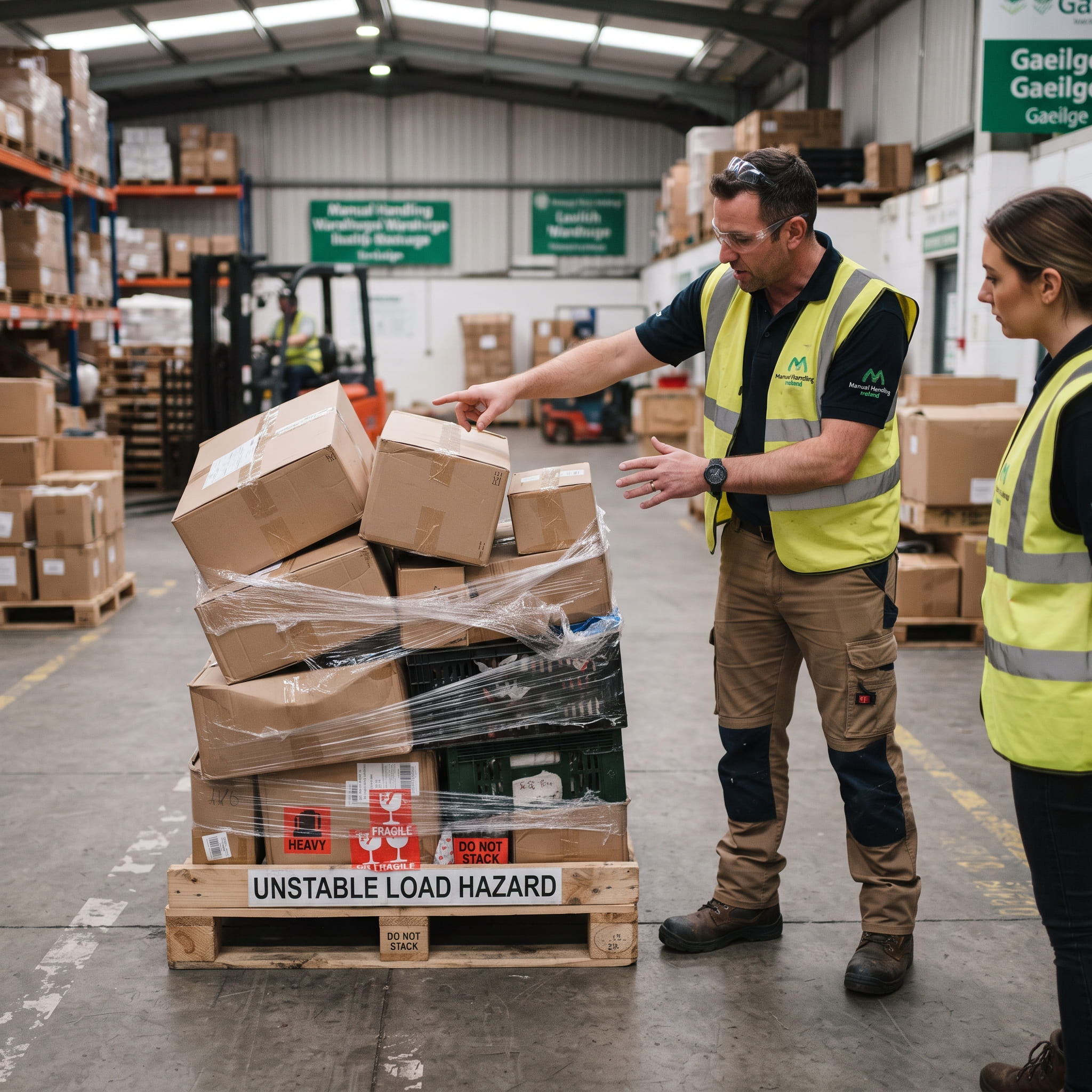
Before lifting a box, container, package or other workplace load, employees should take a moment to assess whether it is stable.
A load does not necessarily have to be heavy to be difficult or unsafe to handle. An unstable load can shift unexpectedly, change its centre of gravity, tip, spill or fall while it is being lifted or carried.
This can make the movement difficult to control and may create additional hazards for the person handling the load and anyone working nearby.
In Irish workplaces, unstable loads can occur in warehouses, construction sites, retail stores, healthcare environments, manufacturing facilities, offices and delivery areas. Packages may become unstable because of damaged packaging, unevenly distributed contents, poor stacking, loose materials or incorrect storage.
Professional Manual Handling Ireland practices encourage employees to assess the load before attempting to move it. This means looking beyond its weight and considering its condition, shape, contents, grip and stability.
A suitable Manual Handling Training Ireland course can help workers recognise these warning signs and understand when a load should be repacked, secured, handled by more than one person or moved using appropriate equipment.
Why Load Stability Matters
When a load is stable, its contents remain in a predictable position while it is being handled.
An unstable load can behave differently.
Its contents may:
- Move from one side to another.
- Slide.
- Fall.
- Tip.
- Spill.
- Shift suddenly.
This unexpected movement can make the load harder to control.
For example, a box containing several loose objects may feel manageable when stationary but become difficult to control when lifted because the contents move inside.
Weight Is Not the Only Factor
Employees sometimes assume that a light load is automatically safe.
This is not necessarily the case.
A lightweight but unstable package can create difficulties because the employee may have to react to unexpected movement.
When assessing a load, consider:
- Weight.
- Size.
- Shape.
- Contents.
- Packaging.
- Grip.
- Stability.
All of these factors can influence how safely the load can be moved.
Check the Packaging
The condition of the packaging can provide important clues about stability.
Before lifting, look for:
- Torn cardboard.
- Open boxes.
- Damaged containers.
- Loose tape.
- Broken straps.
- Crushed corners.
- Leaking packaging.
- Unsecured lids.
Damaged packaging may not adequately contain the contents.
If a package appears unstable, it should be dealt with according to workplace procedures before it is moved.
Look for Signs of Movement
An employee may sometimes notice that contents are moving before the load is lifted.
For example, a box might:
- Make a noticeable shifting sound.
- Lean to one side.
- Change shape when pressed.
- Have loose contents visible through an opening.
These signs should not be ignored.
The load should be assessed before attempting to move it.
Check Whether the Weight Is Evenly Distributed
Uneven weight distribution can make a load difficult to control.
Imagine a box where most of the contents are concentrated on one side.
When the employee lifts it, the heavier side may pull downward.
This can make the load feel very different from what was expected.
Where possible, the contents should be arranged so the load is stable and manageable.
Be Careful With Partially Filled Containers
A partially filled container can sometimes be more difficult to control than a full one.
This can occur when contents have room to move inside the container.
For example, liquids or loose materials may shift as the container is lifted.
Employees should consider the characteristics of the contents before handling.
Containers With Liquids
Liquid-filled containers can behave differently from solid loads.
The liquid may move when the container is:
- Lifted.
- Turned.
- Accelerated.
- Stopped.
This can affect control.
Employees should follow workplace procedures for moving liquid containers and use appropriate equipment where required.
Check the Centre of Gravity
The centre of gravity is essentially the point around which the load's weight is balanced.
Employees do not need to calculate it mathematically to recognise an unstable load.
Instead, they should look for signs that the weight is concentrated unevenly.
A load that is heavily weighted toward one side may be more difficult to handle than a similar-sized load with evenly distributed contents.
Tall Loads Can Be Less Stable
Tall or narrow loads may be more likely to tip than shorter, wider loads.
This can be particularly relevant when:
- Stacking boxes.
- Moving equipment.
- Transporting materials.
- Loading trolleys.
The height and shape of the load should be considered before movement.
Stacked Loads
Employees should check stacked packages before moving them.
A stack may become unstable if:
- Boxes are not aligned.
- Heavy items are placed inappropriately.
- Packaging is damaged.
- The stack is too high.
- The surface is uneven.
Employees should follow workplace procedures for stacking and moving palletised or stored goods.
Check the Base
The bottom of a load provides its foundation.
If the base is damaged, unstable or positioned incorrectly, the entire load may be affected.
Employees should look at:
- The condition of the bottom package.
- The surface underneath.
- Whether the load is leaning.
- Whether it can be moved without tipping.
Avoid Pulling Unstable Loads From a Stack
An employee may be tempted to remove one box from the middle of a stack.
This can cause the boxes above it to shift.
Before removing a package, employees should consider whether the surrounding stack will remain stable.
If there is uncertainty, the task should be reassessed.
Check Labels and Instructions
Some loads may have labels indicating how they should be handled.
These could identify:
- Fragile contents.
- Orientation requirements.
- Maximum stacking conditions.
- Special handling instructions.
Employees should follow relevant workplace instructions and labels.
Be Careful With Damaged Boxes
A damaged box may not be able to support its contents properly.
Cardboard can weaken when it becomes:
- Wet.
- Torn.
- Crushed.
- Overloaded.
Employees should not assume that a familiar box can be handled normally if its condition has changed.
Test the Load Carefully
When appropriate, employees may be able to assess a load before fully lifting it.
This could involve checking whether it can be moved slightly under controlled conditions or confirming its contents and stability.
The employee should avoid performing a test that creates unnecessary risk.
If the load is clearly unstable, it should not simply be lifted to "see what happens."
Plan Before Lifting
A short pause before lifting can help identify problems.
Ask:
What is inside?
Is the load stable?
Is the packaging intact?
Is the weight evenly distributed?
Can I get a secure grip?
Is the route clear?
Do I need assistance?
This simple assessment can prevent avoidable problems.
Check the Route
An unstable load requires careful movement.
The route should be clear of:
- Obstacles.
- Uneven surfaces.
- Wet areas.
- Narrow passages.
- Other hazards.
If the load shifts while being carried, the employee should have sufficient space to stop safely.
Consider the Destination
The destination should be prepared before the load is moved.
Employees should know where they are going to place it.
The receiving surface should be stable and have enough space for the load.
This reduces the need for unnecessary repositioning while carrying.
Use Suitable Handling Equipment
Mechanical handling equipment may be appropriate for unstable or awkward loads.
Depending on the workplace, this might include:
- Trolleys.
- Carts.
- Pallet trucks.
- Hoists.
- Lift tables.
- Other suitable handling aids.
The equipment must be appropriate for the load and used according to workplace procedures.
Do Not Overload Handling Equipment
A trolley or cart can become unstable if too much weight or an unsuitable load is placed on it.
Employees should follow the equipment's operating limits and workplace instructions.
Loads should also be positioned so they remain stable during movement.
Team Handling of Unstable Loads
Some loads may be more appropriately handled by two or more people.
Team handling can provide additional control for large or awkward objects.
However, simply adding another person does not automatically make an unstable load safe.
The team should plan:
- How the load will be lifted.
- Where each person will stand.
- The route.
- The destination.
- Communication signals.
Communication Is Important
Employees should communicate clearly during team handling.
Simple commands such as:
"Ready."
"Lift."
"Move."
"Stop."
"Lower."
can help coordinate movement.
If the load starts shifting unexpectedly, everyone should know how to respond.
Avoid Sudden Movements
Sudden acceleration, stopping or turning can cause unstable contents to move.
Employees should move at a controlled pace and avoid unnecessary changes in direction.
This is particularly important when transporting containers with liquid or loose materials.
Restricted Visibility
An unstable or oversized load may also restrict visibility.
This creates an additional risk.
Employees should make sure they can see enough of the route to move safely.
If the load blocks the view, consider:
- Using a trolley.
- Reducing the load.
- Asking someone to guide the movement.
- Using another handling method.
Manual Handling Training Ireland
Professional Manual Handling Training Ireland can teach employees how to recognise different types of manual handling risk before they begin a task.
Training can help workers assess:
- Load stability.
- Weight.
- Shape.
- Grip.
- Packaging.
- Route.
- Workplace conditions.
This helps employees make informed decisions rather than relying on assumptions.
Manual Handling Course Ireland
A suitable Manual Handling Course Ireland can provide a practical framework for evaluating a load.
Before lifting, employees can ask:
Load
Is it stable and manageable?
Packaging
Is the container intact?
Contents
Could anything move unexpectedly?
Grip
Can I hold it securely?
Route
Is there enough space to move safely?
Equipment
Would a handling aid provide better control?
Assistance
Should another person be involved?
Manual Handling Certificate Ireland
Employees who complete appropriate training may receive a Manual Handling Certificate Ireland.
A certificate provides evidence that relevant training has been completed.
However, certification does not mean employees should manually handle every load.
Workers should continue to assess each task and follow workplace procedures when they encounter an unstable package.
What Employers Can Do
Employers can help reduce unstable-load risks by:
- Providing appropriate packaging.
- Maintaining storage areas.
- Training employees.
- Inspecting damaged packages.
- Using suitable storage systems.
- Providing handling equipment.
- Establishing clear procedures for unstable loads.
- Encouraging employees to report damaged or unsafe packages.
Prevention is generally better than discovering a problem after a load has already been lifted.
A Simple Unstable-Load Checklist
Before lifting, check:
1. Packaging: Is the box or container intact?
2. Contents: Could anything move unexpectedly?
3. Weight: Is the load heavier on one side?
4. Shape: Is it tall, narrow or awkward?
5. Stability: Is it leaning or likely to tip?
6. Grip: Can you hold it securely?
7. Route: Is the path clear?
8. Equipment: Would a trolley or other aid improve control?
9. Assistance: Do you need another person?
If the load cannot be controlled safely, do not simply proceed because it needs to be moved.
Building Safer Manual Handling Habits
Recognising unstable loads should become part of everyday workplace behaviour.
Employees should develop the habit of pausing before lifting unfamiliar or difficult packages.
Instead of immediately picking up the load, consider:
Condition.
Contents.
Weight distribution.
Grip.
Route.
Handling method.
This small amount of preparation can make a significant difference to how safely a load is handled.
Conclusion
Recognising an unstable load before lifting is an important part of safe manual handling.
A load can be unstable because its contents move, its weight is unevenly distributed, its packaging is damaged or its shape makes it difficult to control. Stacking, storage conditions and the surrounding environment can also affect stability.
Employees should therefore avoid judging a load solely by its weight. Before lifting, they should check its packaging, contents, shape, grip and stability, as well as the route and destination.
Professional Manual Handling Training Ireland helps workers recognise these risks and understand when a load may require repackaging, assistance or suitable handling equipment. A Manual Handling Course Ireland can provide practical knowledge for lifting, carrying, pushing, pulling and moving loads safely.
A Manual Handling Certificate Ireland provides evidence that relevant training has been completed, but safe handling depends on applying that knowledge to the specific task.
By learning to identify unstable loads before lifting, employees can avoid unexpected movement, improve control and make safer decisions in warehouses, construction sites, retail environments, healthcare facilities, offices and other Irish workplaces.