



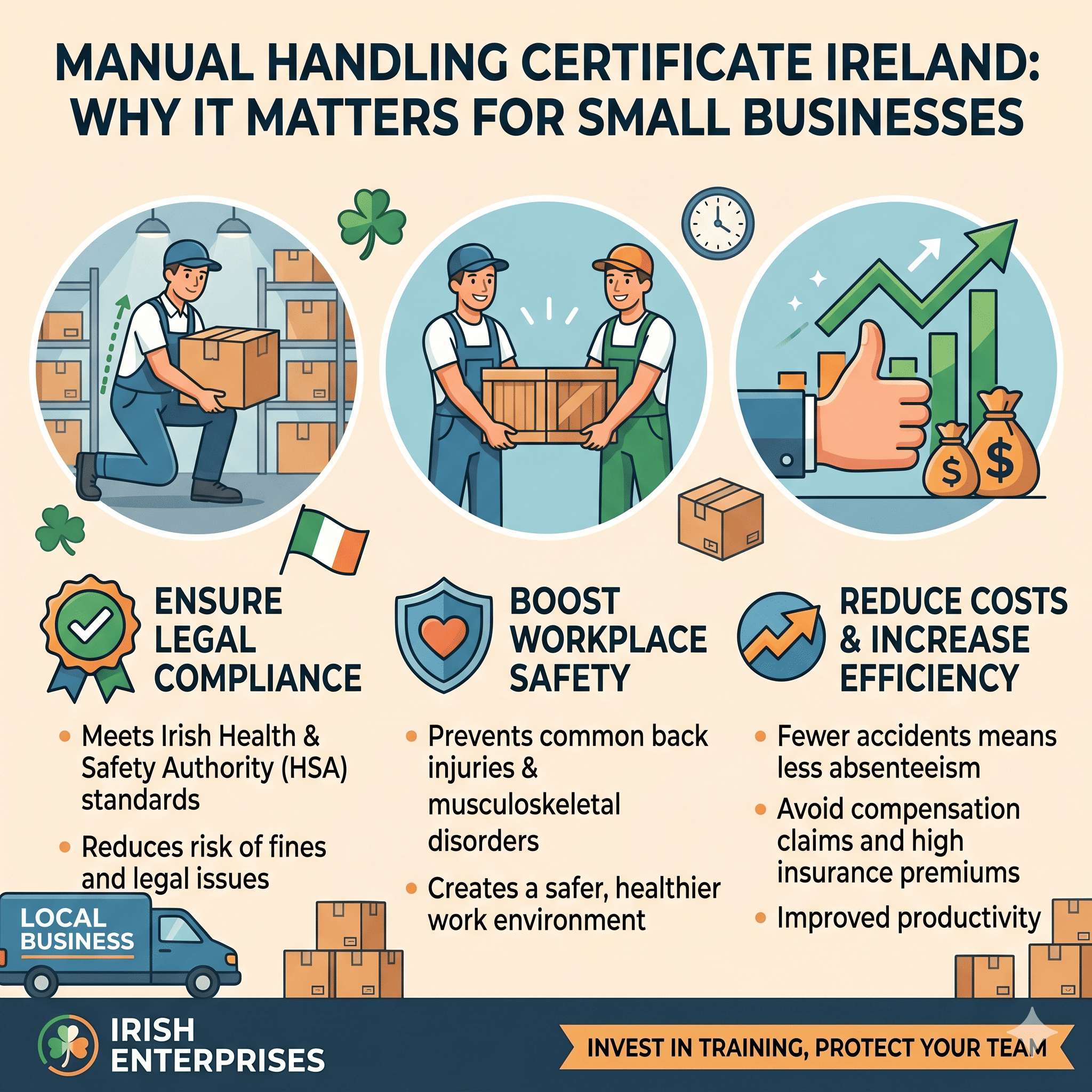
Creating a safe work environment is one of the most important responsibilities for any employer in Ireland. Across industries—from construction and logistics to healthcare and retail—employees regularly perform tasks that involve lifting, carrying, pushing, or pulling loads. While these activities are often routine, they can present serious risks if not handled correctly.
This is where manual handling Ireland training plays a crucial role. By ensuring employees complete a structured manual handling course Ireland and obtain a valid manual handling certificate Ireland, businesses can significantly improve workplace safety and reduce the risk of accidents.
In this article, we explore how manual handling training Ireland supports safer work environments and why it is essential for modern workplaces.
Understanding Manual Handling Risks
Manual handling tasks are a leading cause of workplace injuries in Ireland.
Common risks include:
- Back injuries from improper lifting
- Muscle strains caused by overexertion
- Slips and falls while carrying loads
- Injuries from dropping or mishandling objects
Without proper training, these risks increase significantly. Implementing effective manual handling Ireland practices helps address these hazards and protect employees.
The Role of Training in Workplace Safety
Training is the foundation of a safe work environment.
A comprehensive manual handling course Ireland provides employees with the knowledge and skills needed to perform tasks safely. Through manual handling training Ireland, workers learn how to:
- Identify hazards
- Assess risks
- Apply safe techniques
- Use equipment correctly
A valid manual handling certificate Ireland confirms that employees have completed this training and are prepared to work safely.
Promoting Safe Lifting Techniques
One of the key ways manual handling Ireland training supports safety is by teaching proper lifting techniques.
Employees learn to:
- Bend their knees instead of their back
- Keep loads close to their body
- Maintain a stable posture
- Avoid twisting movements
These techniques reduce strain on the body and prevent injuries.
Encouraging Risk Awareness
A safe work environment depends on employees being aware of potential hazards.
A manual handling course Ireland helps workers recognize risks such as:
- Slippery or uneven surfaces
- Obstructed walkways
- Poor lighting
- Limited space
By identifying these hazards early, employees can take steps to avoid accidents.
Supporting Pre-Task Planning
Many workplace accidents occur because employees act without thinking.
Manual handling training Ireland emphasizes the importance of planning before performing any task.
Employees are taught to consider:
- The weight and size of the load
- The route they will take
- Whether assistance or equipment is needed
Planning reduces uncertainty and improves safety.
Reducing Physical Strain and Fatigue
Fatigue is a major contributor to workplace accidents.
Poor manual handling techniques require more effort, leading to exhaustion and reduced concentration.
By applying the skills learned in manual handling Ireland, employees can:
- Use their energy more efficiently
- Reduce physical strain
- Maintain focus throughout the day
This helps create a safer work environment.
Encouraging the Use of Equipment
Many manual handling tasks can be made safer with the use of equipment.
Employees trained in manual handling Ireland know when and how to use:
- Trolleys
- Pallet trucks
- Lifting aids
Using equipment reduces the need for manual effort and minimizes risk.
Improving Teamwork and Communication
Some manual handling tasks require collaboration between employees.
A manual handling course Ireland teaches effective communication and coordination during team lifts.
Clear communication ensures that all participants move in sync, reducing the risk of accidents.
Preventing Repetitive Strain Injuries
Repetitive tasks can lead to injuries over time, especially if performed incorrectly.
Manual handling training Ireland helps employees recognize when repetition becomes a risk and how to manage it through:
- Task rotation
- Regular breaks
- Consistent use of proper techniques
Preventing these injuries supports long-term safety.
Strengthening Workplace Safety Culture
A strong safety culture is essential for maintaining a safe work environment.
When businesses prioritize manual handling Ireland training, they create a culture where safety is a shared responsibility.
Employees are more likely to:
- Follow best practices
- Report hazards
- Support colleagues
This collective effort improves overall workplace safety.
Supporting Legal Compliance
Employers in Ireland are required to provide a safe working environment and ensure that employees receive appropriate training.
Providing manual handling training Ireland and ensuring staff hold a manual handling certificate Ireland helps businesses meet these legal obligations.
Certification serves as proof of compliance during inspections and audits.
Reducing Workplace Accidents
The ultimate goal of manual handling Ireland training is to reduce accidents.
By equipping employees with the skills and knowledge needed to perform tasks safely, businesses can significantly lower the risk of injuries.
Fewer accidents lead to a safer and more productive workplace.
Improving Employee Confidence
Employees who are properly trained feel more confident in their abilities.
A manual handling certificate Ireland provides assurance that workers have the skills needed to perform tasks safely.
Confidence reduces hesitation and improves performance.
Reducing Absenteeism and Costs
Workplace injuries often result in time off work and increased costs.
By improving safety through manual handling Ireland practices, businesses can reduce absenteeism and lower expenses related to injuries.
This benefits both employees and employers.
Adapting to Different Work Environments
Manual handling risks vary across industries.
Employees trained in manual handling Ireland can adapt their skills to different environments, whether they are:
- Working in construction
- Handling goods in retail
- Assisting patients in healthcare
This adaptability ensures safety across various roles.
Continuous Improvement Through Training
Workplace safety is an ongoing process.
Employers should provide regular refresher manual handling training Ireland to ensure that employees stay up to date with best practices.
A manual handling course online offers a convenient way to maintain training without disrupting operations.
Long-Term Benefits of Safer Work Environments
Investing in manual handling Ireland training provides long-term benefits, including:
- Reduced injury rates
- Improved productivity
- Higher employee morale
- Stronger compliance
These benefits contribute to a healthier and more efficient workplace.
Conclusion
Manual handling Ireland training plays a vital role in supporting safer work environments. By ensuring employees complete a structured manual handling course Ireland and obtain a valid manual handling certificate Ireland, businesses can reduce risks, prevent injuries, and create a culture of safety.
Ultimately, investing in manual handling training Ireland is not just about meeting requirements—it’s about protecting employees, improving efficiency, and building a workplace where safety is a priority every day.