



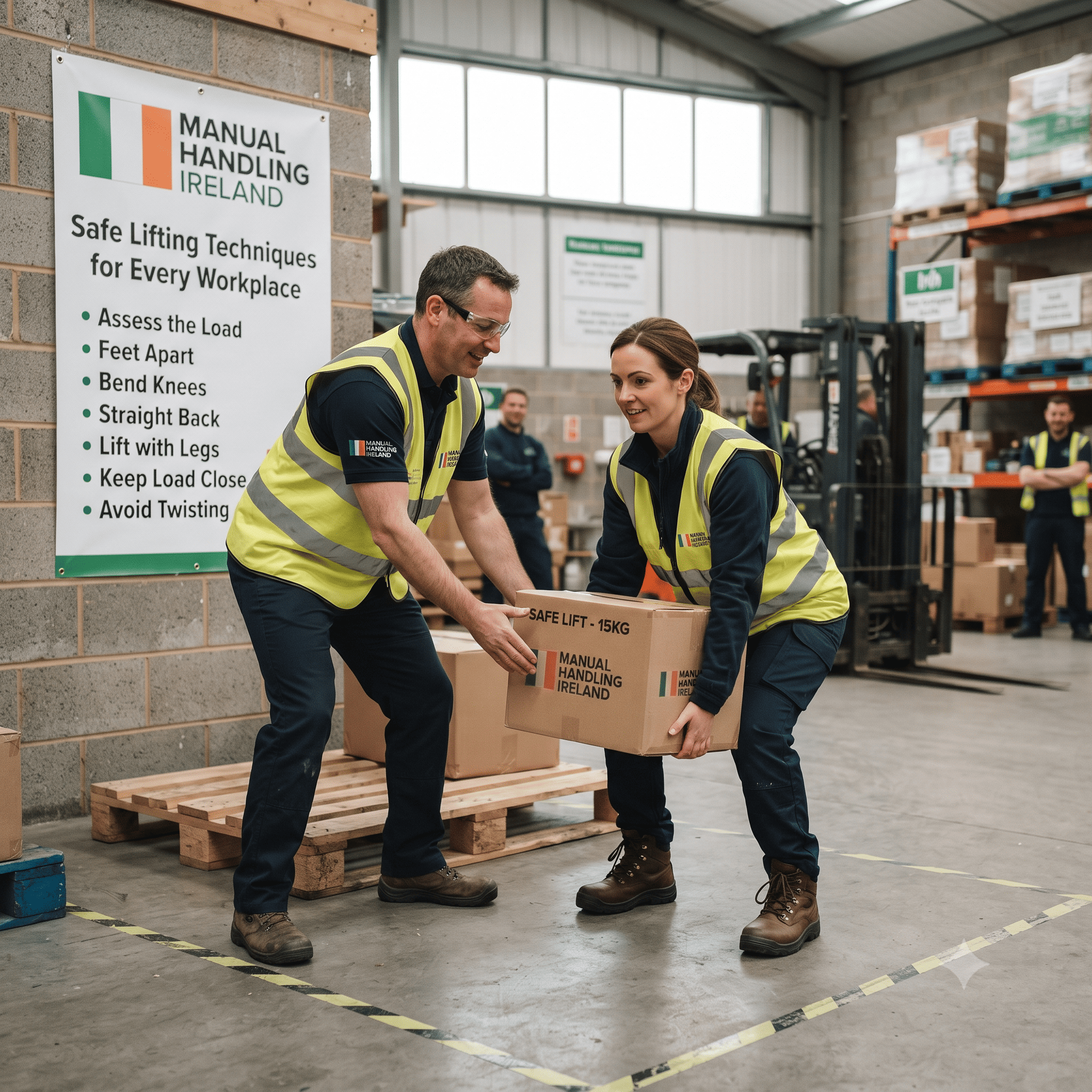
Manual handling is an everyday part of working life across Ireland. Whether employees are lifting boxes in a warehouse, carrying building materials on a construction site, moving equipment in an office, or assisting patients in a healthcare setting, safe lifting techniques are essential for preventing injuries and maintaining a productive workplace.
Unfortunately, manual handling injuries remain one of the leading causes of workplace accidents in Ireland. Poor lifting habits can result in back pain, muscle strains, joint injuries, and long-term musculoskeletal disorders. Many of these injuries develop gradually through repeated poor technique rather than a single accident.
The good news is that most manual handling injuries are preventable. A professional Manual Handling Training Ireland programme teaches employees how to lift safely, assess risks, and carry out manual handling tasks with confidence. Completing a recognised Manual Handling Course Ireland also provides employees with a Manual Handling Certificate Ireland, demonstrating their understanding of safe working practices.
In this guide, we'll explore safe lifting techniques that can be applied in every workplace and explain why proper manual handling training is an essential investment for both employees and employers.
What Is Manual Handling?
Manual handling refers to any activity that involves lifting, lowering, carrying, pushing, pulling, holding, or moving a load using physical effort.
Common workplace examples include:
- Lifting stock
- Carrying tools
- Moving office equipment
- Loading vehicles
- Unloading deliveries
- Pushing trolleys
- Pulling pallet trucks
- Repositioning furniture
Although these tasks may appear simple, using poor technique can place unnecessary strain on the body and increase the risk of injury.
Why Safe Lifting Matters
Improper lifting techniques can affect almost every part of the body.
Common manual handling injuries include:
- Lower back pain
- Muscle strains
- Shoulder injuries
- Neck pain
- Knee problems
- Joint damage
- Repetitive strain injuries
Many injuries occur gradually as employees repeat unsafe lifting habits over weeks, months, or years.
Learning correct techniques significantly reduces these risks.
Assess the Task Before Lifting
Safe lifting begins before touching the load.
Every employee should pause and assess the task by asking:
- How heavy is the object?
- Is the load stable?
- Can it be broken into smaller parts?
- Is the route clear?
- Will assistance be needed?
- Is mechanical equipment available?
Taking a few seconds to assess the situation can prevent many workplace injuries.
A quality Manual Handling Course Ireland teaches employees to make risk assessment a routine part of every manual handling task.
Position Your Feet Correctly
Good balance is the foundation of safe lifting.
Employees should:
- Stand with their feet approximately shoulder-width apart.
- Position one foot slightly ahead of the other if appropriate.
- Ensure both feet remain firmly on the ground.
- Face the direction of the lift.
A stable stance improves balance and reduces unnecessary strain on the body.
Bend Your Knees, Not Your Back
One of the most common manual handling mistakes is bending from the waist.
Instead:
- Bend at the knees.
- Keep your back in a neutral position.
- Lower yourself toward the load.
- Allow your legs to perform most of the lifting effort.
The leg muscles are much stronger than the muscles of the lower back, making this technique both safer and more efficient.
Keep the Load Close to Your Body
Holding an object away from your body greatly increases pressure on your back and shoulders.
Whenever possible:
- Hold the load close to your waist.
- Keep elbows tucked in.
- Maintain the load near your centre of gravity.
- Avoid reaching while lifting.
This simple adjustment significantly reduces physical strain.
Maintain a Neutral Spine
Maintaining a natural curve in your spine is essential throughout the lift.
Avoid:
- Rounding your back.
- Leaning excessively forward.
- Arching backwards.
A neutral spine distributes forces more evenly and protects the muscles, joints, and discs in your back.
Lift Smoothly and Avoid Sudden Movements
Jerking or rushing a lift increases the likelihood of muscle strains.
Instead:
- Lift gradually.
- Keep movements controlled.
- Maintain balance throughout.
- Avoid sudden changes in direction.
Smooth lifting provides greater control and reduces injury risk.
Avoid Twisting While Carrying
Twisting is one of the leading causes of manual handling injuries.
If you need to change direction:
- Move your feet.
- Turn your entire body.
- Keep your shoulders aligned with your hips.
- Maintain the load close to your body.
Turning with your feet instead of twisting your spine protects your lower back.
Watch Where You're Going
Employees carrying loads should always ensure the route is safe.
Look for:
- Slippery floors
- Uneven ground
- Obstacles
- Poor lighting
- Narrow walkways
- Other workers nearby
Good visibility helps prevent trips, slips, and collisions.
Know Your Limits
Attempting to lift loads that are too heavy is a common cause of workplace injuries.
Never hesitate to:
- Ask for assistance.
- Divide heavy loads into smaller parts.
- Use lifting equipment.
- Delay the task if conditions are unsafe.
Understanding your own limits is a key part of safe manual handling.
Use Mechanical Aids Whenever Possible
Modern workplaces often provide equipment designed to reduce physical effort.
Examples include:
- Pallet trucks
- Trolleys
- Hoists
- Lift tables
- Adjustable lifting equipment
- Conveyors
Using these aids reduces physical strain while improving efficiency and productivity.
A professional Manual Handling Training Ireland programme explains when mechanical assistance should be used.
Plan the Entire Lift
Before lifting, think about every stage of the task.
Consider:
- Where the load is going.
- How it will be carried.
- Where it will be placed.
- Whether there is enough space.
- Whether someone else is needed.
Planning helps eliminate unnecessary risks before lifting begins.
Work as a Team
Some objects require more than one person to move safely.
When team lifting:
- Agree on the plan.
- Nominate one person to coordinate.
- Lift together.
- Walk at the same pace.
- Communicate throughout the task.
Good teamwork improves both safety and efficiency.
Maintain Good Housekeeping
A tidy workplace supports safer manual handling.
Employees should ensure:
- Walkways remain clear.
- Storage areas are organised.
- Equipment is returned after use.
- Spillages are cleaned promptly.
- Cables do not create trip hazards.
Good housekeeping reduces many avoidable workplace accidents.
Reduce Repetitive Strain
Manual handling injuries often develop gradually due to repetitive movements.
Employers and employees can reduce this risk by:
- Rotating tasks.
- Taking regular breaks.
- Using mechanical aids.
- Improving workstation layouts.
- Following proper lifting techniques consistently.
Preventing fatigue helps maintain safe performance throughout the working day.
Why Manual Handling Training Matters
Even experienced employees benefit from professional training.
A recognised Manual Handling Course Ireland teaches workers how to:
- Identify hazards.
- Assess lifting tasks.
- Apply correct lifting techniques.
- Improve body mechanics.
- Use equipment safely.
- Develop long-term safe working habits.
Rather than relying on routine or experience alone, employees gain practical knowledge that supports safer decision-making.
Benefits for Employers
Employers who invest in Manual Handling Training Ireland often experience:
- Fewer workplace injuries.
- Lower absenteeism.
- Improved productivity.
- Better staff confidence.
- Reduced compensation claims.
- Stronger health and safety compliance.
- A more positive workplace culture.
Training benefits both employees and the organisation as a whole.
Earning a Manual Handling Certificate Ireland
After completing a recognised course, participants receive a Manual Handling Certificate Ireland.
This certificate confirms that employees understand:
- Safe lifting techniques.
- Manual handling principles.
- Risk assessment.
- Hazard awareness.
- Safe working practices.
Many employers request certification before employees undertake roles involving regular manual handling tasks.
Conclusion
Safe lifting is a skill that every employee can develop with the right knowledge and training. By using correct posture, assessing risks before lifting, planning tasks carefully, and making good use of mechanical aids, workers can significantly reduce the likelihood of manual handling injuries.
A professional Manual Handling Training Ireland programme provides practical guidance that employees can apply immediately in their daily work. Through a comprehensive Manual Handling Course Ireland, participants learn proven lifting techniques, improve hazard awareness, and build the confidence needed to carry out physical tasks safely.
Earning a recognised Manual Handling Certificate Ireland demonstrates a commitment to workplace safety and professional development. Whether you work in construction, healthcare, retail, warehousing, manufacturing, hospitality, logistics, or an office environment, following safe lifting techniques is essential for protecting your health, supporting your colleagues, and creating a safer workplace for everyone.