



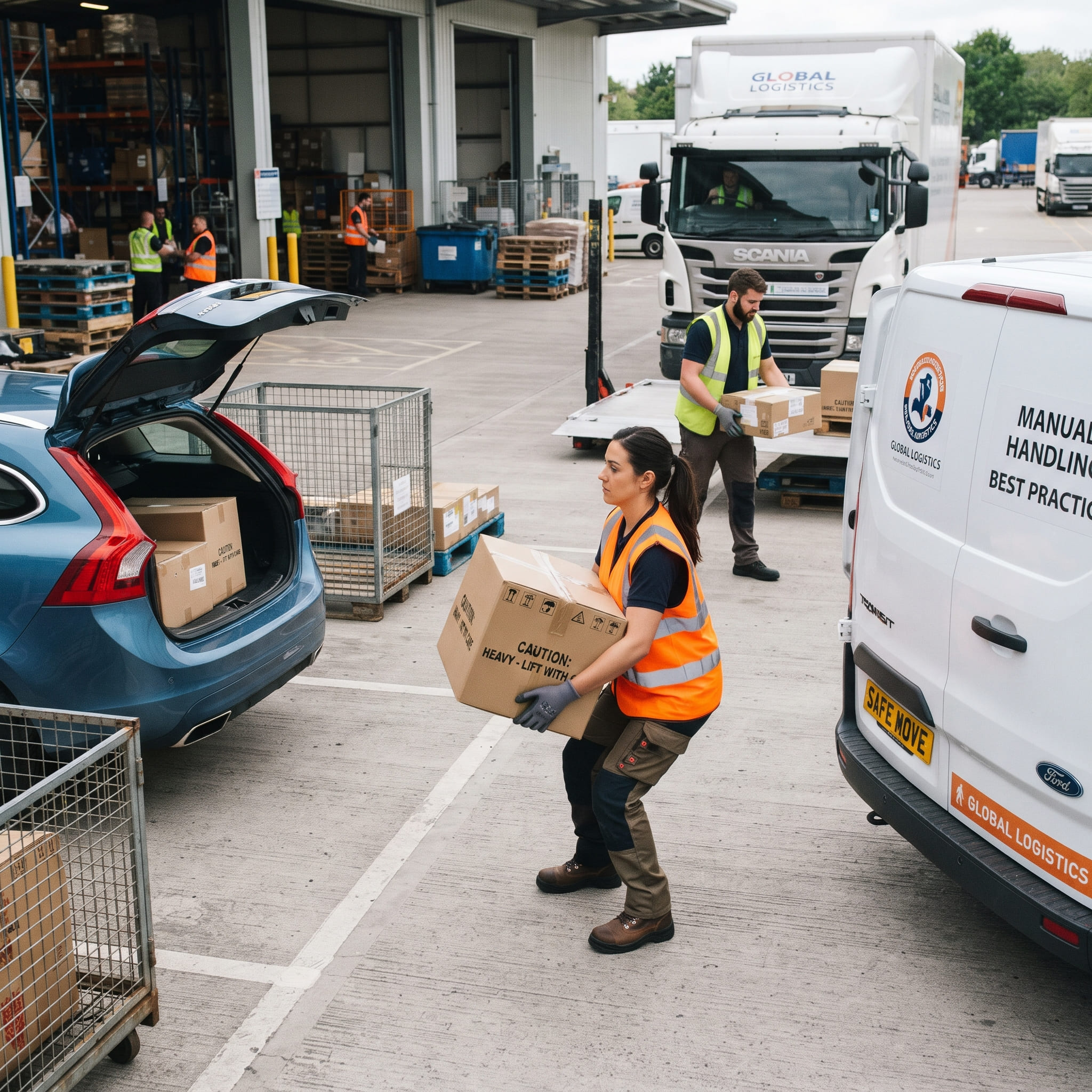
Loading items into cars, vans, and trucks is a common activity across many Irish workplaces. Delivery drivers, warehouse employees, tradespeople, retail workers, and logistics teams regularly move boxes, tools, equipment, stock, and materials into vehicles for transport.
Although these tasks may seem routine, vehicle loading can create significant manual handling challenges. Employees may need to lift items from floor level into a vehicle, reach deep into a van, move heavy objects around other packages, or handle loads in restricted spaces. Repeated lifting throughout a shift can also increase physical fatigue.
Poor loading practices may contribute to back strain, shoulder discomfort, dropped loads, slips, and other workplace incidents. Unstable items can shift during transport, creating additional hazards when the vehicle is opened at the destination.
Effective Manual Handling Training Ireland helps employees recognise these risks and understand safer handling practices. However, training must be supported by suitable equipment, safe vehicle layouts, proper load securing, and appropriate workplace procedures.
1. Assess the Load Before Lifting
Before placing an item into a vehicle, employees should assess its weight, size, shape, and stability.
A small box may contain heavy equipment, while a large package may be awkward to grip or difficult to position inside a vehicle. Some items may also have unevenly distributed contents, sharp edges, or packaging that makes them slippery.
Workers should consider whether the load can be held securely and whether they can lift it without excessive reaching or awkward twisting.
Important checks include:
-
Whether the weight is known or can be reasonably estimated.
-
Whether the package has secure handholds.
-
Whether its contents could shift during movement.
-
Whether the item is too bulky to carry comfortably.
-
Whether mechanical equipment or assistance is needed.
Employees should not attempt to lift a load simply because it needs to be loaded quickly. If its weight or handling requirements make the task unsuitable, they should seek assistance or use appropriate equipment.
2. Position the Vehicle Safely Before Loading
The position of a vehicle can affect the physical demands of loading and unloading.
Where possible, vehicles should be parked on stable, level ground with sufficient space around them for workers to move safely. Parking on a slope or uneven surface may make it harder to control loads, use trolleys, or maintain balance.
The loading area should be clear of unnecessary obstacles, and workers should be protected from passing traffic where relevant.
Employers should establish procedures for loading near roads, public access areas, or busy delivery bays. These may include designated loading zones, warning signs, barriers, and appropriate vehicle safety measures.
Employees should also ensure that the vehicle is secured against unintended movement before loading begins. They should follow the vehicle and workplace procedures for parking, applying the parking brake, and using any required safety controls.
A safe loading area allows employees to concentrate on handling the load without being exposed to avoidable environmental hazards.
3. Reduce Lifting From Floor Level
One common manual handling challenge occurs when items need to be lifted from the ground into a vehicle.
The height difference can require employees to raise loads through a substantial range of movement. If the item is heavy or awkward, this may create additional physical demands, especially when repeated many times.
Where possible, employers should reduce unnecessary lifting from floor level by using suitable loading platforms, adjustable lift tables, or other appropriate handling equipment.
Packages can also be organised before loading so that workers do not need to repeatedly move items between the ground and the vehicle.
When a manual lift is necessary, employees should position themselves close to the load, establish a secure grip, and avoid twisting while lifting. They should not attempt to raise a load that is too heavy or difficult to control.
The safest approach depends on the load, the vehicle height, the space available, and the employee's capabilities. If the task cannot be completed safely, an alternative method should be arranged.
4. Avoid Excessive Reaching Into Vehicles
Reaching deep into a car boot, van, or truck can make loading more difficult.
When employees stretch forward to position a package at the back of a vehicle, the load may be held away from the body. This can increase the physical demands of the movement, particularly when the package is heavy or bulky.
Reaching over other packages can also make it harder to maintain a secure grip and control the load.
Employees should organise the loading process so that items can be placed without excessive reaching. Where practical, they should position themselves securely at the vehicle opening and move packages into place using suitable equipment or a planned sequence.
Workers should avoid climbing into a vehicle or standing on unsuitable surfaces to reach items. If a load cannot be positioned safely from the available access point, the loading arrangement should be reconsidered.
A well-organised vehicle layout can reduce awkward movements and make unloading easier at the destination.
5. Organise the Vehicle to Minimise Repeated Handling
Poor vehicle organisation can force employees to move the same items several times before they are correctly positioned.
For example, a worker may load heavy boxes first, only to discover that smaller packages need to be placed behind them. Repositioning the load can create unnecessary lifting, carrying, and twisting.
Before loading, employees should consider the delivery sequence, the size of the items, and where each package needs to be placed.
Practical measures include:
-
Grouping goods according to delivery destination.
-
Keeping frequently needed items accessible where safe to do so.
-
Placing heavier items in suitable positions that support load stability.
-
Avoiding unnecessary stacking or awkward arrangements.
-
Leaving enough space for safe access to the load.
-
Planning the sequence of loading and unloading in advance.
Vehicle layout should also account for the vehicle's payload limits and the manufacturer's guidance on load distribution.
Good organisation reduces unnecessary handling and helps employees retrieve items without moving other packages out of the way.
6. Use Suitable Loading Equipment
Mechanical handling equipment can reduce the need for employees to lift heavy items manually.
Depending on the vehicle and load, suitable options may include sack trucks, platform trolleys, pallet trucks, tail lifts, loading ramps, and purpose-designed lifting aids.
Equipment should be selected according to the load's weight and dimensions, the vehicle's design, the available space, and the conditions at the loading location.
For example, a trolley may help transport several boxes across a warehouse, but it may not be suitable for moving them over uneven ground or up steep steps. A tail lift may reduce the height through which a heavy item needs to be lifted, provided it is suitable for the load and operated correctly.
Employees should check equipment before use and follow relevant instructions. They should never exceed rated capacities or use damaged equipment.
Employers must ensure that workers receive appropriate training or instruction for specialised equipment and that the loading area provides sufficient room for safe operation.
7. Work Safely With Heavy or Bulky Items
Large tools, furniture, machinery components, and oversized packages may be difficult to handle in confined vehicle spaces.
Bulky loads can obstruct visibility, while long items may strike vehicle doors or nearby people when being turned. Heavy objects may also require awkward movements if there is insufficient space to position them properly.
Before moving such items, workers should assess the available space and identify a suitable route into the vehicle.
Where necessary, they should use purpose-designed equipment or arrange team handling. If more than one person is involved, they should agree on hand positions, movement instructions, and how the load will be placed.
Team handling does not automatically make a load safe. The object must still be manageable, and everyone involved must be able to control their part of the movement.
If the item cannot be handled safely using available resources, employees should stop and request an alternative loading method.
8. Secure Loads to Prevent Movement During Transport
Manual handling safety does not end when an item has been placed inside a vehicle. Goods that move during transport can create hazards when the vehicle stops or when its doors are opened.
An unsecured box may slide, while a heavy item may fall towards an employee during unloading. Packages that shift can also damage other goods or create an unstable arrangement.
Loads should be distributed and secured according to the vehicle manufacturer's guidance and applicable workplace procedures.
Depending on the load, suitable controls may include restraint straps, load bars, partitions, non-slip materials, and appropriate containers.
Employees should check that goods are stable before the vehicle moves. They should avoid stacking items in ways that could collapse or obstruct access to the doors.
When unloading, workers should open doors carefully and assess whether packages may have shifted during transport. If the load appears unstable, they should avoid standing in its potential fall path and seek a safe method of stabilising or removing it.
9. Consider Weather and Ground Conditions
Loading and unloading frequently take place outdoors, where rain, ice, wind, and uneven surfaces can affect safety.
Wet vehicle floors and muddy loading areas can increase the risk of slipping. Strong winds may also make lightweight but bulky items difficult to control.
Employees should inspect the loading area and vehicle access points before moving goods. Where appropriate, they should use suitable footwear and protective clothing and keep surfaces clear of avoidable hazards.
If a vehicle floor is wet or contaminated, the hazard should be addressed according to workplace procedures before loading continues.
Workers should also consider whether a ramp or trolley can be used safely under the prevailing conditions. Equipment that is suitable on a dry, level surface may become difficult to control on a slippery slope.
Where conditions make loading unsafe, employees should pause the task and arrange suitable controls rather than rushing to complete it.
10. Reduce Fatigue During Repeated Loading Tasks
Delivery and warehouse workers may load and unload multiple vehicles during a shift. Repeated lifting, carrying, pushing, and pulling can contribute to fatigue, particularly when tasks involve heavy packages or limited recovery time.
Fatigue may affect concentration and make it harder to maintain consistent control over loads.
Employers should review workloads, delivery schedules, and the frequency of repetitive handling. They should consider whether equipment, better vehicle organisation, or revised work procedures could reduce unnecessary physical effort.
Appropriate breaks and task variation may also help manage physical demands, depending on the work being performed.
Employees should report when fatigue or discomfort makes a task difficult to perform safely. Supervisors should investigate recurring problems and avoid work targets that encourage unsafe shortcuts.
11. Provide Relevant Manual Handling Training
Employees who load cars, vans, and trucks need practical guidance that reflects their actual duties.
A Manual Handling Course Ireland can help workers understand risks associated with lifting from different heights, handling awkward loads, carrying items, and working in restricted spaces. Training can also reinforce the importance of route planning, equipment use, and load stability.
Employers should provide clear procedures for loading and unloading, including how to deal with oversized packages, unsafe vehicle access, and loads that have shifted during transport.
A Manual Handling Certificate Ireland may provide a record of course completion, but it does not replace task-specific risk assessments, suitable equipment, or effective supervision.
Training should be reviewed when employees take on new duties, vehicle arrangements change, or handling procedures are updated.
Conclusion
Loading items into cars, vans, and trucks can create manual handling risks because workers often lift loads across different heights, reach into restricted spaces, and handle packages repeatedly throughout a shift. Poor vehicle organisation, unstable goods, unsuitable equipment, and slippery loading areas can make these tasks more difficult.
Employers can reduce risks by assessing loads, positioning vehicles safely, improving vehicle layouts, providing suitable handling equipment, and securing goods before transport. Employees should plan each movement, avoid excessive reaching, communicate when assistance is needed, and report unsafe conditions.
Effective Manual Handling Training Ireland, supported by suitable risk assessments and practical controls, can help businesses improve loading and unloading safety.
The objective is to make every stage of vehicle loading manageable, from removing goods from the storage area to securing them for transport and unloading them at their destination.