



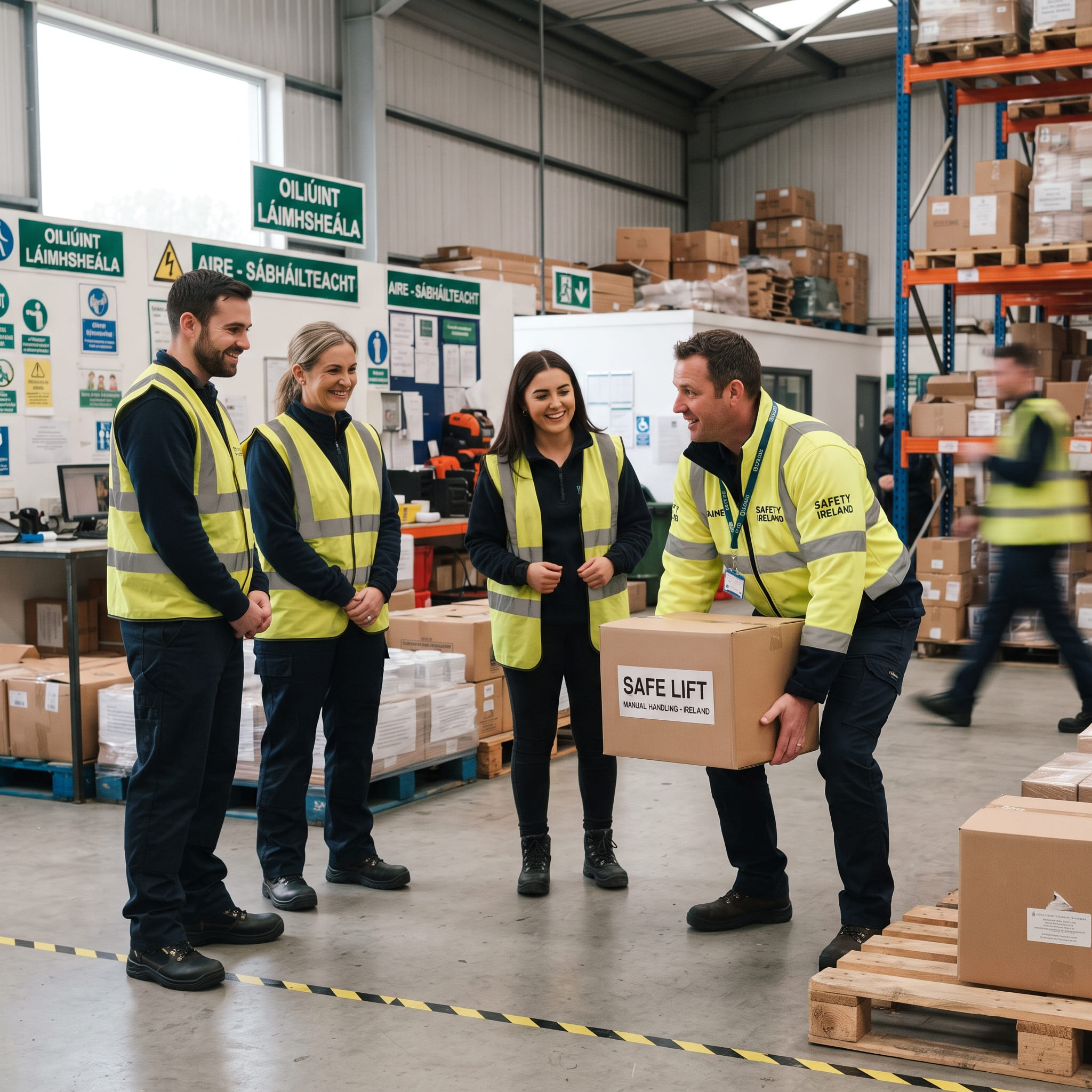
Employee confidence plays an important role in workplace safety. Workers who understand how to approach a task, recognise potential hazards and use equipment correctly are more likely to make informed decisions during their working day.
This is particularly important in workplaces where employees regularly perform manual handling activities.
Across Ireland, workers in construction, healthcare, warehousing, retail, manufacturing, logistics, hospitality and many other sectors may need to lift, carry, push, pull or move loads. These activities can be routine, but they still require appropriate planning and awareness.
A lack of knowledge can make employees uncertain about how to handle difficult loads or when they should ask for assistance. On the other hand, excessive confidence without appropriate knowledge can also create risks.
Effective Manual Handling Training Ireland aims to create a balanced approach. Employees should understand their responsibilities, recognise their limitations and know how to approach manual handling tasks safely.
A suitable Manual Handling Course Ireland can give workers practical knowledge about risk assessment, load assessment, lifting, carrying, pushing, pulling, team handling and the use of mechanical aids.
This article explains how appropriate safety training can improve employee confidence while supporting safer working practices.
What Does Employee Confidence Mean in Workplace Safety?
Workplace confidence does not mean believing that every task can be completed without assistance.
Instead, a confident employee understands:
- How to assess a task.
- What hazards to look for.
- When assistance is needed.
- How to use available equipment.
- When to stop and reassess.
- How to communicate concerns.
This type of confidence can support better decision-making.
Employees should feel comfortable saying that a load is too awkward, a route is unsuitable or additional assistance is required.
Training Reduces Uncertainty
One of the biggest benefits of structured training is reducing uncertainty.
An employee who has never been taught how to assess a manual handling task may not know what factors to consider.
They may simply look at the weight of an object and decide whether they can lift it.
Training can introduce a broader approach.
Workers can learn to consider:
- The load.
- The task.
- The environment.
- The individual.
- Available equipment.
This gives employees a framework for making decisions.
Understanding Manual Handling Risks
Confidence begins with understanding the risks.
Employees should know that manual handling injuries are not limited to lifting extremely heavy objects.
Risks can also arise from:
- Repetition.
- Awkward postures.
- Excessive reaching.
- Twisting.
- Long carrying distances.
- Pushing and pulling.
- Poor workplace conditions.
Once employees understand these factors, they can become more aware of risks during everyday activities.
Learning Through Practical Examples
Practical examples can make safety information easier to understand.
Instead of simply telling employees to "lift safely", training can demonstrate how different situations affect the handling task.
For example:
Scenario 1: A small, stable box with a clear route.
Scenario 2: A large box that blocks visibility.
Scenario 3: An awkward load requiring two people.
Scenario 4: A repetitive task involving many small items.
Each situation requires employees to think about the risks rather than automatically applying the same approach.
Confidence in Risk Assessment
Risk assessment can seem complicated when employees have never received appropriate instruction.
Training can make the process more straightforward.
Before moving a load, employees can ask:
How heavy is it?
Is it awkward?
Where is it going?
Is the route clear?
Do I need assistance?
Can mechanical equipment be used?
These questions encourage employees to pause before acting.
Knowing When to Ask for Help
One of the most valuable forms of workplace confidence is knowing when to ask for assistance.
Employees should not feel that asking for help means they are incapable of performing their job.
Some loads are simply unsuitable for one person.
A worker who understands this is more likely to:
- Request assistance.
- Use a trolley.
- Use mechanical equipment.
- Ask a supervisor for guidance.
- Stop an unsafe task.
This can help prevent employees from taking unnecessary risks.
Building Confidence With Equipment
Many workplaces provide equipment to reduce manual handling demands.
Examples include:
- Trolleys.
- Pallet trucks.
- Hoists.
- Lift tables.
- Carts.
- Other handling aids.
Employees need to understand how and when equipment should be used.
Appropriate instruction can reduce uncertainty and make employees more comfortable using available safety controls.
Confidence During Team Handling
Team handling requires communication and coordination.
Employees should understand how to:
- Plan the movement.
- Choose a team leader.
- Agree on commands.
- Coordinate lifting.
- Stop together.
- Communicate obstacles.
Training can help employees feel more prepared when they need to work with colleagues to move a large or awkward load.
Helping New Employees
New employees may initially lack confidence when performing physical workplace tasks.
They may be unfamiliar with:
- Workplace layouts.
- Equipment.
- Storage systems.
- Types of loads.
- Manual handling procedures.
Suitable training can give them a foundation before they begin performing tasks independently.
Supervision and workplace-specific instruction can then reinforce that knowledge.
Supporting Experienced Employees
Training is not only useful for new workers.
Experienced employees can also benefit from refreshing their knowledge.
Over time, employees may develop shortcuts or become accustomed to performing tasks in a particular way.
Refresher training provides an opportunity to review established habits and consider whether safer or more efficient approaches are available.
It can also reinforce the importance of reassessing tasks when workplace conditions change.
Confidence Should Not Become Complacency
There is an important difference between confidence and overconfidence.
A confident employee might say:
"I understand this task and know how to approach it safely."
An overconfident employee might say:
"I've done this for years, so I don't need to think about it."
The second approach can increase risk.
Good training should encourage employees to remain alert and reassess tasks rather than assuming that experience automatically makes every situation safe.
Improving Communication
Training can also improve workplace communication.
Employees who understand manual handling risks may be more likely to communicate about:
- Difficult loads.
- Damaged equipment.
- Poor storage.
- Unsafe routes.
- Fatigue.
- Repetitive tasks.
This creates opportunities for hazards to be addressed before an injury occurs.
Creating a Positive Safety Culture
Employee confidence can contribute to a stronger safety culture.
When workers feel comfortable discussing safety concerns, they are more likely to report problems.
A positive workplace culture encourages employees to:
- Ask questions.
- Report hazards.
- Request assistance.
- Follow procedures.
- Suggest improvements.
Safety becomes part of everyday work rather than something discussed only after an accident.
Confidence and Workplace Productivity
Safety training is primarily about protecting employees, but it can also support productivity.
Employees who understand how to approach a task may spend less time:
- Trying to move unsuitable loads.
- Finding alternative methods at the last moment.
- Recovering from avoidable mistakes.
- Waiting because they are unsure what to do.
Better planning can make tasks more organised and efficient.
However, productivity should never come at the expense of safety.
Reducing Unsafe Shortcuts
Employees may take shortcuts when they are uncertain about the correct procedure.
For example, they may manually carry several items because they are unsure whether a trolley should be used.
Training can clarify appropriate procedures and give workers the confidence to use available safety controls.
Clear workplace policies should support this training.
Recognising Personal Limitations
Good safety training teaches employees to recognise when a task exceeds what they can safely manage.
This can involve considering:
- Load size.
- Load weight.
- Physical position.
- Available space.
- Distance.
- Repetition.
- Fatigue.
Understanding these factors can help workers make safer decisions.
Manual Handling Training Ireland
Professional Manual Handling Training Ireland can give employees a structured understanding of workplace manual handling risks.
Training can cover:
- Manual handling principles.
- Load assessment.
- Risk assessment.
- Safe lifting.
- Carrying.
- Pushing and pulling.
- Team handling.
- Mechanical aids.
- Hazard recognition.
This knowledge can improve employee confidence because workers understand what to look for before beginning a task.
Manual Handling Course Ireland
A suitable Manual Handling Course Ireland can provide employees with practical knowledge that can be applied to everyday work.
The goal should not simply be to memorise a set of lifting instructions.
Employees should understand how to adapt their approach to different situations.
For example, handling a small box in an open stockroom is different from moving a large piece of equipment through a restricted area.
Training can help employees recognise those differences.
Manual Handling Certificate Ireland
Employees who complete appropriate training may receive a Manual Handling Certificate Ireland.
A certificate provides evidence that relevant training has been completed.
It can also give employees reassurance that they have received structured instruction in important manual handling principles.
However, certification should not be viewed as the end of learning.
Employees still need to apply their knowledge to their actual workplace tasks and follow employer procedures.
Refresher Training
Skills and knowledge can become less familiar over time.
Refresher training can help employees revisit:
- Risk assessment.
- Safe handling techniques.
- Equipment use.
- Team communication.
- Hazard recognition.
The HSA's guidance indicates that manual handling refresher training should generally be provided at intervals of no more than three years, or sooner where significant changes occur in work, equipment or the work area.
Employers should also consider their own workplace risk assessments when determining appropriate training arrangements.
Practical Ways Employers Can Build Employee Confidence
Employers can support confident and safe employees by:
Providing appropriate training
Employees need the knowledge to understand the risks they face.
Demonstrating workplace procedures
Generic knowledge should be reinforced with workplace-specific information.
Providing suitable equipment
Workers need access to the controls they are expected to use.
Encouraging questions
Employees should feel comfortable asking for clarification.
Supporting hazard reporting
Workers should be encouraged to identify problems.
Providing supervision where appropriate
This can be particularly important for new employees.
What Employees Can Do
Employees can also take responsibility for developing safe confidence.
Workers should:
- Apply their training.
- Assess loads before moving them.
- Use available handling equipment.
- Ask for assistance.
- Report hazards.
- Avoid unnecessary shortcuts.
- Communicate with colleagues.
- Stop and reassess tasks when conditions change.
Confidence should always be combined with good judgement.
Conclusion
Employee confidence is an important part of workplace safety, particularly when workers regularly perform manual handling tasks.
Effective Manual Handling Training Ireland can give employees the knowledge they need to understand hazards, assess loads, plan movements and choose appropriate handling methods.
A suitable Manual Handling Course Ireland can also help workers understand when to use mechanical equipment, when to ask for assistance and how to communicate effectively during team handling.
A Manual Handling Certificate Ireland provides evidence of completed training, but the real value of training comes from applying the knowledge in everyday workplace situations.
The most effective safety culture is one where employees are confident enough to make informed decisions but cautious enough to recognise their limitations.
When workers understand the risks and know what to do, they are better prepared to approach manual handling tasks in a controlled and responsible way. Combined with suitable equipment, effective risk assessment and good workplace procedures, safety training can help create more confident, capable and safer employees across Irish workplaces.