



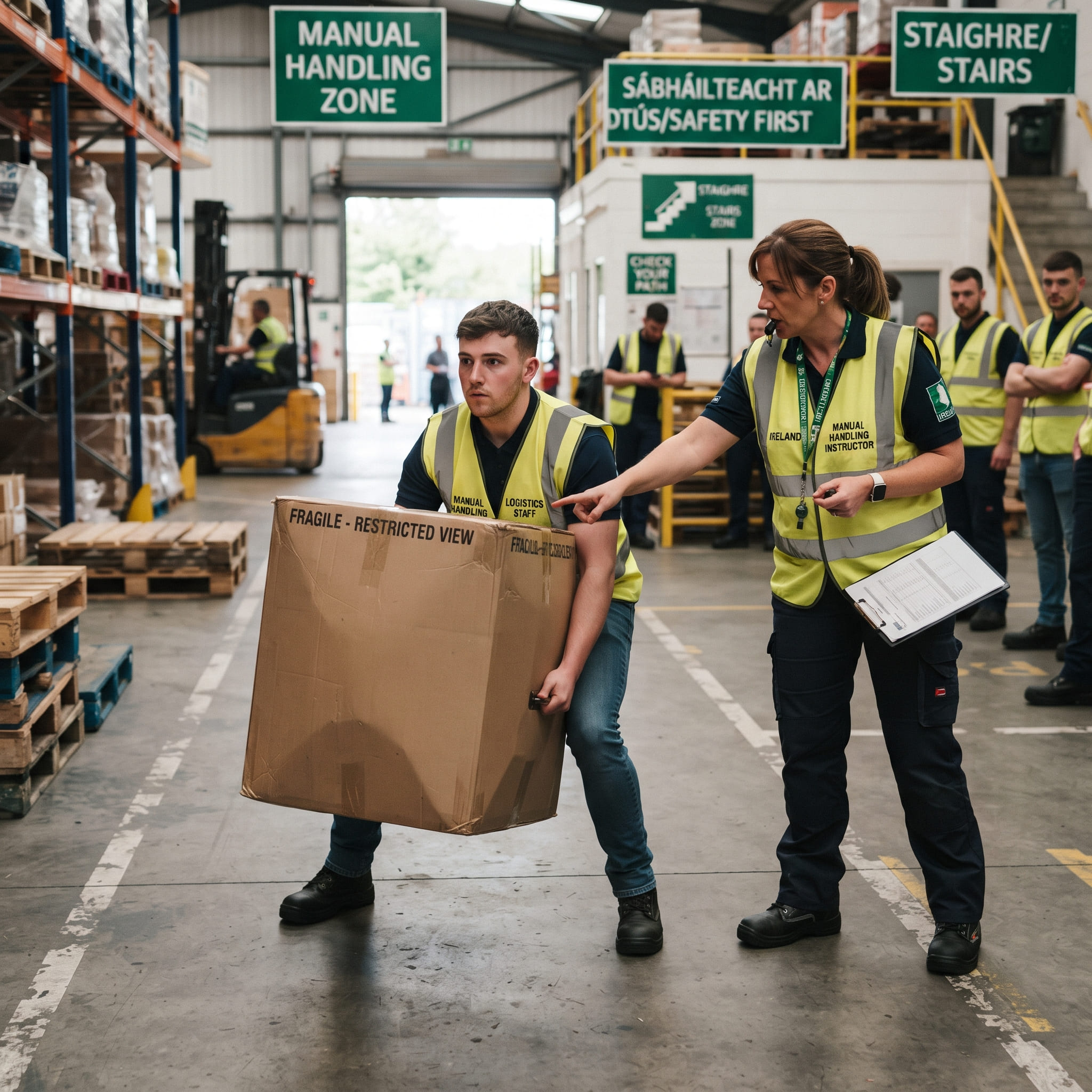
Manual handling is part of everyday work in many Irish industries. Employees may lift boxes in warehouses, move equipment in healthcare environments, handle stock in retail, transport materials on construction sites or relocate supplies in offices.
In many of these situations, workers may have to handle a load that restricts their visibility.
A large box may block the view of the floor. A long object may make it difficult to see around corners. A package stored in a confined space may require an employee to work from an awkward position. Even a relatively small load can become difficult to handle safely if the working area is poorly arranged.
Restricted visibility is therefore an important consideration when planning a manual handling task.
Professional Manual Handling Training Ireland helps employees recognise that safe lifting involves more than the weight of the load. Workers should also consider whether they can see the route, maintain a stable position and control the load throughout the movement.
A suitable Manual Handling Course Ireland can provide practical guidance on assessing loads, planning routes, using appropriate handling equipment and getting assistance when visibility is limited.
Why Restricted Visibility Creates Manual Handling Risks
When employees cannot see clearly, they may have difficulty identifying hazards.
These can include:
- Obstacles on the floor.
- Steps.
- Uneven surfaces.
- Other workers.
- Doors.
- Shelving.
- Vehicles.
- Equipment.
- The final placement area.
The risk becomes more significant when the employee is carrying a load that requires both hands.
A worker may be physically capable of carrying a box but still be unable to see where they are walking.
Large Boxes Can Block Your View
One of the most common examples is carrying a large cardboard box.
The box may not be particularly heavy, but its dimensions can prevent the employee from seeing the floor directly ahead.
This can create problems if the route contains:
- A step.
- A cable.
- Packaging.
- A pallet.
- Another person.
Employees should consider whether the load can be divided or moved using suitable equipment.
Do Not Assume a Short Distance Is Safe
Employees sometimes think that visibility does not matter if they only need to move a load a few metres.
However, a short route can still contain hazards.
A worker carrying a box across a room may encounter another employee, a chair, a trolley or an unexpected change in floor level.
The complete route should be considered before lifting.
Check the Route First
Whenever possible, employees should inspect the route before picking up the load.
Look for:
- Obstacles.
- Changes in floor level.
- Wet surfaces.
- Narrow areas.
- Doors.
- People.
- Equipment.
If the route is unsuitable, it should be cleared or another method should be considered.
Keep the Load Under Control
When visibility is restricted, maintaining control of the load becomes especially important.
Employees should avoid sudden movements and should not attempt to move faster simply because they cannot see clearly.
If the load becomes difficult to control, stopping and reassessing the task may be safer than continuing.
Consider the Size and Shape of the Load
Visibility problems are not limited to large boxes.
Long, wide or unusually shaped objects can also restrict a worker's view.
Examples include:
- Pipes.
- Boards.
- Furniture.
- Large equipment.
- Long packages.
- Oversized containers.
The shape of the object should be considered before movement begins.
Use a Different Carrying Position Where Appropriate
Sometimes changing how an object is held can improve visibility.
However, employees should not adopt an awkward or unstable position simply to see around a load.
The method should allow the worker to maintain control and move safely.
If this cannot be achieved, another handling method may be more appropriate.
Consider Mechanical Handling Equipment
A suitable handling aid can sometimes solve visibility problems as well as reduce physical effort.
Depending on the workplace, this could include:
- Trolleys.
- Carts.
- Pallet trucks.
- Lift equipment.
- Other mechanical aids.
The equipment must be suitable for the load and working environment.
Do Not Overload a Trolley
Using a trolley does not automatically make a task safe.
Employees should make sure that the load:
- Is stable.
- Does not block visibility.
- Is within the equipment's capacity.
- Does not interfere with safe movement.
If the load is stacked too high, the employee may still have restricted visibility.
Team Handling Can Improve Visibility
Some large objects may be more appropriately handled by two or more employees.
For example, one worker may be positioned so that they can see the route while another controls the other end of the load.
Team handling should be planned in advance.
Employees should agree on the route and communicate throughout the movement.
Communication During Team Handling
Clear communication can help when visibility is restricted.
One person can take responsibility for giving instructions where appropriate.
Useful commands may include:
- "Ready."
- "Move."
- "Stop."
- "Turn."
- "Lower."
Everyone involved should understand the instructions before movement starts.
Corners and Doorways
Corners can create additional visibility problems.
An employee carrying a large object may not be able to see whether someone is approaching from the other direction.
Employees should take appropriate care when approaching corners and doorways.
Where necessary, another person can help guide the movement.
Restricted Visibility in Narrow Areas
Confined or narrow spaces can make manual handling particularly challenging.
The employee may have limited room to:
- Turn.
- Adjust their grip.
- Step sideways.
- Lower the load.
If the load also blocks visibility, the task may become significantly more difficult.
The route and handling method should be assessed before the movement begins.
Stairs and Restricted Visibility
Stairs require particular attention.
If a load blocks the employee's view, they may not be able to see the next step clearly.
Employees should not manually carry a load on stairs if it prevents safe navigation.
Alternative handling methods should be considered where appropriate.
Changes in Floor Level
Even small changes in floor level can create hazards when visibility is restricted.
These may include:
- Door thresholds.
- Ramps.
- Steps.
- Raised flooring.
- Uneven surfaces.
The route should be checked before carrying the load.
Poor Lighting Makes Visibility Problems Worse
Restricted visibility from the load itself can become more problematic when the workplace is poorly lit.
Employees may struggle to see:
- The floor.
- Obstacles.
- Other workers.
- The load's destination.
Adequate workplace lighting is therefore an important part of the overall safety environment.
Keep Walkways Clear
Good housekeeping is particularly important where large loads are regularly transported.
Employees should avoid leaving:
- Boxes.
- Packaging.
- Tools.
- Cables.
- Equipment.
in areas used for carrying loads.
A clear route reduces the number of hazards an employee needs to navigate.
Check the Destination Before Lifting
The final placement area should also be prepared.
If the destination is blocked, an employee may have to carry the load around while searching for somewhere to put it.
This can increase handling time and create additional movements.
Prepare the destination before lifting whenever possible.
Do Not Throw or Drop Loads
When visibility is restricted, employees may be tempted to drop or slide a package into position.
This can create additional hazards and may damage the load.
Loads should be placed down in a controlled manner.
Visibility and Manual Handling in Warehouses
Warehouses often contain tall shelving and large quantities of stock.
Employees may move packages through busy aisles where visibility can already be limited by:
- Shelving.
- Pallets.
- Stock.
- Equipment.
- Other workers.
Large loads can make these conditions more challenging.
Warehouse routes should be planned and maintained.
Visibility on Construction Sites
Construction sites can present constantly changing conditions.
Materials, temporary structures and equipment may affect visibility.
Employees should follow site procedures and assess the route before manually moving materials.
Where appropriate, mechanical handling methods should be used.
Visibility in Retail
Retail employees may carry stock from storage areas to shelves.
Large packages can block visibility, particularly in narrow aisles.
Employees should consider customer movement as well as physical obstacles when transporting stock.
Visibility in Healthcare
Healthcare workers may move equipment, supplies and other loads through corridors and rooms.
If equipment or containers restrict visibility, employees should consider whether another handling method or assistance is appropriate.
This is particularly important in busy environments where people may move unexpectedly.
Individual Factors
Employees should also consider their own ability to control the load.
If a worker is unfamiliar with the task or cannot comfortably see the route, they should ask for assistance.
Good workplace safety encourages employees to speak up when a task is difficult to control.
Fatigue and Restricted Visibility
Fatigue can affect concentration.
An employee who is tired may be less likely to notice hazards or plan the route effectively.
This is particularly relevant where restricted visibility requires increased attention.
Employees should avoid rushing through manual handling tasks because of time pressure or workload.
Manual Handling Training Ireland
Professional Manual Handling Training Ireland helps employees understand how visibility can affect manual handling safety.
Training can cover:
- Safe lifting.
- Load assessment.
- Route planning.
- Carrying.
- Pushing and pulling.
- Team handling.
- Risk assessment.
- Mechanical handling aids.
These skills can help employees make better decisions when a load restricts their view.
Manual Handling Course Ireland
A suitable Manual Handling Course Ireland can encourage employees to ask practical questions before lifting:
Can I see where I am going?
Does the load block my view?
Is the route clear?
Are there steps or uneven surfaces?
Can I control the load safely?
Would equipment or assistance improve the situation?
These questions can help identify visibility problems before the task begins.
Manual Handling Certificate Ireland
Employees who complete appropriate training may receive a Manual Handling Certificate Ireland.
The certificate provides evidence that relevant training has been completed.
However, certification does not mean that every load should be manually carried.
Workers should continue to assess individual tasks and report situations where visibility or control is inadequate.
What Employers Can Do
Employers can reduce risks associated with restricted visibility by:
- Providing suitable handling equipment.
- Keeping walkways clear.
- Improving workplace lighting.
- Organising storage effectively.
- Reducing unnecessary carrying distances.
- Assessing large and awkward loads.
- Providing appropriate manual handling training.
- Encouraging employees to request assistance.
Workplace layout can often be improved to make manual handling easier.
A Simple Restricted-Visibility Checklist
Before lifting a load, ask:
1. Can I see the route?
If not, the task needs further consideration.
2. Does the load block my view?
If it does, consider an alternative method.
3. Is the route clear?
Remove or report obstacles where appropriate.
4. Are there changes in floor level?
Identify steps, ramps and uneven surfaces.
5. Is the lighting adequate?
Make sure hazards can be seen.
6. Can I control the load?
Do not proceed if the load is difficult to manage.
7. Do I need assistance?
Ask for help when appropriate.
8. Would handling equipment be safer?
Consider a suitable trolley or mechanical aid.
Building Safer Manual Handling Habits
Employees can develop better habits by treating visibility as part of every handling assessment.
Before lifting, take a moment to consider:
Load.
Visibility.
Route.
Environment.
Destination.
Equipment.
This simple approach can prevent employees from discovering hazards only after they have already picked up the load.
Conclusion
Restricted visibility can make an otherwise manageable manual handling task considerably more difficult. Large boxes, awkward packages, long objects, confined spaces and poorly organised workplaces can all prevent employees from seeing the route clearly.
The risks can increase further when restricted visibility is combined with poor lighting, uneven floors, stairs, obstacles or busy working areas.
Employees should therefore assess visibility before lifting. If a load blocks the view, they should consider whether it can be divided, moved using suitable equipment or handled with assistance.
Professional Manual Handling Training Ireland helps workers understand how visibility, workplace layout and load characteristics interact. A suitable Manual Handling Course Ireland can teach employees practical methods for assessing loads, planning routes and selecting safer handling methods.
A Manual Handling Certificate Ireland provides evidence of completed training, but safe manual handling depends on applying that knowledge to real workplace situations.
By keeping routes clear, maintaining adequate lighting, using appropriate equipment and avoiding loads that cannot be safely controlled, employers and employees can reduce unnecessary handling risks and create safer workplaces throughout Ireland.