



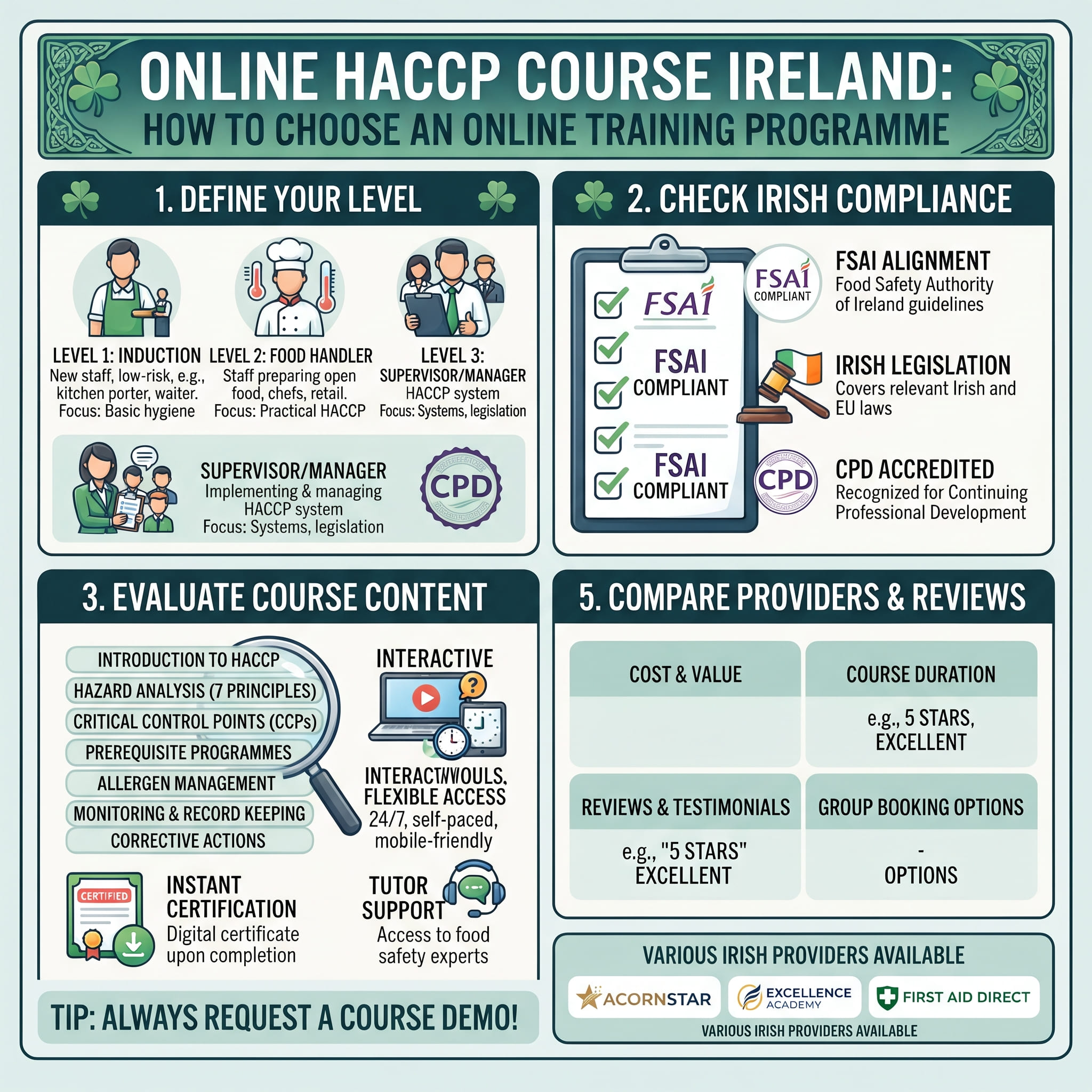
Food safety is an essential responsibility for businesses that prepare, store, transport, or serve food. Restaurants, cafés, hotels, catering companies, supermarkets, and food manufacturing facilities must follow appropriate procedures to prevent contamination and protect consumers. Employees also need to understand how their everyday activities affect food safety and why established hygiene procedures must be followed.
An haccp course online offers a convenient way to learn about food safety principles without attending a classroom at a fixed time. Online training can be particularly useful for busy employees, business owners, and individuals who want to develop their knowledge around existing work commitments.
However, online programmes differ in their content, assessment methods, duration, and certificate arrangements. Before enrolling in an haccp certification course, it is important to determine whether the programme matches your responsibilities and provides the knowledge you need.
This guide explains what to look for when choosing online HACCP training in Ireland and how to compare providers before making a decision.
1. Check the Course Content Before Enrolling
The first step is to review the syllabus and learning objectives. A suitable haccp food safety course should explain the main principles of Hazard Analysis and Critical Control Points (HACCP) and show how they apply to food handling and food preparation.
HACCP is a systematic approach to identifying food safety hazards and establishing controls to prevent, eliminate, or reduce significant hazards to acceptable levels.
Depending on the course level, the syllabus may cover:
-
Biological, chemical, and physical food safety hazards.
-
Food contamination and cross-contamination.
-
Personal hygiene and safe food handling.
-
Cleaning and disinfection procedures.
-
Temperature control and safe food storage.
-
Hazard analysis and Critical Control Points.
-
Monitoring procedures and record keeping.
-
Corrective actions when food safety controls fail.
-
Verification of food safety procedures.
Check that the course covers subjects relevant to your work. For example, an employee working in a restaurant may need practical guidance on handling raw ingredients, preventing cross-contamination, and maintaining suitable storage conditions.
Someone responsible for developing or maintaining a HACCP-based system may need more advanced instruction on hazard analysis, monitoring, verification, and documentation.
Do not choose a course solely because its title includes HACCP. Review what you will actually learn.
2. Make Sure the Training Matches Your Job Role
Food safety responsibilities vary depending on the workplace and the employee's duties. A food handler may need a different level of training from a kitchen supervisor or a person responsible for a food safety management system.
Before purchasing haccp training, consider what you need to understand and apply in your current position.
For example, food handlers commonly need to understand personal hygiene, contamination prevention, safe storage, and the importance of following workplace procedures. Supervisors may also need to understand how to monitor staff practices, maintain records, and respond when a problem occurs.
People responsible for HACCP-based procedures may require more detailed knowledge of identifying hazards, determining CCPs, establishing critical limits, and checking whether controls are effective.
Ask the provider whether the course is designed for beginners, food handlers, supervisors, or managers. Check the stated learning outcomes and confirm with your employer if a particular course level or qualification is required.
A suitable programme should provide the depth of knowledge appropriate to your responsibilities rather than assuming that one course meets every learner's needs.
3. Evaluate the Online Learning Experience
One of the main advantages of an online course is flexibility. Learners may be able to study from home, during suitable breaks, or outside normal working hours.
However, flexibility is most useful when the learning materials are clear, organised, and easy to understand.
When evaluating an haccp course online, look for features such as:
-
Clearly organised lessons and modules.
-
Straightforward explanations of food safety principles.
-
Visual examples, diagrams, or educational videos.
-
Practical workplace scenarios.
-
Knowledge checks or quizzes.
-
Progress tracking, where available.
-
Access to materials for review.
-
Clear instructions for completing the programme.
For example, a lesson might explain what happens when chilled food is stored outside the limits specified by the business. Learners should understand why the issue must be reported, why the affected food may need assessment, and why corrective action must follow established procedures.
Before enrolling, check the estimated study time and whether the course is self-paced or has a fixed completion deadline. You should also confirm which devices and browsers are supported.
An effective online learning experience should help you understand the subject rather than simply move through a series of pages.
4. Understand the Certificate and Its Requirements
Many learners choose online training because they need evidence that they have completed a food safety programme. However, the meaning of a certificate depends on the course, provider, and assessment arrangements.
Before purchasing haccp certification, establish exactly what the provider offers.
Check whether the certificate confirms attendance, completion of the learning materials, or successful completion of an assessment. These outcomes are not necessarily equivalent.
You should also check:
-
The organisation that issues the certificate.
-
The course title and completion date.
-
Whether your name appears on the document.
-
Whether the certificate can be verified.
-
Whether an assessment must be passed.
-
Whether refresher training is recommended.
-
Whether your employer accepts the particular course.
If a provider claims that a programme is accredited, regulated, or formally recognised, ask for details and verify the claim with the relevant organisation.
Do not assume that every online course has the same qualification status simply because the provider uses similar terminology.
A certificate can demonstrate that training has been completed, but it does not automatically prove practical competence in every food-handling task or confirm that a business meets all applicable food safety requirements.
5. Check the Assessment Method
Assessment helps determine whether learners have understood the course content. Before enrolling in a haccp certification course, review how your knowledge will be evaluated.
Online programmes may use multiple-choice questions, short quizzes, written exercises, or workplace scenarios. The appropriate method depends on the course level and learning objectives.
Assessments may cover food safety hazards, personal hygiene, contamination prevention, temperature control, and the principles of HACCP.
A practical scenario could ask you to identify possible contamination risks when raw food is delivered or explain what should happen if a required monitoring check identifies a problem.
Before enrolling, find out whether the assessment is included in the price, whether a minimum pass mark applies, and whether retakes are permitted. Check whether the provider explains incorrect answers or offers support when learners struggle with a topic.
A transparent assessment process helps you understand what is required to complete the programme successfully.
For employers, assessment results and training records can also help demonstrate that staff have completed relevant learning, although these records do not replace workplace supervision or practical competency checks where needed.
6. Review the Provider's Credibility and Transparency
Choosing an online course means relying on the provider to deliver suitable learning materials and explain its services accurately.
A trustworthy provider should make essential information easy to find. This includes the course syllabus, price, duration, assessment requirements, certificate arrangements, contact information, and terms of service.
When reviewing a provider, ask:
-
Is the organisation clearly identified?
-
Is the course content explained in sufficient detail?
-
Can you contact the provider if you need assistance?
-
Are payment and refund conditions available?
-
Is information about personal data and privacy provided?
-
Are claims about accreditation or recognition supported by evidence?
Be cautious of promises that a certificate guarantees employment or will automatically be accepted by every employer.
In Ireland, the Food Safety Authority of Ireland (FSAI) provides information about food safety responsibilities and training. Its official website, https://www.fsai.ie/, is a useful resource when checking the general requirements relevant to food businesses.
Comparing the provider's information with official guidance can help you make a more informed decision.
7. Confirm That the Course Covers Relevant Irish Food Safety Requirements
If you intend to work in Ireland, choose training that helps you understand the food safety responsibilities applicable to your role.
Under applicable EU food hygiene rules, food business operators must ensure that food handlers receive appropriate hygiene instruction or training in line with their work. People responsible for developing and maintaining HACCP-based procedures must also receive adequate training in applying HACCP principles.
A suitable haccp food safety course may cover topics such as:
-
Checking deliveries and the condition of ingredients.
-
Storing chilled, frozen, and dry foods appropriately.
-
Preventing cross-contamination during preparation.
-
Managing allergens and preventing unintended allergen transfer.
-
Following appropriate cooking, cooling, and reheating procedures.
-
Monitoring relevant food safety controls.
-
Maintaining accurate records.
-
Reporting problems and following corrective actions.
The training you need depends on your responsibilities and the nature of the food business. An introductory course may be appropriate for one position but insufficient for a person managing a complex food safety system.
Review the course syllabus and consult the FSAI's guidance before deciding whether a particular programme is suitable.
8. Compare Prices, Duration, and Learner Support
Online HACCP training is available at different prices and course lengths. Comparing these factors can help you identify a programme that fits your budget and schedule.
However, the cheapest option is not always the best value. When comparing haccp training, check what the advertised price includes.
Determine whether learning materials, assessments, certificate issuance, and permitted retakes are included. If you are arranging training for several employees, ask whether the provider offers group pricing.
Course duration should also reflect the subject matter. A short introductory programme may suit learners who need basic food safety knowledge, while people with greater responsibilities may need more detailed instruction.
There is no single course duration that automatically makes a programme suitable. The quality and relevance of the content are more important than the number of minutes advertised.
Learner support is another consideration. Check whether help is available for questions about the course, technical problems, or assessment requirements.
Choosing a programme with clear pricing, realistic learning objectives, and appropriate support can make the training experience more effective.
9. Look for Practical Examples You Can Apply at Work
Food safety training is most useful when learners can connect what they study with real workplace situations.
For example, an employee preparing food should understand how contaminated equipment can transfer harmful microorganisms to ready-to-eat products. A worker responsible for chilled storage should understand why temperature checks matter and what to do when a problem is identified.
A good haccp course online should use examples that explain not only what a hazard is but also how it can arise and how established procedures help control it.
Look for lessons involving realistic food handling, cleaning, storage, monitoring, and reporting situations. These can help you recognise potential problems and understand your responsibilities.
Online learning can develop theoretical knowledge, but certain tasks may also require supervised practice or workplace-specific instruction. Employers should ensure that staff can apply the relevant procedures correctly.
Conclusion
Choosing an online HACCP course in Ireland involves more than finding a convenient programme or an affordable certificate. You should review the syllabus, confirm that the course matches your job responsibilities, understand the assessment process, and check the provider's credibility.
A suitable haccp certification course should have clear learning objectives and provide useful knowledge about food safety hazards, contamination prevention, temperature control, monitoring, and HACCP principles.
Before enrolling in an haccp course online, verify what the certificate represents and whether the training meets your employer's requirements. If your role involves managing HACCP-based procedures, ensure that the programme provides sufficient depth for those responsibilities.
By choosing appropriate haccp training, you can develop food safety knowledge that supports safer working practices and helps you understand your role in protecting consumers.
Ultimately, haccp certification should be viewed as one part of an ongoing commitment to food safety, supported by practical skills, appropriate supervision, accurate records, and consistent workplace procedures.