



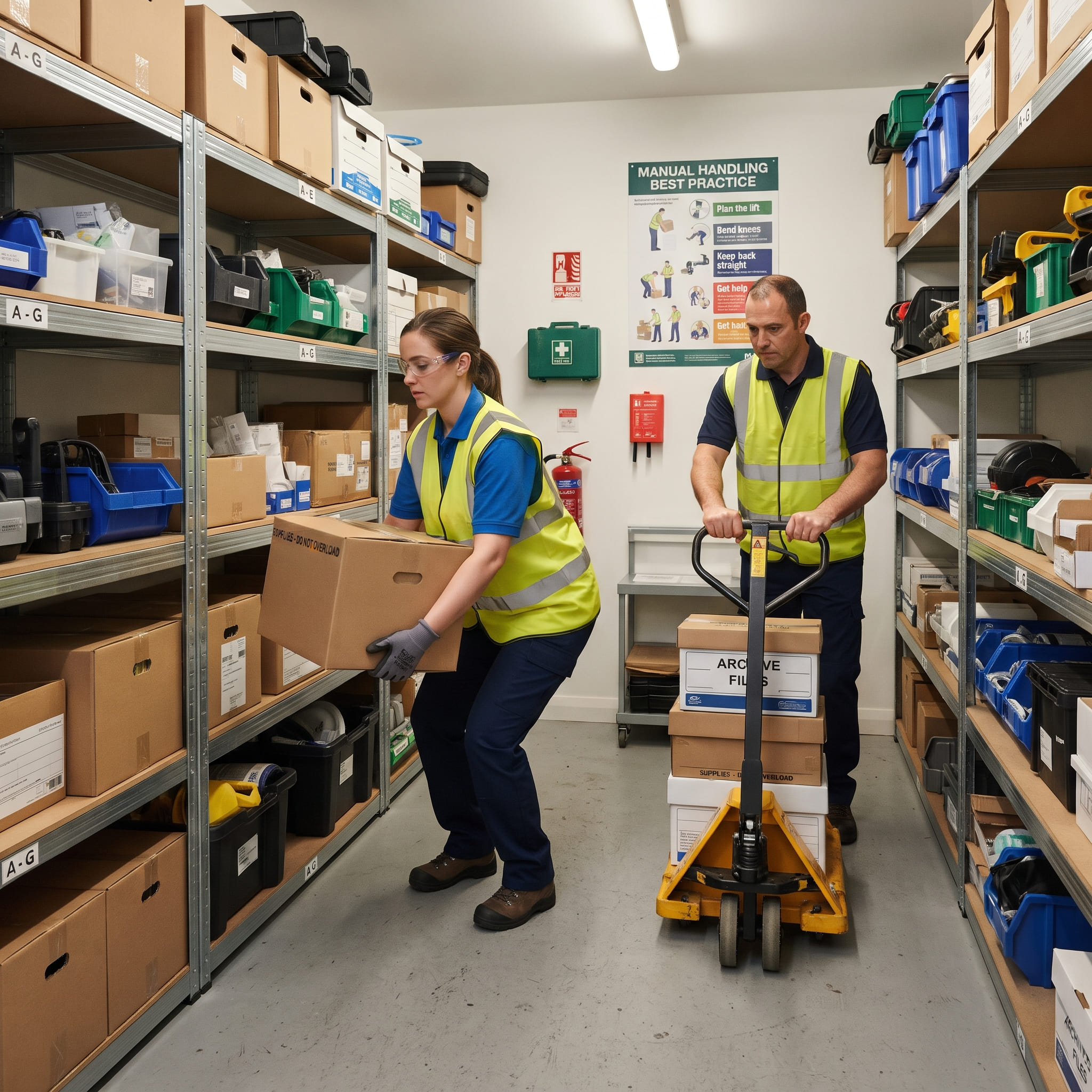
Small storage rooms are common in offices, shops, warehouses, hotels, restaurants, healthcare facilities, and other workplaces. They provide convenient spaces for keeping supplies, tools, equipment, stock, and materials. However, limited floor space and poorly organised shelving can make everyday handling tasks more difficult than expected.
Employees may need to lift boxes from low shelves, reach for items stored overhead, turn in narrow aisles, or move bulky objects around other stored materials. These activities can increase the risk of muscle strains, back injuries, shoulder discomfort, and other manual handling problems, particularly when workers have insufficient room to position themselves correctly.
Reducing these risks requires more than reminding employees to lift carefully. Employers should consider how storage areas are designed, how frequently used items are positioned, and whether workers can move loads without twisting or overreaching.
Understanding these factors is an important part of Manual Handling Training Ireland, helping employees and employers recognise hazards and adopt safer working practices.
1. Identify Common Manual Handling Hazards in Small Storage Rooms
The first step towards improving safety is identifying the conditions that make handling tasks difficult.
In small storage rooms, common hazards include:
-
Narrow aisles that restrict movement.
-
Boxes and equipment stored directly on the floor.
-
Heavy objects positioned above shoulder height.
-
Frequently used materials placed on high or low shelves.
-
Unstable stacks of boxes or containers.
-
Poor lighting that makes it difficult to assess loads.
-
Restricted turning space when carrying bulky items.
-
Obstructed access to shelves, doors, and emergency routes.
These conditions can force employees to adopt awkward postures or handle loads without sufficient clearance.
For example, an employee retrieving a heavy box from the back of a crowded shelf may need to lean forward while reaching around other items. If the box is difficult to grip, moving it can place additional strain on the back, arms, and shoulders.
Employers should inspect storage rooms regularly and assess how employees actually retrieve, move, and replace items. A task that appears straightforward on paper may present significant difficulties in a confined space.
2. Organise Shelves to Make Frequently Used Items Accessible
The arrangement of stored materials has a direct influence on manual handling safety.
Frequently used items should be placed where employees can access them without excessive bending, stretching, or reaching. Suitable storage positions generally allow workers to handle materials around waist-to-chest height, depending on the item's weight, shape, and handling requirements.
Heavy or awkward items should not automatically be placed on the highest available shelves simply because they are difficult to fit elsewhere. Instead, employers should identify appropriate lower or middle shelf positions that allow controlled handling.
Consider the following improvements:
-
Store frequently accessed supplies in convenient locations.
-
Place heavier items on suitable shelves at accessible heights.
-
Keep lighter, less frequently used materials on higher shelves where appropriate.
-
Avoid placing heavy objects directly on the floor if retrieving them would require difficult lifting.
-
Label shelves clearly to reduce unnecessary searching and rearranging.
-
Keep similar items together so workers can retrieve them efficiently.
Storage arrangements should also reflect the physical characteristics of individual loads. A lightweight but oversized package may need more clearance than a compact, heavier object.
Good organisation reduces unnecessary handling and makes it easier for employees to maintain stable positions when lifting or carrying items.
3. Keep Aisles and Access Routes Clear
Limited space becomes particularly hazardous when boxes, packaging materials, or equipment are left in walkways.
Employees carrying loads need sufficient room to see where they are going, maintain balance, and move without colliding with shelves or other objects. Obstacles can cause sudden changes in direction, awkward steps, or loss of balance.
Storage rooms should have designated areas for stock, waste, and equipment. Items should never be left temporarily in access routes simply because shelves are full.
Practical measures include:
-
Removing empty boxes and packaging promptly.
-
Keeping floors free from loose materials and trailing cables.
-
Ensuring doors can open without obstruction.
-
Maintaining clear access to frequently used shelves.
-
Cleaning spills immediately and investigating recurring floor hazards.
-
Avoiding storage practices that require workers to step over objects.
Employees should not be expected to carry heavy loads through an obstructed route when a safer alternative is available.
Before moving an item, workers should check the intended route and remove manageable obstacles where appropriate. If the route cannot be made safe, the task should be paused until the problem is addressed.
4. Avoid Lifting While Twisting in Confined Spaces
One of the main difficulties in small storage rooms is the lack of space to turn around comfortably.
An employee may lift a box from a shelf and then twist the upper body to place it on a trolley or carry it towards the door. Combining lifting with twisting can increase physical strain, especially when the load is heavy, bulky, or held away from the body.
Whenever possible, workers should position themselves directly in front of the item before lifting. They should consider where the load needs to go and arrange the working space before beginning.
Safer practices include:
-
Moving unnecessary objects out of the immediate working area.
-
Turning the feet in the direction of movement rather than twisting the torso.
-
Keeping the load close to the body where practical.
-
Avoiding sudden movements while holding an item.
-
Placing the load down before changing position if space is restricted.
-
Using a suitable trolley or other handling aid when appropriate.
If the room is too crowded to lift and turn safely, the correct response is to improve the space or change the handling method. Employees should not be encouraged to force themselves into awkward positions to complete a task quickly.
5. Assess the Weight, Size, and Stability of Each Load
Packages stored in small rooms may vary considerably in weight, shape, and stability. A box that looks easy to handle may contain dense equipment or materials that shift during movement.
Employees should not rely on appearance alone when deciding whether a load is manageable.
Before lifting, they should check whether the item has a weight label, whether its contents are likely to move, and whether the packaging is damaged. If the load is unfamiliar, they should establish what is inside where possible.
A safe assessment should consider:
-
The load's approximate weight.
-
Its size and shape.
-
The availability of secure handholds.
-
Whether the contents may shift.
-
The distance the item must be moved.
-
The available space and carrying route.
-
The worker's capability and the handling method required.
There is no single weight limit that makes every manual handling task safe. Risk depends on several factors, including posture, repetition, distance, and the working environment.
If an item is too heavy or awkward to handle safely, workers should use suitable mechanical assistance, seek help where appropriate, or arrange an alternative method.
6. Use Suitable Storage Equipment and Handling Aids
The right equipment can reduce unnecessary lifting and improve control in confined storage areas.
Depending on the workplace, useful options may include shelving units designed for the stored materials, step platforms for suitable access tasks, small stock trolleys, wheeled containers, and lifting aids.
Equipment must be appropriate for the task and the dimensions of the room. A large trolley may be unsuitable if it cannot turn safely in the available space. Similarly, shelving should be stable, suitable for the expected loads, and arranged to allow safe access.
Employers should ensure that:
-
Shelving is suitable for the weight and type of materials stored.
-
Loads are distributed according to the shelving manufacturer's guidance.
-
Handling aids can move through the available routes.
-
Wheels, brakes, handles, and other relevant components are maintained.
-
Workers know how to use equipment safely.
-
Defective equipment is removed from service until repaired or replaced.
Employees should not climb on shelving, boxes, chairs, or improvised platforms to retrieve items. Where access equipment is needed, the employer should provide a suitable solution and ensure it is used correctly.
7. Reduce Repeated Lifting and Unnecessary Handling
Small storage rooms can become inefficient when stock is repeatedly moved to reach other items. Employees may have to remove several boxes, retrieve one product, and then replace everything they moved.
This creates additional lifting, carrying, and placing tasks without adding value to the work.
A better storage system can reduce the number of times each item must be handled. Frequently accessed supplies should remain accessible, while deliveries should be organised so that new stock does not block existing materials.
Employers can reduce unnecessary handling by:
-
Reviewing which items are used most frequently.
-
Keeping stock locations consistent.
-
Using clear labels and simple inventory systems.
-
Avoiding excessive stock accumulation.
-
Separating damaged, expired, or unwanted materials.
-
Planning deliveries and restocking activities.
-
Keeping suitable quantities near the point of use.
These changes can improve efficiency while reducing the physical demands placed on employees throughout the working day.
8. Provide Appropriate Manual Handling Training
Storage-room hazards are not always obvious to employees, especially when tasks are routine. Workers may become accustomed to reaching into crowded shelves, lifting from awkward positions, or carrying boxes through narrow spaces.
Appropriate training helps employees recognise these risks and understand when a handling task needs to be changed.
A Manual Handling Course Ireland can help workers develop awareness of risk factors, load assessment, safer handling techniques, and the importance of workplace risk controls. Training should be relevant to the tasks employees actually perform rather than relying entirely on general lifting demonstrations.
Employees should understand how to assess a load, plan a route, position themselves, avoid unnecessary twisting, and recognise when assistance or equipment is required.
Completing a Manual Handling Certificate Ireland course may provide evidence that an employee has undertaken training. However, training alone does not remove workplace hazards. Employers must also assess risks, provide suitable equipment, maintain safe storage arrangements, and implement appropriate controls.
Training should be reviewed when working practices change, new equipment is introduced, or assessments identify additional risks.
9. Improve Lighting, Flooring, and General Housekeeping
Poor environmental conditions can make manual handling more difficult.
Inadequate lighting may prevent employees from seeing shelf edges, labels, obstacles, or damaged packaging. Uneven or slippery flooring can affect balance, particularly when workers carry objects that restrict their view.
Employers should ensure storage rooms have adequate lighting for the tasks performed. Floors should be maintained in good condition and kept clean, dry, and free from unnecessary obstacles.
Where items are stored in corners or behind larger containers, employees should be able to see what they are retrieving before attempting to lift it.
Good housekeeping should be part of everyday working routines rather than an occasional activity. Employees should know where materials belong and how to report damaged shelving, unsafe stacking, or recurring access problems.
10. Encourage Employees to Report Unsafe Storage Conditions
Workers who use a storage room every day may notice problems before managers do. They may identify shelves that are difficult to access, items that are repeatedly moved, or loads that cannot be lifted without awkward postures.
Employers should encourage employees to report these issues without fear of being criticised for delaying a task.
Reports should be followed by practical action. Depending on the problem, this might involve rearranging shelves, removing excess stock, providing a trolley, changing delivery procedures, or carrying out a more detailed risk assessment.
Supervisors should also observe handling tasks where appropriate. This can help identify differences between written procedures and the conditions workers face in practice.
A storage room should be reviewed whenever significant changes occur, including increased stock levels, new equipment, or changes to the type of materials handled.
Conclusion
Small storage rooms can create significant manual handling challenges when space is limited, shelves are poorly organised, and employees must repeatedly lift or move awkward loads. However, many of these risks can be reduced through practical workplace improvements.
Organising frequently used items at accessible heights, keeping aisles clear, assessing loads before lifting, avoiding twisting, and providing suitable handling aids can make everyday tasks safer and more efficient. Employers should also maintain good lighting and flooring, encourage hazard reporting, and provide training relevant to the work being performed.
Effective Manual Handling Training Ireland should support these controls rather than replace them. By combining employee awareness with suitable storage design and regular risk assessments, businesses can reduce unnecessary physical strain and create safer, more organised storage areas.