



Retail is one of Ireland's largest employment sectors, with thousands of employees working in supermarkets, department stores, pharmacies, hardware stores, clothing retailers, furniture shops, and convenience stores. While retail is often associated with customer service, many employees spend a significant portion of their day lifting, carrying, pushing, pulling, and moving stock.
Whether unloading deliveries, stacking shelves, moving promotional displays, or transporting goods between storage areas, manual handling is a routine part of retail work. When these tasks are performed incorrectly, they can lead to back injuries, muscle strains, shoulder pain, and long-term musculoskeletal disorders.
A professional Manual Handling Training Ireland programme helps retail employees develop the practical skills needed to perform manual handling tasks safely. Through a recognised Manual Handling Course Ireland, workers learn correct lifting techniques, hazard awareness, risk assessment, and safe working practices. Completing a Manual Handling Certificate Ireland demonstrates that employees understand these essential safety principles and are prepared to contribute to a safer retail workplace.
This guide explores safe stock handling and lifting techniques that help reduce workplace injuries while improving efficiency and customer service.
Why Manual Handling Is Important in Retail
Every retail business depends on efficient stock movement.
Typical manual handling tasks include:
- Unloading deliveries
- Carrying stock from storage rooms
- Restocking shelves
- Moving promotional displays
- Transporting boxes
- Handling customer returns
- Moving furniture or equipment
- Pushing stock cages
- Loading customer purchases
Although many of these tasks appear straightforward, they become physically demanding when repeated throughout the working day.
Safe manual handling protects employees while helping stores operate efficiently.
Common Retail Manual Handling Injuries
Retail employees frequently experience injuries caused by poor lifting techniques or repetitive manual handling.
Common injuries include:
- Lower back pain
- Shoulder strains
- Neck pain
- Muscle injuries
- Wrist strains
- Knee injuries
- Repetitive strain injuries
- Long-term musculoskeletal disorders
Many of these injuries develop gradually after months of repetitive lifting rather than through one single incident.
Understanding Manual Handling Risks in Retail
Retail environments present several unique manual handling challenges.
Employees may encounter:
- Narrow aisles
- Busy customer areas
- Slippery floors
- Crowded stockrooms
- Heavy or awkward deliveries
- High shelving
- Poorly stacked boxes
- Seasonal increases in workload
Recognising these hazards before starting a task helps reduce the risk of workplace accidents.
A quality Manual Handling Course Ireland teaches employees how to identify and manage these risks effectively.
Assess Every Task Before Lifting
Before lifting any item, employees should take a few moments to assess the task.
Consider:
- How heavy is the load?
- Is the object stable?
- Can the load be divided?
- Is the route clear?
- Are customers nearby?
- Is assistance needed?
- Can lifting equipment be used?
Making this assessment before lifting helps prevent unnecessary injuries.
Use Correct Lifting Techniques
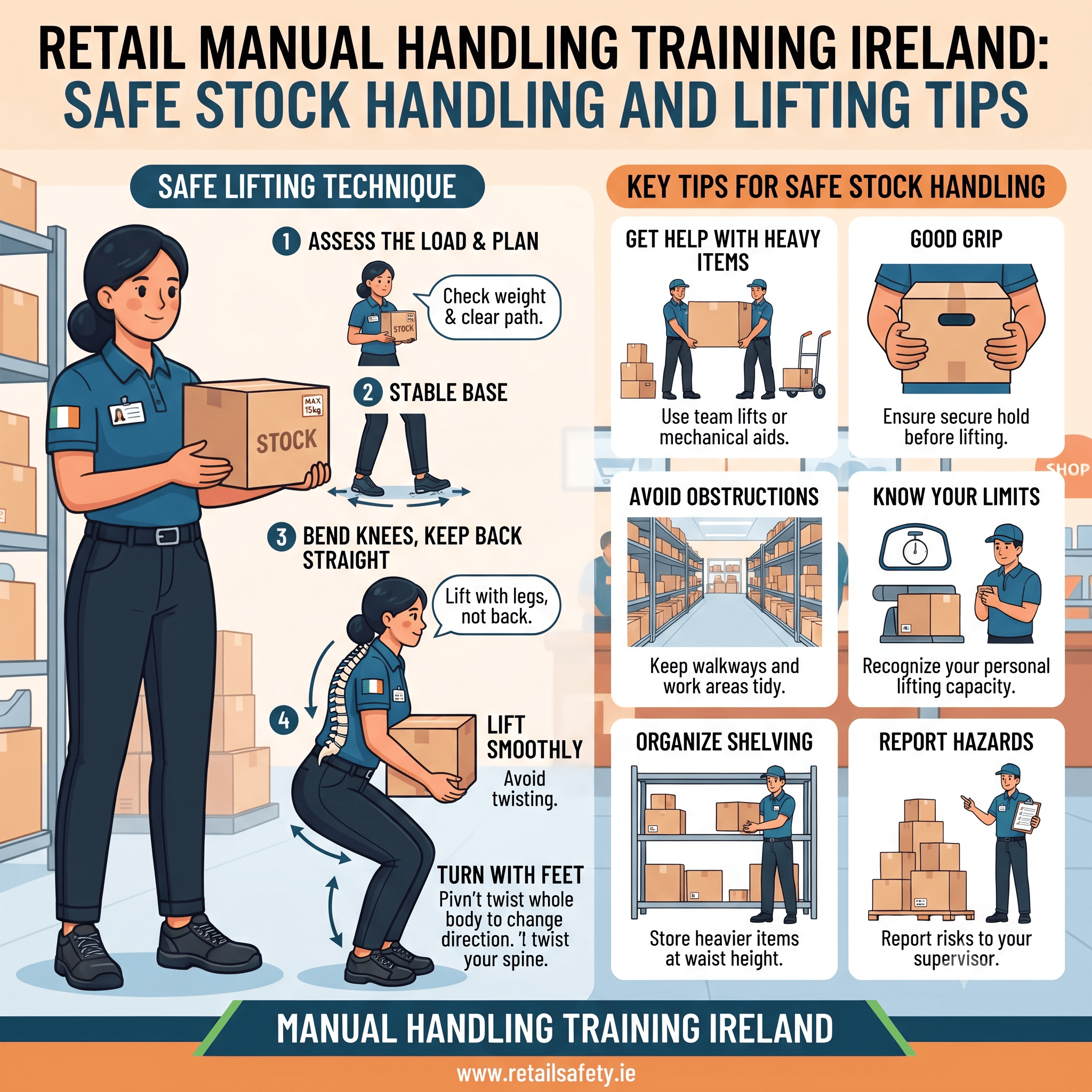
Safe lifting techniques are one of the most important parts of Manual Handling Training Ireland.
Employees learn to:
- Stand with feet shoulder-width apart.
- Bend at the knees.
- Keep the back in a neutral position.
- Lift using the strength of the legs.
- Hold the load close to the body.
- Avoid sudden or jerking movements.
- Lower the load carefully.
These techniques reduce strain on the spine and improve overall control.
Keep Loads Close to Your Body
Holding stock too far away from your body increases pressure on your muscles and joints.
Instead:
- Carry items close to your waist.
- Keep elbows tucked in.
- Maintain balance while walking.
- Avoid reaching unnecessarily.
Keeping the load close makes lifting safer and less physically demanding.
Avoid Twisting While Carrying
Retail employees often need to place stock on shelves or display units.
Twisting while holding a load can quickly lead to back injuries.
Instead:
- Turn with your feet.
- Move your whole body.
- Keep your shoulders aligned with your hips.
- Maintain the load close to your body.
Good body movement protects the lower back.
Organise Stockrooms Properly
An organised stockroom supports safer manual handling.
Good practice includes:
- Keeping walkways clear.
- Storing heavier items at waist height where possible.
- Labelling storage areas clearly.
- Stacking goods securely.
- Removing damaged packaging promptly.
Well-organised storage reduces unnecessary lifting and improves efficiency.
Make Full Use of Mechanical Aids
Retail workplaces often provide equipment that reduces physical effort.
Examples include:
- Stock trolleys
- Roll cages
- Pallet trucks
- Platform trolleys
- Lift tables
- Hand trucks
Employees should use these aids whenever appropriate rather than attempting unnecessary manual lifting.
A professional Manual Handling Course Ireland explains when mechanical assistance is the safest option.
Safe Shelf Stocking Techniques
Shelf replenishment is one of the most common retail tasks.
To reduce injury risk:
- Place heavier items on lower shelves where practical.
- Avoid excessive reaching.
- Use step platforms for high shelving.
- Lift one item at a time when necessary.
- Position yourself directly in front of the shelf before lifting.
Small adjustments like these greatly reduce physical strain during repetitive work.
Moving Promotional Displays Safely
Retail displays can be bulky, awkward, and difficult to move.
Employees should:
- Check the weight before moving.
- Remove loose items.
- Use trolleys whenever possible.
- Ask for assistance with large displays.
- Plan the route through the store.
Planning ahead reduces the likelihood of accidents in busy customer areas.
Managing Deliveries Safely
Deliveries often arrive during busy trading hours.
When unloading stock:
- Inspect packages for damage.
- Move one load at a time.
- Keep loading areas organised.
- Avoid blocking fire exits or customer walkways.
- Separate heavy and light items.
Safe delivery handling helps prevent injuries while maintaining an organised workplace.
Preventing Repetitive Strain Injuries
Retail work often involves repeating the same movements for long periods.
Employees can reduce repetitive strain by:
- Rotating tasks where possible.
- Taking scheduled breaks.
- Using lifting equipment.
- Stretching during breaks.
- Applying correct lifting techniques consistently.
Reducing repetitive strain protects long-term health.
Working Safely Around Customers
Retail environments are unique because employees often perform manual handling tasks while customers are shopping.
Workers should:
- Be aware of customer movement.
- Use warning signs where appropriate.
- Avoid carrying oversized loads through crowded aisles.
- Keep emergency exits clear.
- Never leave stock unattended in walkways.
Protecting customers is just as important as protecting staff.
Benefits for Retail Employers
Investing in Manual Handling Training Ireland benefits both employees and businesses.
Advantages include:
- Fewer workplace injuries
- Reduced absenteeism
- Improved productivity
- Better customer service
- Increased employee confidence
- Lower insurance and compensation costs
- Stronger workplace safety culture
Healthy employees are better able to provide excellent customer service while maintaining efficient store operations.
Flexible Online Manual Handling Training
Many retail businesses choose online learning because it fits around shift work and busy trading periods.
Benefits include:
- Learn at your own pace.
- Complete training from any location.
- Study on multiple devices.
- Minimal disruption to business operations.
- Easy induction for new employees.
- Quick certification after successful completion.
Online training allows retailers to maintain consistent safety standards across multiple stores.
The Importance of a Manual Handling Certificate Ireland
After completing a recognised course, participants receive a Manual Handling Certificate Ireland.
The certificate confirms that employees understand:
- Safe lifting techniques
- Manual handling principles
- Risk assessment
- Hazard awareness
- Safe workplace procedures
Many retail employers request certification before employees begin roles involving regular manual handling.
It also demonstrates professionalism and a commitment to workplace safety.
Creating a Safer Retail Workplace
A strong safety culture benefits everyone in the workplace.
Retail employers should encourage employees to:
- Report hazards immediately.
- Keep stockrooms organised.
- Use mechanical aids whenever available.
- Follow safe lifting techniques.
- Ask for help when required.
- Never rush manual handling tasks.
When safe manual handling becomes part of everyday operations, stores experience fewer injuries, better productivity, and a more positive working environment.
Conclusion
Manual handling is an essential part of retail work, from receiving deliveries and stocking shelves to moving displays and assisting customers with purchases. Without the correct techniques, these everyday tasks can lead to preventable injuries that affect employee wellbeing and business performance.
A professional Manual Handling Training Ireland programme gives retail employees the knowledge and practical skills needed to perform manual handling tasks safely and efficiently. Through a comprehensive Manual Handling Course Ireland, workers learn how to assess risks, apply correct lifting techniques, use mechanical aids effectively, and maintain safe working practices in busy retail environments.
Earning a recognised Manual Handling Certificate Ireland demonstrates a commitment to workplace safety and professional standards. For retailers across Ireland, investing in manual handling training is more than meeting health and safety obligations—it is an investment in healthier employees, improved productivity, better customer service, and a safer shopping environment for everyone.