



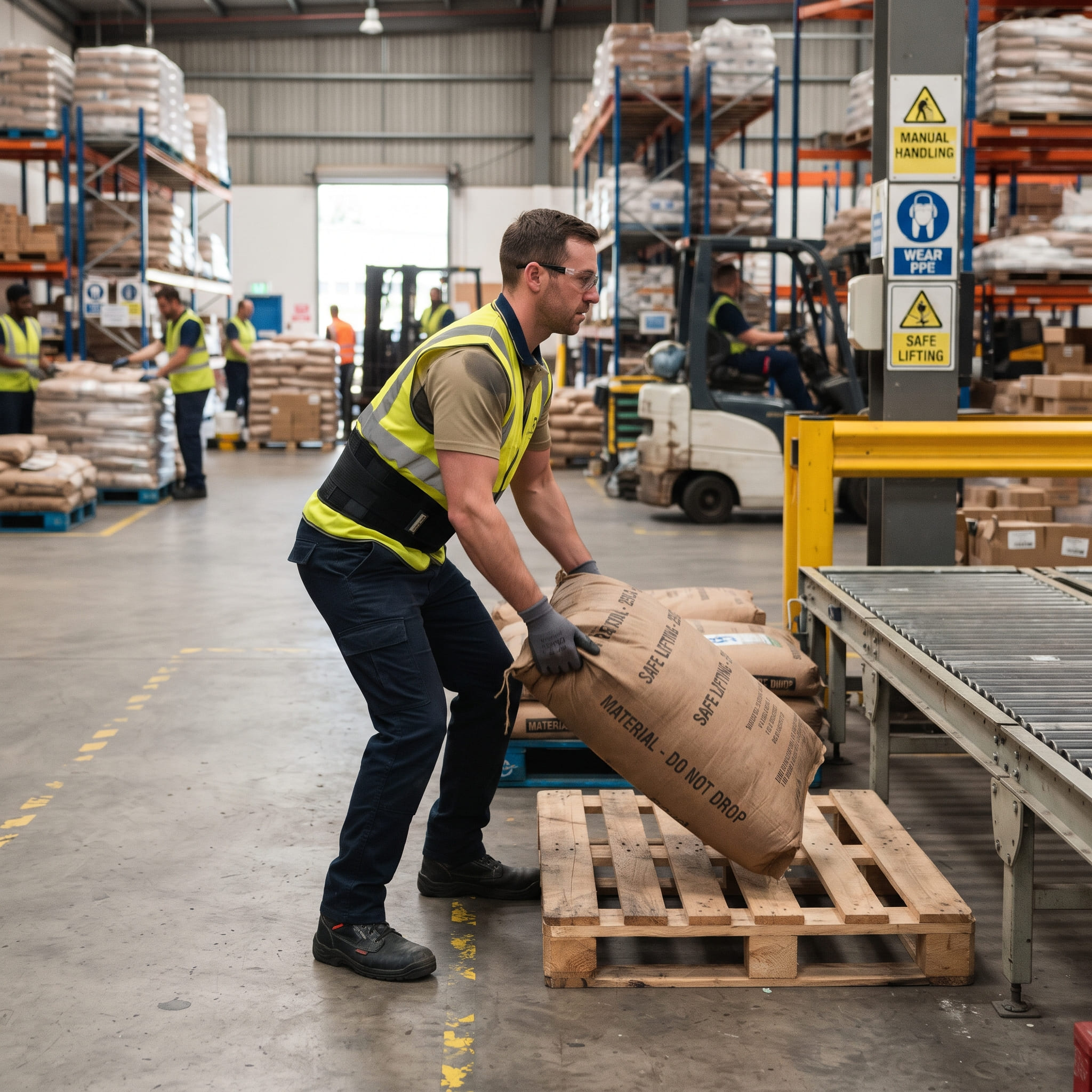
Bags, sacks, and other flexible loads are handled every day in warehouses, shops, farms, construction sites, food production facilities, and delivery operations. These loads may contain ingredients, packaging materials, soil, waste, stock, or other workplace supplies. Although many appear straightforward to move, their flexible shape and changing weight distribution can make them more difficult to handle than rigid boxes or containers.
A sack may sag when lifted, a bag may tear under pressure, or loose contents may shift unexpectedly during carrying. Employees may also struggle to establish a secure grip when packaging has no handles or when the surface is slippery. These difficulties can encourage awkward postures, sudden movements, and excessive physical effort.
Safe handling requires workers to assess the load, plan the movement, and use a suitable technique or handling aid. Employers must also consider the work environment, the frequency of lifting, and whether packaging and storage arrangements create unnecessary risks.
Effective Manual Handling Training Ireland helps employees recognise these challenges and apply safer practices when working with bags, sacks, and flexible materials.
1. Assess the Weight and Contents Before Lifting
The first step is to understand what is inside the bag or sack. Two packages of similar size may have very different weights depending on their contents. A sack of dense material, for example, may be significantly heavier than a bag containing lightweight packaging.
The contents can also affect how the load behaves. Loose materials may settle towards the bottom, while liquids or partially filled bags may move as the package changes position.
Before lifting, employees should check available weight labels, inspect the packaging, and consider whether the contents are likely to shift. If the weight is unknown, they should establish it where reasonably possible rather than relying on appearance alone.
A suitable assessment should consider:
-
The approximate weight of the load.
-
The size and shape of the package.
-
The stability of its contents.
-
The availability of secure handholds.
-
The distance the load must be carried.
-
The height from which it must be lifted.
-
The worker's capability and the surrounding conditions.
If the load is too heavy or awkward to manage safely, workers should use suitable mechanical assistance, seek appropriate help, or arrange another handling method.
2. Establish a Secure Grip
Unlike rigid containers, flexible bags and sacks can change shape when handled. Their surfaces may be slippery, dusty, damp, or difficult to grasp, particularly when there are no designated handles.
A poor grip can cause the load to slip or force employees to squeeze the package excessively. This can increase discomfort in the hands and forearms while making the load harder to control.
Where possible, employees should identify suitable areas for gripping before lifting. They should avoid relying on thin seams, damaged corners, or packaging that may tear under pressure.
Practical precautions include:
-
Checking that the packaging is intact.
-
Using designated handles where provided.
-
Holding the load securely without placing unnecessary pressure on weak areas.
-
Keeping hands dry and ensuring the grip is not obstructed.
-
Avoiding sudden pulling movements.
-
Using suitable containers or handling equipment when a secure grip is difficult.
Workers should not assume that gloves will solve every grip problem. Gloves must be appropriate for the material and task, and the load itself must still be suitable for safe handling.
3. Prepare for Shifting or Uneven Contents
One of the main challenges with flexible loads is that their contents may move during lifting or carrying. A sack that initially feels balanced can become awkward when loose materials settle at one end.
This movement can alter the load's centre of gravity and make it more difficult to maintain a stable posture. Employees may react by twisting their bodies, changing their grip suddenly, or leaning to compensate.
Before moving the package, workers should check whether the contents are likely to shift. Where appropriate, bags should be closed securely and placed in suitable containers that help maintain stability.
If the load is leaking, damaged, or visibly unstable, it should be assessed before handling. Employees should not attempt to control a package that is falling apart or whose contents may escape unexpectedly.
Businesses can also reduce these risks by selecting suitable packaging sizes and materials, ensuring sacks are filled appropriately, and using internal containers or supports where necessary.
4. Use a Stable Lifting Position
The lifting position should allow employees to control the load without excessive bending, twisting, or reaching.
When handling a bag on the floor, workers should position themselves as close to it as practical and establish a stable stance. They should bend their hips and knees as appropriate, maintain a controlled posture, and secure their grip before beginning the lift.
The aim is not to force every person into one rigid lifting technique. Different loads and workplace conditions require different approaches, and the safest method depends on the circumstances.
Useful principles include:
-
Positioning the feet securely before lifting.
-
Keeping the load close to the body where practical.
-
Avoiding sudden jerking movements.
-
Moving smoothly and maintaining control.
-
Avoiding twisting the trunk while holding the load.
-
Stopping if the package cannot be lifted or controlled safely.
Employees should not attempt to lift a bag from an awkward position simply because the task is familiar. If the package is trapped beneath other materials or positioned in a confined space, the surrounding area should be rearranged where possible before handling begins.
5. Avoid Carrying Bags That Obstruct Visibility
Large sacks and bulky bags can block an employee's view of the floor and the route ahead. This can increase the risk of tripping, colliding with objects, or losing balance when stepping over uneven surfaces.
Flexible loads can also swing or change shape during movement, making them harder to control in narrow walkways.
Before carrying a bag, employees should check whether they can see the route clearly and maintain a secure hold. The load should not be carried in a position that forces the worker to lean backwards or hold it far away from the body to see ahead.
If visibility is restricted, an alternative handling method should be considered. A suitable trolley, wheeled container, or other mechanical aid may be safer than carrying the load by hand.
Routes should be cleared of loose packaging, cables, spills, and other obstacles. Employees should also check doorways and corners before moving bulky sacks through them.
6. Reduce Repeated Lifting and Carrying
Bags and sacks are often handled in large quantities. Workers may repeatedly lift individual packages from pallets, transfer them to shelves, or carry them between workstations.
Even when each package is manageable, frequent lifting can increase fatigue and physical strain over time. The risk may be greater when employees work quickly, have limited recovery time, or handle loads from low or high positions.
Employers should examine the full task rather than focusing only on the weight of one bag.
Measures to reduce repeated handling include:
-
Storing frequently used materials at accessible heights.
-
Using suitable trolleys or conveyors.
-
Positioning deliveries close to their intended storage areas.
-
Reducing unnecessary transfers between containers.
-
Organising work to avoid repeated lifting from floor level.
-
Reviewing workload and recovery opportunities.
Where practical, bulk materials can sometimes be supplied in packaging or container formats that reduce the number of manual movements required.
The objective should be to eliminate unnecessary handling and reduce physical demands wherever reasonably practicable.
7. Use Suitable Equipment for Heavy or Awkward Sacks
Mechanical aids can help reduce the physical effort required to move bags and sacks. Depending on the workplace, options may include platform trolleys, sack trucks, pallet trucks, conveyors, lifting devices, or suitable wheeled containers.
The selected equipment must match the load and the working environment. For example, a sack truck may be unsuitable for a soft bag that cannot remain stable on its platform unless additional support is provided.
Before use, employees should check that the equipment is in good condition and that the load can be secured. They should also consider whether the route includes slopes, tight corners, uneven surfaces, or thresholds that could affect control.
Employers should provide instruction on the safe use of relevant equipment and arrange maintenance where necessary.
Workers should not improvise lifting aids or use damaged equipment. If a load cannot be moved safely using the available resources, the task should be paused until a suitable method is provided.
8. Store Bags and Sacks Safely
Storage arrangements can influence the difficulty of every subsequent handling task. Bags stacked too high may fall, while sacks placed unevenly can shift when an employee removes one from the pile.
Packages left directly in walkways can also create trip hazards and restrict access to other materials.
Employers should establish appropriate storage procedures based on the weight, shape, and stability of the loads. Stacks should be stable and should not exceed the limits of the relevant storage system or handling equipment.
Workers should avoid pulling a bag from beneath an unstable pile. Where a stack needs to be rearranged, the task should be planned so that materials can be moved without creating additional hazards.
Good storage practices include keeping aisles clear, separating damaged packaging, labelling materials clearly, and placing heavier bags in suitable accessible positions.
Storage arrangements should be reviewed when package sizes, stock levels, or working methods change.
9. Recognise Environmental and Packaging Hazards
The surrounding environment can make flexible loads more difficult to handle safely. Wet floors, poor lighting, restricted space, and extreme temperatures may affect grip, balance, and the condition of the packaging.
For example, damp sacks may become slippery or weaker, while dusty materials can affect hand grip. Damaged bags may leak or release contents during movement.
Employees should inspect the package and the route before beginning a task. Spills should be addressed using the appropriate workplace procedures, and damaged packaging should be reported.
Where the contents present additional hazards, such as chemicals, sharp materials, or contaminated waste, workers must follow the relevant handling instructions and use appropriate protective measures. Manual handling precautions alone may not address all the risks associated with these materials.
Employers should ensure that storage conditions and packaging are suitable for the products being handled.
10. Support Safe Handling Through Training and Risk Assessment
Employees need practical guidance on recognising the hazards associated with flexible loads. Training should cover load assessment, grip, posture, route planning, the use of handling aids, and situations in which manual lifting should be avoided.
A Manual Handling Course Ireland can help workers understand these principles and apply them to their workplace activities. The training should be relevant to the types of bags and sacks employees actually handle, including their typical weights, shapes, and storage arrangements.
A Manual Handling Certificate Ireland may provide evidence that an employee has completed a training course. However, a certificate does not make a hazardous load safe or replace the employer's responsibility to assess risks and provide suitable controls.
Employers should review handling tasks when new materials are introduced, packaging changes, or employees report difficulties. Workers should be encouraged to raise concerns about excessive weight, poor grip, damaged bags, or unsafe storage arrangements.
Combining practical training with suitable equipment, effective supervision, and workplace risk assessments helps create safer and more consistent handling practices.
Conclusion
Handling bags, sacks, and flexible loads can present challenges because their contents may shift, their shape can change, and secure handholds may be limited. These factors can make lifting, carrying, and placing loads more physically demanding than expected.
Employers can reduce risks by assessing loads before lifting, improving packaging and storage arrangements, keeping routes clear, reducing repeated handling, and providing suitable equipment. Employees should maintain control of each movement and seek an alternative method whenever a load cannot be handled safely.
Effective Manual Handling Training Ireland supports these measures by helping workers recognise hazards and make informed decisions. With appropriate planning, risk assessment, and practical controls, workplaces can reduce unnecessary physical strain and improve safety when handling flexible loads.