



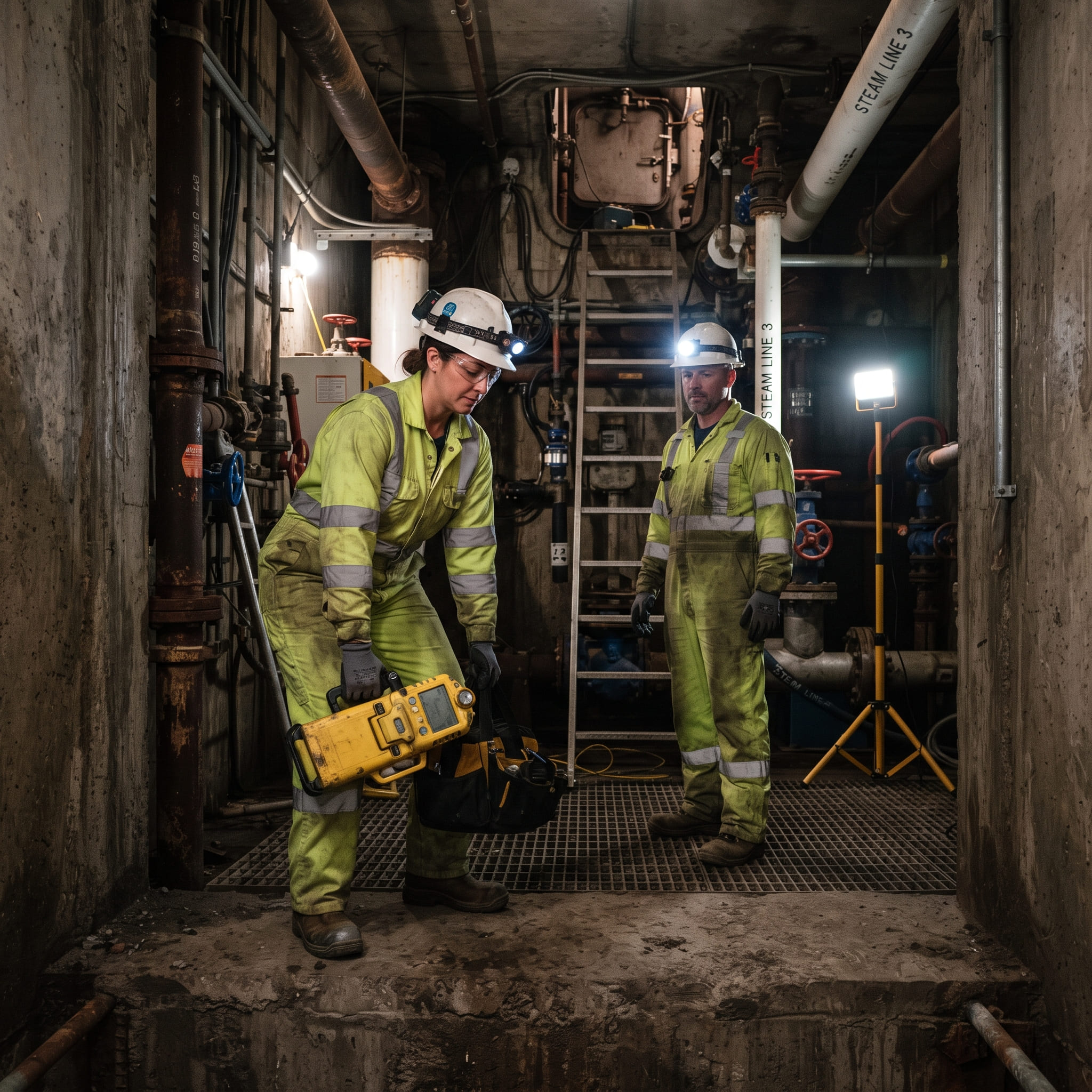
Manual handling can become significantly more challenging when employees have to work in confined or restricted areas. In many Irish workplaces, employees may need to lift, carry, push, pull or reposition equipment in spaces where movement is limited.
Construction, maintenance, utilities, manufacturing, engineering and other industries can involve tasks where workers have restricted access or limited room to manoeuvre. In these environments, a load that would be relatively straightforward to handle in an open workplace may become much more difficult.
Limited space can affect posture, visibility, grip, movement and communication. Employees may be unable to position themselves comfortably, while awkward routes can make carrying equipment more demanding.
This is why manual handling tasks performed in confined spaces should be carefully planned and risk assessed.
Professional Manual Handling Training Ireland can help employees understand how to assess loads, plan movements and use safer handling methods. However, confined-space work requires broader controls as well. Employers must consider the characteristics of the space, the work activity and any additional hazards associated with the environment.
This article explores practical ways to manage manual handling risks when working in confined or restricted areas.
Why Manual Handling Is More Difficult in Confined Spaces
In an open workplace, employees can often position themselves around a load and choose a convenient route.
Confined spaces may not provide the same flexibility.
Workers may have:
- Limited room to stand.
- Restricted movement.
- Narrow access points.
- Low ceilings.
- Poor visibility.
- Difficult routes.
- Limited space for equipment.
These conditions can make even relatively small loads more challenging to handle.
Employees may have to work in awkward positions or change direction multiple times while carrying equipment.
What Is a Confined Space?
A confined space can generally be understood as an enclosed or substantially enclosed place where specific hazards may arise because of the nature of the space.
Examples can include certain:
- Tanks.
- Silos.
- Chambers.
- Manholes.
- Vessels.
- Pits.
- Sewers.
- Underground spaces.
However, not every small or restricted area is legally classified as a confined space.
Where confined-space work is involved, employers must consider the specific legal and safety requirements applicable to that work. Manual handling should therefore be assessed alongside the other hazards associated with the environment.
Carry Out a Risk Assessment Before Starting
Planning is particularly important when manual handling takes place in a restricted area.
Before work begins, employers and employees should consider:
- What needs to be moved?
- How heavy is it?
- How large or awkward is it?
- How will it enter the space?
- How will it be removed?
- What route will be used?
- Is mechanical assistance possible?
- How will workers communicate?
- Are there emergency considerations?
A task that appears simple from outside the space may become considerably more difficult once an employee is inside.
Consider the Load
The characteristics of the load should be assessed before it is moved.
Consider:
- Weight.
- Size.
- Shape.
- Stability.
- Grip.
- Centre of gravity.
- Packaging.
A large object may be particularly difficult in a narrow area because it can restrict visibility and movement.
Where practical, large loads may be broken down into smaller components before being transported.
Reduce the Need for Manual Handling
One of the most effective approaches is to avoid unnecessary manual handling.
Employers should ask:
Does this load actually need to be carried manually?
Could it be:
- Lowered mechanically?
- Raised using suitable equipment?
- Transported using a trolley?
- Divided into smaller components?
- Positioned closer to the work area beforehand?
Eliminating unnecessary handling can significantly reduce exposure to physical risks.
Use Suitable Mechanical Equipment
Mechanical equipment can be particularly valuable where space is restricted.
Depending on the task and environment, equipment might include:
- Hoists.
- Lifting devices.
- Trolleys.
- Winches.
- Material-handling systems.
Equipment must be suitable for the specific environment and used according to appropriate procedures.
Where lifting equipment is used, employees should receive the necessary instruction and training.
Plan How Equipment Will Enter the Space
A common mistake is considering only how equipment will be used once inside the confined area.
The method of getting equipment and materials into the space should also be considered.
Ask:
- Is the access point large enough?
- Can the load pass through safely?
- Can workers control it during entry?
- Is there sufficient room to position it?
- How will it be removed?
Planning these details beforehand can prevent unnecessary manual handling.
Avoid Awkward Postures
Restricted spaces can make it difficult to maintain comfortable working positions.
Employees may have to:
- Bend.
- Kneel.
- Crouch.
- Reach.
- Twist.
- Work at low levels.
Repeated handling in these positions can increase physical demands.
Where possible, employers should redesign the task or introduce equipment that reduces the need for awkward positioning.
Do Not Twist While Carrying
Twisting can become particularly tempting in narrow spaces.
For example, an employee may try to lift an object and rotate around an obstacle rather than repositioning themselves.
Where possible, workers should avoid unnecessary twisting and plan the movement before lifting.
If the space does not allow safe movement, the task should be reassessed.
Check Visibility
A load that blocks an employee's view can create additional hazards.
This can be especially problematic in narrow areas.
Employees should avoid carrying loads that prevent them from seeing where they are going where practical.
Alternative handling methods or assistance may be necessary.
Keep Routes Clear
A confined area already provides limited space.
Adding tools, materials, packaging or other equipment can make movement even more difficult.
Before starting work:
- Remove unnecessary items.
- Organise tools.
- Keep access routes clear.
- Store materials appropriately.
- Ensure equipment does not obstruct movement.
Good housekeeping is particularly important in restricted environments.
Consider Communication
Communication can be more difficult when employees are working in enclosed or restricted areas.
If more than one person is involved in moving a load, everyone should understand:
- Who is leading.
- When to begin.
- Which direction to move.
- When to stop.
- How to communicate if something goes wrong.
Clear communication is essential for team handling.
For confined-space work, communication arrangements should also form part of the overall safety and emergency procedures.
Team Handling
Some loads may require two or more workers.
Before attempting team handling, employees should agree on the movement.
This is especially important when visibility is restricted.
One person should coordinate the movement where appropriate so that employees do not move independently.
If the space is too restricted for safe team handling, an alternative method should be considered.
Consider Pushing and Pulling
Manual handling risks in confined spaces are not limited to lifting.
Employees may also need to:
- Push equipment.
- Pull materials.
- Move trolleys.
- Reposition machinery.
Restricted space can make pushing and pulling more difficult because employees may not have enough room to establish a stable position.
The condition of floors and surfaces should also be assessed.
Consider Floor Conditions
The surface underfoot can significantly influence manual handling.
Potential issues include:
- Uneven surfaces.
- Wet areas.
- Slippery flooring.
- Loose materials.
- Obstacles.
Employees moving loads need sufficient stability and space to control their movements.
Any relevant environmental hazards should be addressed before manual handling begins.
Consider Lighting
Poor visibility can make manual handling more difficult.
Employees may struggle to see:
- Obstacles.
- Load edges.
- Uneven surfaces.
- Other workers.
- The destination point.
Suitable lighting should be provided for the work being performed, taking account of the characteristics of the environment.
Manage Repetitive Manual Handling
Some confined-space tasks may involve repeated handling of materials or equipment.
For example, maintenance workers may need to repeatedly move tools or components through a restricted area.
Employers should assess:
- Frequency.
- Duration.
- Load weight.
- Working posture.
- Recovery time.
- Opportunities to use equipment.
Reducing unnecessary repetition can help reduce physical demands.
Consider Fatigue
Confined-space work can sometimes be physically demanding.
Fatigue may affect an employee's ability to maintain concentration and perform physical tasks consistently.
Employees should be aware of signs of fatigue and communicate concerns when necessary.
Employers should organise work appropriately and consider the physical demands of the task.
Manual Handling Training Ireland
Professional Manual Handling Training Ireland can help employees understand fundamental manual handling principles.
Training can cover:
- Risk assessment.
- Load assessment.
- Safe lifting.
- Carrying.
- Pushing and pulling.
- Team handling.
- Body positioning.
- Mechanical aids.
These skills can be applied when employees are working in restricted environments.
However, manual handling training should not replace the specific safety measures required for confined-space work.
Manual Handling Course Ireland
A suitable Manual Handling Course Ireland can help employees develop the ability to think about the complete handling task.
Workers should consider:
The load: What am I moving?
The task: What movement is required?
The environment: Is there enough room?
The route: Can I move safely?
The equipment: Can mechanical assistance be used?
This approach is particularly useful in environments where normal lifting movements are restricted.
Manual Handling Certificate Ireland
Employees who complete appropriate training may receive a Manual Handling Certificate Ireland.
A certificate provides evidence that relevant manual handling training has been completed.
However, a manual handling certificate does not by itself authorise an employee to enter or work in a confined space.
Confined-space work may require additional training, procedures, risk assessments and emergency arrangements depending on the specific circumstances.
Employers should ensure employees have all training and authorisation relevant to the work they are expected to perform.
Do Not Improvise Handling Methods
Restricted environments can encourage employees to improvise.
For example, workers may attempt to:
- Drag equipment unnecessarily.
- Carry loads through unsuitable routes.
- Use inappropriate lifting points.
- Work around obstacles instead of stopping.
Improvisation can create additional risks.
If the planned method does not work, stop and reassess rather than forcing the task to continue.
Emergency Planning
Confined-space work requires particular attention to emergency arrangements.
If an employee becomes injured while handling a load, access and rescue can be more complicated than in an open workplace.
Manual handling planning should therefore fit into the overall emergency arrangements for the work.
Workers should know the relevant procedures before beginning the task.
Employers Should Consult Workers
Employees who regularly work in restricted areas can provide valuable practical information.
They may know:
- Which access routes are difficult.
- Which equipment is awkward to move.
- Where bottlenecks occur.
- Which loads require assistance.
- Which tasks create excessive physical demands.
Consulting employees can help employers identify risks that may otherwise be overlooked.
Review the Task Regularly
Manual handling risk assessments should be reviewed when conditions change.
This may include:
- New equipment.
- Different loads.
- Changes to access.
- Changes to work procedures.
- Increased production.
- Changes in staffing.
- Changes to the work environment.
A handling method that worked previously may no longer be suitable after a significant change.
Conclusion
Manual handling in confined or restricted spaces can present additional challenges because employees may have limited room to move, reduced visibility and fewer opportunities to position themselves comfortably.
Tasks should therefore be carefully planned before work begins.
Employers should consider the load, route, environment, equipment, working posture and frequency of handling. Where possible, unnecessary manual handling should be eliminated or reduced through better planning, mechanical equipment and improved work organisation.
Employees should avoid rushing, ask for assistance when necessary and stop if a planned handling method cannot be carried out safely.
Professional Manual Handling Training Ireland can provide employees with important knowledge about risk assessment, lifting, carrying, pushing, pulling and team handling. A suitable Manual Handling Course Ireland can help workers develop safer habits that can be applied across different workplace environments.
A Manual Handling Certificate Ireland demonstrates completion of relevant manual handling training, but it should not be confused with the additional requirements that may apply to confined-space work.
Ultimately, safe manual handling in restricted environments depends on combining appropriate training with effective risk assessment, suitable equipment, good communication and careful planning. By addressing these factors before work begins, Irish employers can reduce unnecessary physical risks and create safer working conditions for employees.