



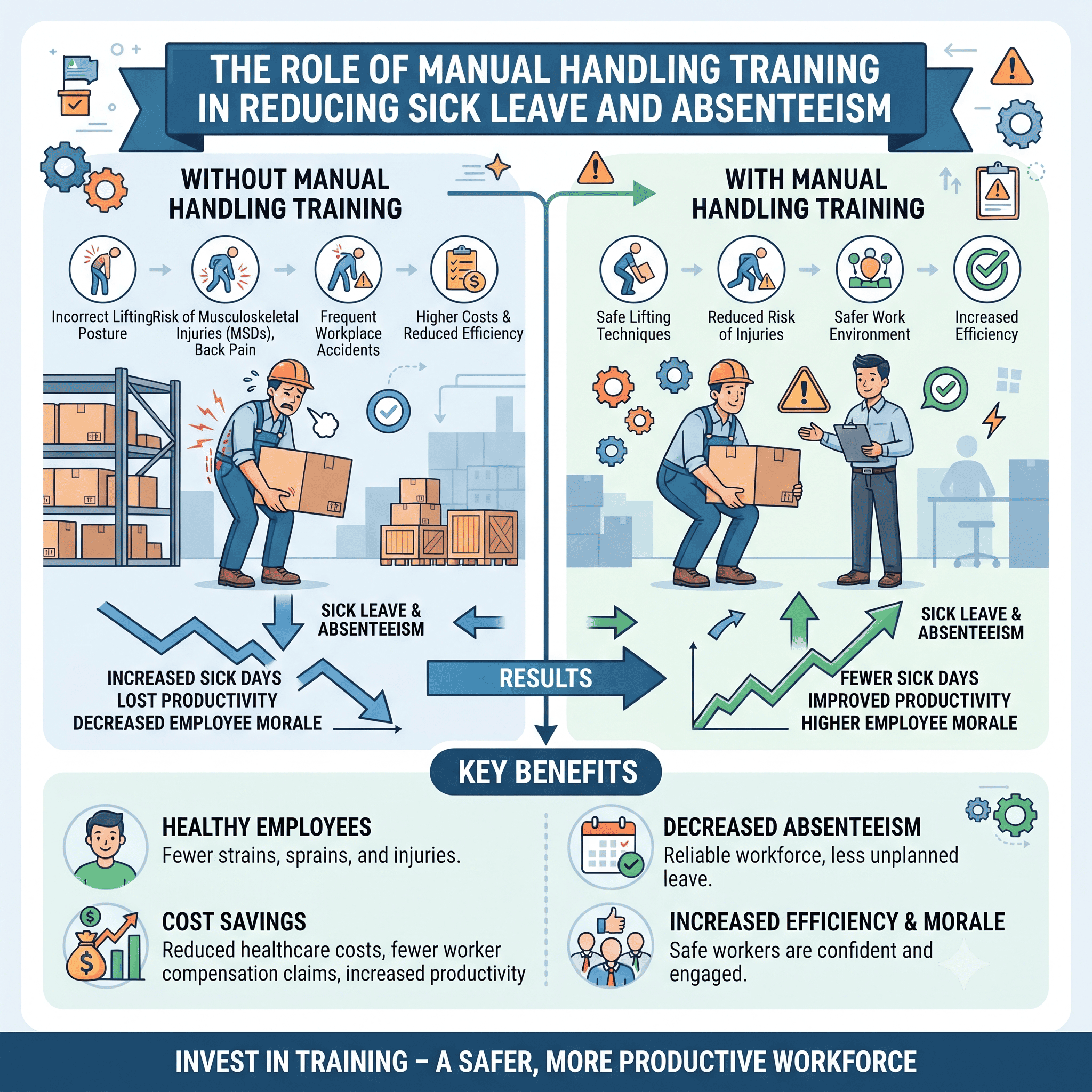
Employee wellbeing plays a vital role in the success of every organisation. Healthy employees are more productive, more engaged, and better able to perform their daily responsibilities. Unfortunately, manual handling injuries continue to be one of the leading causes of workplace absences across Ireland, affecting businesses of every size and industry.
Whether employees work in construction, healthcare, retail, warehousing, manufacturing, logistics, hospitality, education, or facilities management, many jobs involve lifting, carrying, pushing, pulling, or moving loads. When these tasks are performed using poor techniques or without proper planning, the result can be back injuries, muscle strains, joint problems, and long-term musculoskeletal disorders.
Many of these injuries are entirely preventable. A professional Manual Handling Training Ireland programme equips employees with the knowledge and practical skills needed to carry out manual handling tasks safely. Through a recognised Manual Handling Course Ireland, workers learn safe lifting techniques, risk assessment, hazard awareness, and proper body mechanics. Completing a Manual Handling Certificate Ireland demonstrates that employees understand these essential workplace safety principles.
This article explores how manual handling training helps reduce sick leave and absenteeism while creating healthier, safer, and more productive workplaces throughout Ireland.
Understanding Workplace Absenteeism
Absenteeism refers to employees being away from work due to illness, injury, or other health-related reasons.
While occasional absences are unavoidable, frequent or long-term sick leave can affect:
- Productivity
- Customer service
- Team morale
- Business costs
- Project deadlines
- Overall operational efficiency
Many workplace absences linked to musculoskeletal injuries can be reduced through better manual handling practices.
Manual Handling Injuries Are Often Preventable
Unlike sudden accidents, many manual handling injuries develop gradually over time.
Repeated poor lifting techniques can place excessive strain on muscles, joints, and the spine, eventually leading to pain and reduced mobility.
Common causes include:
- Lifting with a rounded back
- Twisting while carrying
- Holding loads too far from the body
- Repetitive lifting
- Poor posture
- Overloading
- Failing to assess risks
These habits often become routine without proper training.
The Impact of Musculoskeletal Disorders
Musculoskeletal disorders affect muscles, tendons, joints, ligaments, and the spine.
Common symptoms include:
- Lower back pain
- Neck stiffness
- Shoulder injuries
- Knee pain
- Wrist problems
- Muscle fatigue
- Reduced flexibility
These conditions often worsen if employees continue using poor manual handling techniques.
Early education helps prevent these problems from developing.
How Manual Handling Training Reduces Injuries
A professional Manual Handling Training Ireland programme teaches employees how to complete manual handling tasks safely and efficiently.
Training focuses on:
- Safe lifting techniques
- Correct posture
- Risk assessment
- Hazard identification
- Safe use of mechanical aids
- Proper planning
- Body mechanics
When employees consistently apply these techniques, the likelihood of injury decreases significantly.
Encouraging Better Risk Assessment
One of the most valuable lessons taught during a Manual Handling Course Ireland is learning to assess a task before beginning.
Employees are encouraged to ask:
- Is the load too heavy?
- Can assistance be provided?
- Is the route clear?
- Are lifting aids available?
- Is the load stable?
- Are there any hazards nearby?
These simple checks prevent many unnecessary injuries.
Promoting Safe Lifting Techniques
Correct lifting techniques reduce strain on the body.
Employees learn to:
- Bend their knees.
- Keep a neutral spine.
- Hold loads close to the body.
- Lift smoothly.
- Avoid twisting.
- Maintain good balance.
Practising these techniques consistently helps build safe long-term habits.
Reducing Physical Fatigue
Manual handling does not only cause injuries—it also contributes to fatigue.
Employees who use poor techniques often become tired more quickly because they place unnecessary strain on their muscles.
Training encourages workers to:
- Lift efficiently.
- Plan movements.
- Use mechanical aids.
- Avoid unnecessary effort.
Reducing fatigue helps employees remain productive throughout the working day.
Supporting Employee Confidence
Employees who understand safe manual handling are generally more confident performing physical tasks.
They know:
- How to approach different lifting situations.
- When to ask for assistance.
- How to recognise hazards.
- How to use lifting equipment.
Confidence reduces hesitation and encourages safer decision-making.
Preventing Long-Term Health Problems
Repeated manual handling injuries can lead to chronic pain that affects employees both inside and outside work.
Long-term problems may limit:
- Mobility
- Physical activity
- Career opportunities
- Quality of life
Investing in Manual Handling Training Ireland helps employees protect their long-term health while reducing future absence from work.
The Financial Impact of Absenteeism
Employee absences affect businesses in many ways.
Costs may include:
- Temporary staff
- Overtime payments
- Reduced productivity
- Delayed projects
- Training replacement employees
- Administrative costs
Preventing injuries through training is often far more cost-effective than managing their consequences.
Building a Positive Safety Culture
Manual handling training contributes to a stronger workplace safety culture.
Employees become more likely to:
- Follow procedures.
- Report hazards.
- Use equipment correctly.
- Encourage colleagues to work safely.
- Plan manual handling tasks carefully.
A positive safety culture reduces workplace accidents while improving employee morale.
The Importance of Mechanical Aids
Modern workplaces often provide equipment designed to reduce physical strain.
Examples include:
- Trolleys
- Pallet trucks
- Hoists
- Lift tables
- Conveyors
- Adjustable lifting equipment
Training teaches employees when and how to use these aids safely.
Using equipment appropriately reduces injuries and supports long-term employee wellbeing.
Benefits Across Every Industry
Manual handling training benefits employees across many sectors.
Examples include:
Healthcare
Protects staff while assisting patients and moving equipment.
Construction
Reduces injuries when handling building materials and tools.
Warehousing
Supports safer stock movement and order picking.
Retail
Improves safety during deliveries and shelf replenishment.
Manufacturing
Reduces repetitive strain during production tasks.
Hospitality
Helps staff safely move furniture, supplies, and equipment.
Regardless of the industry, safer manual handling leads to healthier employees.
Benefits for Employers
Employers investing in Manual Handling Training Ireland often experience:
- Lower absenteeism
- Fewer workplace injuries
- Improved productivity
- Greater employee confidence
- Better staff retention
- Reduced compensation claims
- Improved compliance with health and safety responsibilities
Healthier employees contribute directly to stronger business performance.
Flexible Online Training
Online Manual Handling Course Ireland programmes make it easier than ever for businesses to train employees.
Advantages include:
- Study at your own pace.
- Complete training around work schedules.
- Learn from any location.
- Access materials on multiple devices.
- Minimal disruption to operations.
- Fast certification after successful completion.
Flexible learning supports consistent training across organisations of every size.
The Value of a Manual Handling Certificate Ireland
Upon successful completion of training, employees receive a Manual Handling Certificate Ireland.
The certificate confirms an understanding of:
- Safe lifting techniques
- Risk assessment
- Hazard awareness
- Workplace safety
- Correct manual handling procedures
Many employers request certification before employees undertake physically demanding roles.
Creating a Healthier Workplace
Reducing absenteeism starts with preventing injuries before they occur.
Organisations that prioritise manual handling training encourage employees to:
- Plan every lift.
- Use correct techniques.
- Report unsafe conditions.
- Work together safely.
- Refresh training regularly.
These habits contribute to healthier employees and more resilient businesses.
Conclusion
Manual handling injuries are one of the leading causes of workplace sick leave across many industries, but they are also among the most preventable. Poor lifting techniques, repetitive strain, inadequate planning, and a lack of hazard awareness can all contribute to injuries that keep employees away from work for days, weeks, or even longer.
A professional Manual Handling Training Ireland programme provides employees with the practical skills needed to lift safely, assess risks, recognise hazards, and use correct body mechanics in their daily work. Through a recognised Manual Handling Course Ireland, workers gain the confidence to perform manual handling tasks efficiently while protecting their health and reducing the likelihood of injury.
Earning a Manual Handling Certificate Ireland demonstrates a commitment to workplace safety and continuous professional development. For employers, investing in manual handling training leads to fewer injuries, reduced sick leave, lower absenteeism, improved productivity, and a stronger safety culture. By making manual handling education a regular part of workplace health and safety, organisations across Ireland can protect their employees, strengthen business performance, and create safer working environments for everyone.