



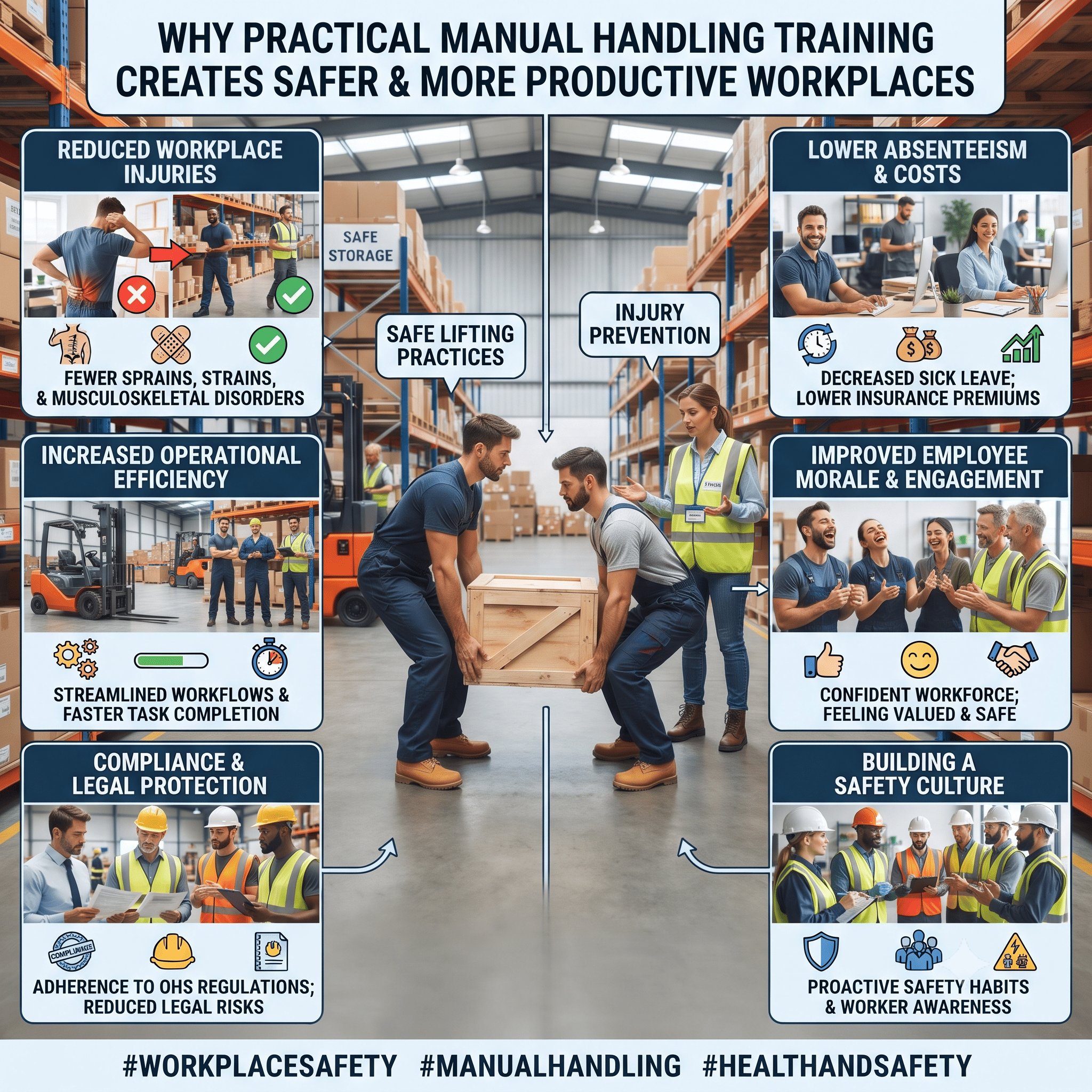
Every successful workplace depends on employees having the knowledge and confidence to carry out their jobs safely. Whether working in healthcare, construction, warehousing, manufacturing, retail, hospitality, logistics, education, or office environments, employees regularly perform manual handling tasks that require careful planning and correct technique. Without proper training, even routine lifting and carrying activities can lead to injuries that affect both individuals and businesses.
Manual handling injuries remain one of the leading causes of workplace accidents in Ireland. Back injuries, muscle strains, shoulder pain, and other musculoskeletal disorders often develop because employees use poor lifting techniques, fail to assess risks, or attempt tasks that could be completed more safely with better planning or mechanical assistance.
A professional Manual Handling Training Ireland programme equips employees with practical skills they can use every day. Through a recognised Manual Handling Course Ireland, learners develop a better understanding of safe lifting techniques, body mechanics, risk assessment, hazard awareness, and the correct use of mechanical aids. Completing a Manual Handling Certificate Ireland demonstrates that employees have gained valuable workplace safety knowledge and are committed to maintaining high safety standards.
This guide explores how practical manual handling training contributes to safer workplaces while improving efficiency, productivity, and employee confidence across a wide range of industries.
Why Practical Learning Is So Effective
People often remember information more effectively when they actively apply it rather than simply reading or listening to instructions.
Practical manual handling training helps employees:
- Understand why safe techniques matter.
- Build confidence through repetition.
- Develop lasting workplace habits.
- Improve decision-making.
- Apply knowledge to real working situations.
Learning by doing makes safe manual handling more natural and easier to remember.
Understanding Manual Handling
Manual handling refers to any activity that involves physical effort to:
- Lift
- Lower
- Carry
- Push
- Pull
- Hold
- Move
- Support a load
These activities take place every day across many industries.
Examples include:
- Moving stock
- Carrying tools
- Handling deliveries
- Lifting equipment
- Repositioning furniture
- Assisting patients
- Loading vehicles
Although common, these tasks require proper technique to minimise injury risks.
Reducing Workplace Injuries
One of the greatest benefits of Manual Handling Training Ireland is injury prevention.
Poor manual handling can lead to:
- Lower back pain
- Shoulder injuries
- Muscle strains
- Neck pain
- Knee problems
- Repetitive strain injuries
Practical training teaches employees safer techniques that reduce physical strain during everyday tasks.
Building Safe Lifting Habits
Good manual handling depends on consistent habits.
Employees learn to:
- Plan every lift.
- Stand with a stable base.
- Bend at the knees.
- Keep the back neutral.
- Hold loads close to the body.
- Avoid twisting.
- Lift smoothly.
Repeating these techniques helps them become automatic during daily work.
Improving Risk Assessment Skills
Every manual handling task should begin with a brief risk assessment.
Employees learn to ask:
- Is the load too heavy?
- Is it awkward to lift?
- Is the route clear?
- Are there obstacles?
- Is assistance needed?
- Can mechanical equipment be used?
These simple questions often prevent accidents before they occur.
Increasing Hazard Awareness
Practical training teaches employees to recognise hazards before starting work.
Examples include:
- Wet floors
- Uneven surfaces
- Poor lighting
- Narrow walkways
- Cluttered storage areas
- Unstable loads
Identifying these hazards early allows employees to reduce risks before lifting begins.
Improving Productivity
Safe workplaces are often more productive workplaces.
Employees who understand correct manual handling techniques:
- Complete tasks more efficiently.
- Waste less energy.
- Experience less fatigue.
- Require fewer work interruptions.
- Avoid unnecessary injuries.
When employees work safely, businesses experience fewer delays caused by accidents or absenteeism.
Reducing Physical Fatigue
Poor lifting techniques place unnecessary strain on muscles and joints.
Employees who use proper manual handling methods:
- Use less physical effort.
- Maintain better posture.
- Move more efficiently.
- Experience less muscle fatigue.
- Maintain energy throughout the working day.
Reducing fatigue improves both safety and productivity.
Encouraging Better Planning
Practical learning teaches employees that safe lifting begins before touching the load.
Workers are encouraged to plan:
- The destination.
- The safest route.
- Potential hazards.
- Whether assistance is needed.
- Whether lifting equipment should be used.
Planning reduces unnecessary movement and improves efficiency.
Promoting Teamwork
Some manual handling tasks require more than one person.
Training encourages employees to:
- Communicate clearly.
- Coordinate lifting movements.
- Agree on lifting plans.
- Work together safely.
Good teamwork reduces confusion and lowers the risk of injury.
Supporting the Use of Mechanical Aids
Many workplaces provide equipment designed to reduce manual lifting.
Examples include:
- Pallet trucks
- Hoists
- Trolleys
- Lift tables
- Adjustable workstations
- Conveyor systems
Practical training helps employees understand when these aids should be used and how they improve workplace safety.
Using mechanical assistance whenever appropriate reduces physical strain and increases efficiency.
Improving Employee Confidence
Employees who receive practical instruction often feel more confident handling manual tasks.
Training helps workers understand:
- Safe lifting techniques.
- Risk assessment.
- Hazard awareness.
- Workplace procedures.
- Proper body mechanics.
Confidence encourages employees to make safer decisions instead of relying on guesswork.
Creating Consistent Workplace Standards
When every employee completes the same Manual Handling Course Ireland, organisations benefit from consistent working practices.
Employees develop a shared understanding of:
- Safe lifting procedures.
- Workplace expectations.
- Risk assessment methods.
- Hazard reporting.
- Proper use of equipment.
Consistency helps create safer workplaces with fewer misunderstandings.
Benefits Across Different Industries
Practical manual handling training benefits almost every sector.
Healthcare
Staff safely assist patients while protecting themselves from injury.
Construction
Workers reduce risks when handling tools, equipment, and building materials.
Warehousing
Employees safely load, unload, and move stock.
Retail
Staff handle deliveries and replenish shelves more efficiently.
Manufacturing
Workers minimise repetitive strain during production activities.
Office Environments
Employees safely move archive boxes, office furniture, and computer equipment.
Regardless of the workplace, safe manual handling improves both employee wellbeing and operational efficiency.
Reducing Absenteeism
Manual handling injuries are one of the leading causes of workplace absence.
Practical training helps reduce:
- Sick leave.
- Lost productivity.
- Overtime costs.
- Temporary staffing requirements.
Healthier employees spend more time contributing to the business rather than recovering from preventable injuries.
Supporting Long-Term Employee Wellbeing
Manual handling training protects employees beyond their immediate work tasks.
Correct lifting techniques help reduce long-term wear and tear on:
- Back
- Shoulders
- Neck
- Knees
- Muscles
- Joints
Protecting employees' long-term health contributes to longer, healthier careers.
Flexible Online Learning
Many organisations now choose online Manual Handling Training Ireland because it combines flexibility with high-quality learning.
Benefits include:
- Study from any location.
- Learn at your own pace.
- Access training on multiple devices.
- Minimal disruption to work schedules.
- Immediate access to course materials.
- Fast certification after successful completion.
Online learning makes workplace safety education accessible to businesses of every size.
The Importance of a Manual Handling Certificate Ireland
After completing training, employees receive a Manual Handling Certificate Ireland.
The certificate demonstrates an understanding of:
- Safe lifting techniques
- Risk assessment
- Hazard awareness
- Workplace safety principles
- Manual handling best practices
Many employers require certification for employees whose roles involve manual handling.
Creating a Strong Safety Culture
Practical training helps create workplaces where safety becomes part of everyday routines rather than an occasional reminder.
Employees become more likely to:
- Assess risks before lifting.
- Report hazards promptly.
- Follow safe procedures.
- Use mechanical aids whenever appropriate.
- Encourage colleagues to work safely.
- Continue improving their manual handling skills.
A strong safety culture benefits everyone in the organisation.
Conclusion
Practical manual handling training is one of the most effective ways to create safer and more productive workplaces. By helping employees understand correct lifting techniques, improve hazard awareness, assess risks, and use mechanical aids appropriately, organisations can significantly reduce workplace injuries while improving operational efficiency.
A professional Manual Handling Training Ireland programme provides employees with practical skills they can apply every day, regardless of their industry or level of experience. Through a recognised Manual Handling Course Ireland, workers gain the confidence to carry out manual handling tasks safely, make informed decisions, and contribute to a positive workplace safety culture. Completing a Manual Handling Certificate Ireland demonstrates a commitment to professional development and responsible working practices.
For employers, investing in practical manual handling training leads to fewer injuries, lower absenteeism, improved productivity, stronger employee confidence, and a healthier working environment. By making practical learning an ongoing part of workplace safety, organisations across Ireland can protect their employees while building more efficient, resilient, and successful businesses.