



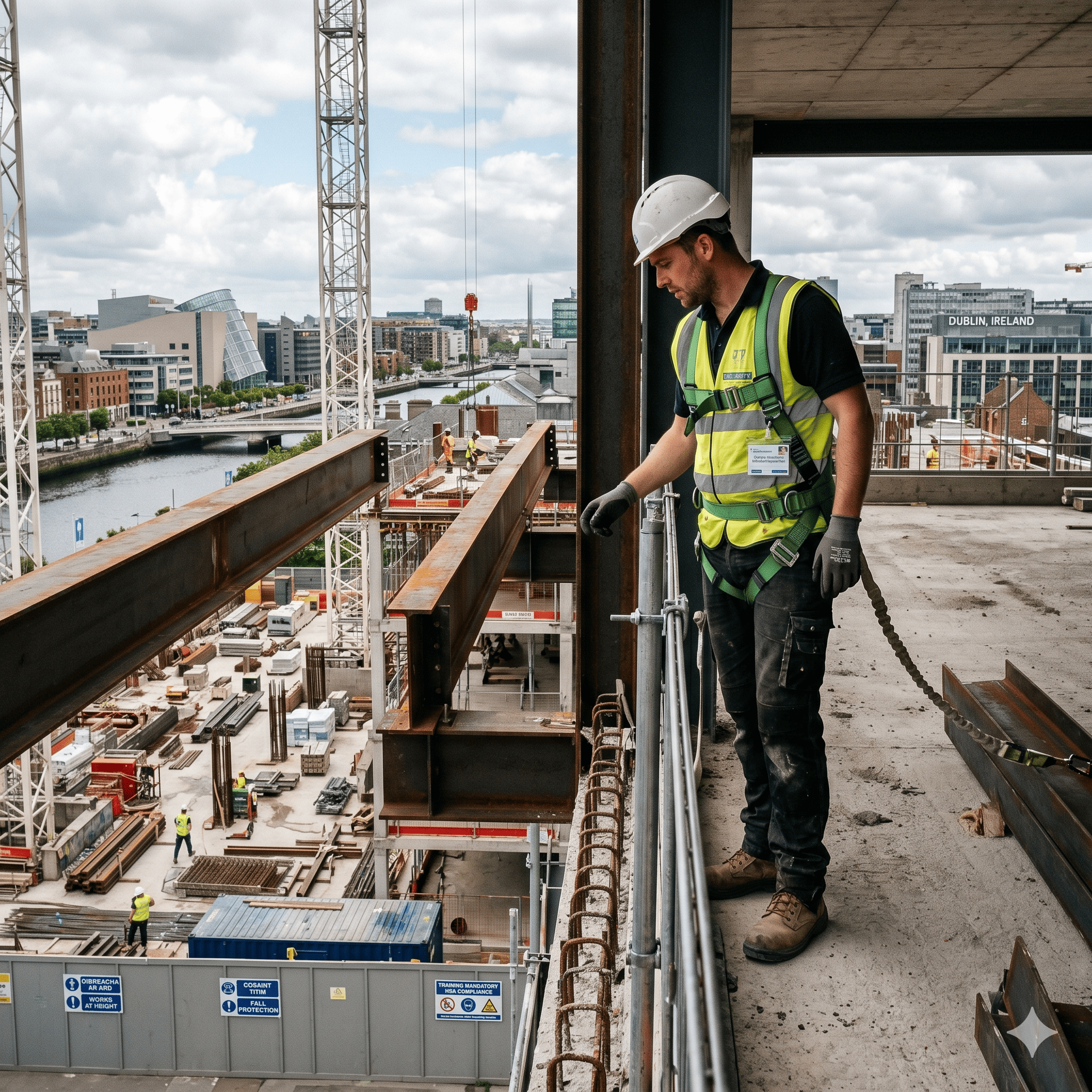
Working at height is one of the most dangerous activities in the construction industry, and in Ireland it is also one of the most strictly regulated. Falls from height remain a leading cause of serious workplace injuries and fatalities, which is why working at heights training is not optional—it is a legal requirement in the Irish construction industry.
Every employer and contractor has a duty of care to ensure that workers are properly trained, competent, and equipped to carry out tasks safely. This article explains why the law requires working at heights training in Ireland, what legislation applies, what the training covers, and how it protects both workers and employers.
Understanding Working at Heights in Construction
“Working at height” refers to any task where a person could fall and suffer injury. In construction, this includes:
- Working on scaffolding
- Roofing and roof repairs
- Ladder use
- Working on mobile elevated platforms (MEWPs)
- Steel frame construction
- Maintenance at height
Even relatively low heights can be dangerous. Many serious accidents happen from falls of just a few meters.
Because of this risk, Irish law places strict obligations on employers to ensure that all height-related work is properly planned and controlled.
Key Irish Laws That Make Training Mandatory
Several pieces of legislation make working at heights training in Ireland a legal requirement in practice.
Safety, Health and Welfare at Work Act 2005
This is the main piece of Irish workplace safety law. It requires employers to:
- Ensure employee safety, health, and welfare
- Provide adequate training and supervision
- Identify workplace hazards
- Implement safe systems of work
In construction, working at height is considered a high-risk activity, so training becomes a core requirement under this act.
General Application Regulations (Work at Height Regulations)
These regulations specifically address working at height and require employers to:
- Avoid working at height where possible
- Use safe equipment and access systems
- Carry out risk assessments
- Ensure employees are competent
- Provide appropriate training
This is the most direct legal basis for requiring working at heights training in Ireland construction sites.
Construction Regulations 2013
The Construction Regulations add further responsibilities, including:
- Appointment of competent personnel
- Site safety management
- Safe work planning
- Coordination of contractors
- Training and supervision requirements
Together, these laws make training a fundamental legal expectation, not just a recommendation.
Why Training Is Considered a Legal Requirement
Even though the law may not always say “you must hold a certificate,” it requires employers to ensure competence and safety knowledge. In practice, this means training is necessary.
Working at heights training is required because:
1. Employers Must Prove Competence
Inspectors and regulators expect employers to demonstrate that workers understand how to work safely at height.
2. Risk Must Be Controlled
Construction work involves unavoidable risks, so training is a key control measure.
3. Prevention Is Legally Required
Irish law prioritizes prevention of accidents, not reaction after incidents.
4. Insurance and Liability Requirements
Insurance providers often require proof of training for high-risk work.
Why Construction Is High Risk
The construction industry has more working at height activity than most sectors. Risks include:
- Unstable working surfaces
- Moving scaffolding structures
- Weather exposure (wind, rain, ice)
- Heavy tools and materials
- Multiple contractors working simultaneously
- Tight deadlines increasing human error
Without proper training, even experienced workers can make mistakes that lead to severe consequences.
What Working at Heights Training Covers
A proper working at heights training course in Ireland provides workers with essential knowledge and practical safety skills.
Hazard Identification
Workers learn to recognize risks such as:
- Unprotected edges
- Fragile roofing materials
- Unsafe ladder positioning
- Slippery surfaces
- Falling objects
Risk Assessment
Before starting work, workers are trained to:
- Evaluate site conditions
- Identify hazards
- Select control measures
- Plan safe access routes
Ladder Safety
Ladders are one of the most common sources of accidents. Training includes:
- Correct ladder setup
- Inspection procedures
- Safe climbing techniques
- Maintaining three-point contact
- Avoiding overreach
Scaffolding Safety
Workers learn:
- Safe access and exit points
- Stability checks
- Guardrail and toe board use
- Working platforms safety rules
Mobile Elevated Work Platforms (MEWPs)
Training covers:
- Safe operation principles
- Harness requirements
- Emergency lowering procedures
- Environmental considerations
Personal Protective Equipment (PPE)
Proper use of PPE is critical:
- Safety harnesses
- Lanyards and anchor points
- Fall arrest systems
- Helmets and protective footwear
Emergency Procedures
Workers are trained in:
- Rescue planning
- First aid awareness
- Incident reporting
- Evacuation procedures
How Training Protects Workers
Working at heights training significantly reduces workplace accidents by:
Improving Awareness
Workers understand dangers before they become incidents.
Building Safe Habits
Training reinforces correct behaviors such as equipment checks and safe positioning.
Reducing Human Error
Most accidents are caused by mistakes, not equipment failure.
Improving Decision-Making
Workers are better able to stop unsafe work when risks are present.
How Training Protects Employers
For employers in Ireland’s construction industry, training provides major benefits:
Legal Compliance
Demonstrates adherence to Irish health and safety law.
Reduced Liability
Proper training reduces risk of legal claims after incidents.
Fewer Accidents
Safer workers mean fewer injuries and less downtime.
Lower Insurance Costs
A strong safety record can improve insurance terms.
Better Reputation
Safe companies are more trusted by clients and contractors.
Online Working at Heights Training
Many providers now offer working at heights online training in Ireland, which is widely used for theoretical knowledge and refresher training.
Benefits of Online Training
- Flexible learning schedule
- Lower cost
- Quick certification
- Easy access from any location
- Ideal for large teams
However, in some construction roles, online training is often combined with practical, on-site assessments.
Common Violations in Construction Sites
Despite legal requirements, accidents still happen due to:
- Lack of proper training
- Missing risk assessments
- Unsafe ladder use
- Inadequate PPE
- Poor supervision
- Rushing to meet deadlines
These violations are exactly what legislation aims to prevent.
Importance of Refresher Training
Working at heights training is not a one-time requirement. Refresher training ensures:
- Updated safety knowledge
- Reinforcement of correct procedures
- Awareness of new equipment or regulations
- Reduced complacency over time
Most certifications are valid for a limited period and must be renewed.
Choosing a Training Provider in Ireland
When selecting a working at heights training course in Ireland, employers should ensure:
- The course meets Irish legal standards
- Certification is widely accepted
- Content is updated regularly
- Training is clear and practical
- The provider has strong reputation
A good provider ensures workers are fully prepared for real-world site conditions.
Final Thoughts
Working at heights training is a legal requirement in Ireland’s construction industry because it directly prevents serious injuries and saves lives. Irish legislation clearly places responsibility on employers to ensure workers are trained, competent, and safe when operating at height.
Construction sites are inherently high-risk environments, but proper training transforms those risks into controlled, manageable activities. It ensures that workers know how to use equipment safely, assess hazards correctly, and respond effectively in emergencies.
For employers, investing in training is not just about compliance—it is about protecting people, reducing risk, and building a safer, more efficient construction industry in Ireland.
Ultimately, working at heights training is not just a legal obligation; it is a fundamental safety standard that no construction workplace should operate without.