



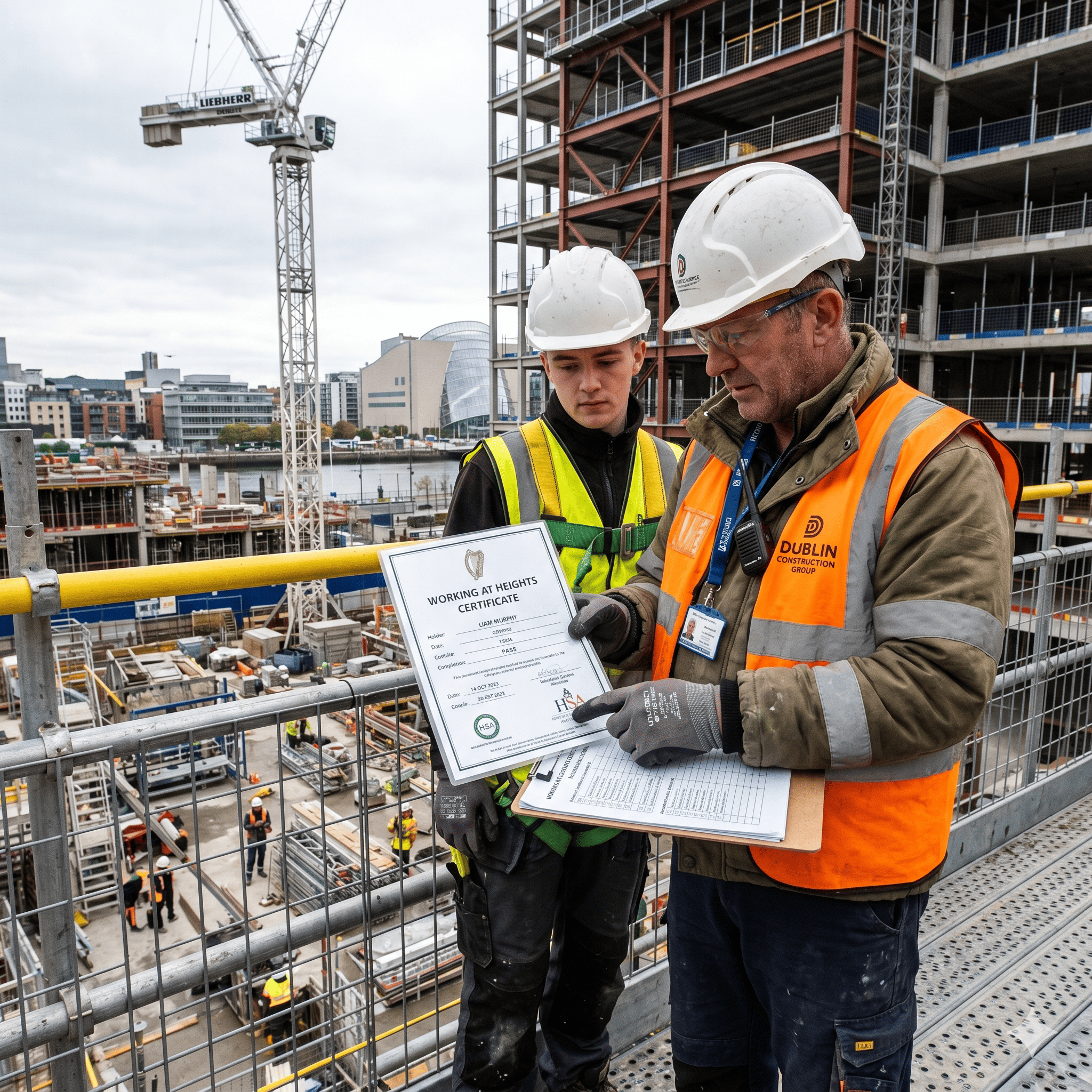
A Working at Heights Certificate is one of the most important safety credentials in Ireland’s high-risk industries, especially construction, maintenance, warehousing, telecommunications, and facilities management. Employers rely on this certification to ensure that workers understand how to operate safely above ground level and comply with Irish health and safety legislation.
However, not all certificates are viewed equally. Employers in Ireland look for specific qualities, standards, and proof of competency before accepting a working at heights certificate online or in-person. Understanding what they expect can help job seekers improve employability and help companies maintain legal compliance and workplace safety.
This guide explains what employers in Ireland look for in a working at heights certificate, why it matters, and how to choose the right training.
Why Employers Require a Working at Heights Certificate
Working at height is one of the most dangerous types of work activity. Falls from ladders, scaffolding, roofs, or elevated platforms can result in serious injuries or fatalities.
Because of this, employers require certification to:
- Ensure worker safety
- Reduce workplace accidents
- Meet legal obligations
- Demonstrate competence during inspections
- Satisfy insurance requirements
Under the Safety, Health and Welfare at Work Act 2005, employers must ensure employees are trained and competent before performing high-risk tasks. A valid working at heights training course in Ireland is the most common way to demonstrate this competence.
What Employers Expect in a Working at Heights Certificate
Employers in Ireland do not just look for any certificate—they look for specific features that confirm quality and compliance.
1. Recognised and Accredited Training Provider
The most important factor is whether the certificate comes from a recognised provider.
Employers expect:
- Accredited training organisation
- Industry-recognised certification
- Compliance with Irish safety standards
- Credibility within construction and industrial sectors
A certificate from an unknown or unverified provider may not be accepted on-site.
2. Clear Alignment with Irish Health and Safety Law
Employers want assurance that training meets Irish legal requirements, including:
- Safety, Health and Welfare at Work Act 2005
- General Application Regulations (Work at Height Regulations)
- Construction safety guidelines
A strong health and safety course in Ireland should clearly reference these regulations.
If a course does not align with Irish law, employers may reject the certificate.
3. Comprehensive Course Content
Employers expect a certificate backed by thorough training that includes both theory and practical safety knowledge.
A proper working at heights training course in Ireland should include:
Hazard Awareness
- Identifying unprotected edges
- Recognising fragile surfaces
- Understanding environmental risks
Risk Assessment
- Evaluating site conditions
- Identifying hazards before work begins
- Selecting control measures
Ladder Safety
- Proper ladder setup
- Inspection before use
- Safe climbing techniques
- Avoiding overreach
Scaffolding Safety
- Safe access and exit
- Stability checks
- Guardrails and toe boards
PPE and Fall Protection
- Harness use
- Anchor points
- Lanyards and fall arrest systems
Emergency Procedures
- Rescue planning
- Incident reporting
- First aid awareness
If any of these areas are missing, employers may question the quality of the training.
4. Validity Period of the Certificate
Employers also look at how long a certificate is valid.
Most working at heights certificates in Ireland are valid for:
- 3 to 5 years
After this period, refresher training is required.
Employers prefer candidates with:
- Recently completed training
- Up-to-date certification
- Evidence of ongoing safety awareness
Expired certificates are often not accepted on active worksites.
5. Online vs In-Person Training Acceptance
With the growth of working at heights online training in Ireland, employers are more open to digital certification—but with conditions.
What Employers Accept from Online Training:
- Theoretical knowledge courses
- Refresher training
- Recognised digital certificates
- Verified completion records
When Employers May Require Practical Training:
- High-risk construction roles
- Scaffolding work
- Rope access tasks
- MEWP operation
Many employers prefer a blended approach combining online theory with practical assessment.
6. Proof of Assessment and Competency
Employers want more than just attendance—they want proof that the worker understands the material.
A valid working at heights certificate online should include:
- Completed assessment or exam
- Passing score confirmation
- Evidence of competency
- Verifiable certification ID
This ensures the worker has actively learned and not just watched content.
7. Employer Recognition and Industry Acceptance
One of the most important considerations is whether other employers in Ireland recognise the certificate.
Employers look for:
- Widely accepted training providers
- Industry-standard certification
- Positive reputation in construction and safety sectors
If a certificate is not commonly accepted across the industry, it may limit job opportunities.
8. Relevance to Job Role
Employers also check whether the training matches the actual job requirements.
For example:
- Construction workers need scaffold and ladder safety training
- Warehouse staff need mezzanine and access training
- Telecom workers need height and climbing safety awareness
A good health and safety course in Ireland should be tailored to real workplace risks.
9. Clarity and Verification of Certificate
Employers expect certificates to be:
- Clearly formatted
- Easy to read
- Containing learner details
- Including issue and expiry dates
- Verifiable (often with QR code or ID number)
Poorly formatted or unverifiable certificates may be rejected.
10. Provider Support and Documentation
Employers prefer training providers who offer:
- Verification support
- Replacement certificates
- Training records access
- Compliance documentation
This is especially important during audits or safety inspections.
Why This Matters for Job Seekers
For workers, having the right working at heights certificate in Ireland can:
- Improve employability
- Increase access to construction sites
- Demonstrate professionalism
- Meet employer expectations
- Support career progression
Without proper certification, many high-risk jobs will not be accessible.
Common Reasons Certificates Are Rejected
Employers may reject certificates due to:
- Non-accredited training provider
- Expired certification
- Missing key safety topics
- Lack of assessment proof
- Poor documentation quality
- No recognition in Ireland
Avoiding these issues is essential for job readiness.
Online Certification and Modern Expectations
Today, many employers accept working at heights online training in Ireland, provided it meets standards.
They expect online courses to:
- Be structured and professional
- Include assessments
- Provide valid certification
- Follow Irish regulations
- Be easily verifiable
Online training is especially popular for refresher courses and theory-based learning.
How to Choose a Certificate That Employers Accept
To ensure your certificate is accepted, choose a course that:
- Is accredited and recognised in Ireland
- Covers full working at heights safety training
- Includes assessment and certification
- Aligns with Irish legislation
- Has strong industry reputation
A well-chosen health and safety course online Ireland increases both safety and employability.
Final Thoughts
A Working at Heights Certificate is more than just a document—it is proof of competence, safety awareness, and legal compliance. Employers in Ireland carefully evaluate certification to ensure workers are properly trained to handle high-risk tasks safely.
From accreditation and course content to validity and employer recognition, every detail matters. A strong certificate improves job opportunities, ensures site access, and supports safer working environments.
Whether completed through classroom learning or working at heights online training in Ireland, the right certification demonstrates that a worker understands how to prevent accidents and follow safe systems of work.
Ultimately, employers are not just looking for a certificate—they are looking for confidence, competence, and commitment to safety.