



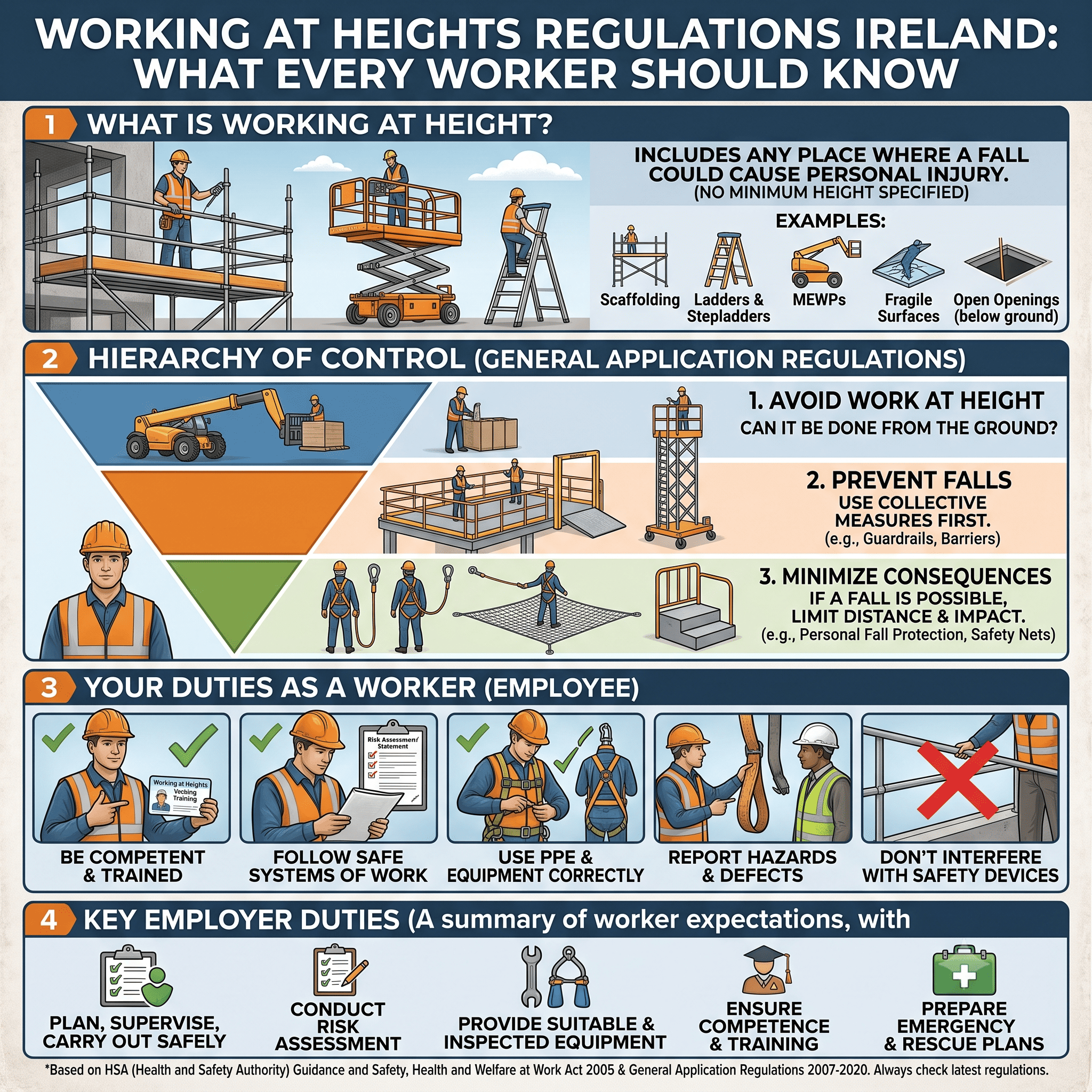
Working at height is an everyday part of many jobs across Ireland. From construction workers and roofers to warehouse employees, maintenance technicians, electricians, and telecommunications engineers, thousands of people carry out tasks above ground level every day. While these activities are often routine, they also present one of the greatest workplace safety risks. Falls from height remain a leading cause of serious injuries and fatalities, making compliance with Working at Heights Regulations in Ireland essential for both employers and employees.
Understanding workplace safety regulations helps workers recognise hazards, follow safe working procedures, and contribute to safer working environments. Completing working at heights training in Ireland provides the knowledge and practical skills needed to work confidently while meeting legal and workplace safety requirements.
This guide explains the key working at heights regulations in Ireland, outlines worker responsibilities, and highlights how training supports compliance and accident prevention.
What Is Considered Working at Height?
Working at height refers to any activity where a person could fall from one level to another and suffer injury.
Many people associate working at height with tall buildings or cranes, but the definition is much broader. A fall from a relatively low height can still result in serious injury.
Examples include:
- Working on roofs
- Using ladders
- Working from scaffolding
- Operating mobile elevated work platforms (MEWPs)
- Installing electrical systems
- Cleaning windows
- Property maintenance
- Warehouse stock retrieval
- Solar panel installation
- Accessing mezzanine floors
If there is a risk of falling, working at height regulations apply.
Why Working at Heights Regulations Matter
Falls from height can have devastating consequences for workers, employers, and businesses.
Possible outcomes include:
- Broken bones
- Head injuries
- Spinal injuries
- Permanent disability
- Lost working time
- Project delays
- Financial costs
- Fatal accidents
Many incidents occur because hazards were not recognised or safe procedures were not followed. Irish workplace safety regulations are designed to reduce these risks through careful planning, suitable equipment, and appropriate training.
The Main Workplace Safety Law in Ireland
The principal legislation governing workplace safety is the Safety, Health and Welfare at Work Act 2005.
This Act requires employers to protect the safety, health, and welfare of employees so far as is reasonably practicable.
Employer duties include:
- Providing a safe workplace
- Maintaining safe systems of work
- Carrying out risk assessments
- Providing suitable equipment
- Delivering appropriate training
- Supervising employees
- Ensuring workers are competent
These legal responsibilities form the foundation of workplace safety throughout Ireland.
Working at Height Regulations
The Safety, Health and Welfare at Work (General Application) Regulations include specific requirements relating to work at height.
The regulations require employers to:
- Avoid working at height where reasonably possible
- Prevent falls wherever practical
- Reduce the consequences of falls where risks remain
- Select appropriate work equipment
- Ensure workers receive suitable training
- Provide effective supervision
The emphasis is always on preventing accidents before they occur.
What Workers Should Know About the Regulations
Although employers have significant legal responsibilities, employees also play an important role in workplace safety.
Workers should understand the following principles.
Follow Safe Working Procedures
Employees should always follow the safe systems of work established by their employer.
These procedures are designed to minimise risks and protect everyone on site.
Ignoring safety procedures can increase the likelihood of accidents.
Attend Required Training
Workers should complete any working at heights training in Ireland required for their role.
Training helps employees understand:
- Workplace hazards
- Equipment use
- Emergency procedures
- Safe work planning
- Risk assessment
Knowledge gained during training should be applied every day on the job.
Use Equipment Correctly
Employees should only use equipment that is suitable for the task and follow the manufacturer's instructions.
Common equipment includes:
- Ladders
- Scaffolding
- Mobile elevated work platforms
- Safety harnesses
- Lanyards
- Fall arrest systems
Equipment should never be used if it appears damaged or unsafe.
Report Hazards Immediately
Workers should report hazards such as:
- Damaged ladders
- Missing guardrails
- Unsafe scaffolding
- Slippery surfaces
- Loose materials
- Defective PPE
Reporting hazards promptly helps prevent accidents before they happen.
Wear Personal Protective Equipment
Where required, employees should wear appropriate PPE.
This may include:
- Safety helmets
- Harnesses
- Lanyards
- Protective footwear
- High-visibility clothing
PPE should be inspected before use and worn correctly.
The Importance of Risk Assessments
One of the key requirements under Irish workplace safety legislation is carrying out suitable risk assessments.
A risk assessment should identify:
- Potential hazards
- Who may be affected
- The level of risk
- Appropriate control measures
- Emergency arrangements
Workers should understand the findings of risk assessments before beginning work.
What Is Covered During Working at Heights Training?
Professional working at heights training in Ireland provides workers with practical knowledge that supports legal compliance.
Training usually covers several key topics.
Hazard Identification
Workers learn how to recognise:
- Open edges
- Fragile roof surfaces
- Falling object hazards
- Weather-related risks
- Uneven working surfaces
- Unsafe access routes
Recognising hazards early helps prevent accidents.
Risk Assessment
Employees learn how to:
- Inspect work areas
- Assess hazards
- Evaluate risks
- Select suitable control measures
- Plan work safely
Planning is one of the most effective accident prevention strategies.
Ladder Safety
Training covers:
- Ladder selection
- Equipment inspection
- Safe positioning
- Correct climbing techniques
- Maintaining three points of contact
- Preventing overreaching
Proper ladder use significantly reduces workplace falls.
Scaffolding Awareness
Workers receive instruction on:
- Safe access
- Platform inspections
- Guardrail systems
- Recognising unsafe conditions
- Reporting defects
Understanding scaffolding safety is particularly important within construction and maintenance industries.
Mobile Elevated Work Platforms (MEWPs)
Training explains:
- Safe operation
- Equipment limitations
- Stability
- Emergency procedures
- PPE requirements
Emergency Procedures
Employees learn how to:
- Respond during emergencies
- Communicate effectively
- Support rescue planning
- Report incidents
Preparation improves emergency response.
Benefits of Following Working at Heights Regulations
Understanding and following workplace safety regulations benefits everyone.
Benefits for Workers
- Increased safety awareness
- Greater confidence
- Better hazard recognition
- Improved decision-making
- Reduced accident risk
- Enhanced professional skills
Benefits for Employers
- Improved legal compliance
- Reduced workplace accidents
- Better productivity
- Stronger safety culture
- Lower operational costs
- Improved workforce competence
Training supports these benefits by helping employees apply safety principles consistently.
Online Working at Heights Training
Many organisations now use working at heights online training in Ireland because it provides flexibility while maintaining high learning standards.
Benefits include:
- Self-paced learning
- Remote access
- Reduced travel
- Digital certificates
- Easier training administration
Online training is particularly useful for businesses operating across multiple locations.
Choosing the Right Training Provider
When selecting health and safety courses online in Ireland, employers should consider providers that offer:
- Up-to-date content
- Alignment with Irish legislation
- Practical workplace examples
- User-friendly online learning
- Recognised certification
- Ongoing learner support
Quality training prepares workers for real workplace situations rather than simply helping them complete a course.
Building a Strong Safety Culture
Understanding regulations is only part of workplace safety.
Employers and employees should also work together to:
- Encourage hazard reporting
- Review risk assessments regularly
- Inspect equipment frequently
- Maintain safe working procedures
- Participate in refresher training
- Promote continuous improvement
A positive safety culture helps ensure that compliance becomes part of everyday work rather than simply meeting legal requirements.
Final Thoughts
Working at Heights Regulations Ireland: What Every Worker Should Know highlights the importance of understanding workplace safety laws whenever tasks involve a risk of falling. Irish regulations place clear responsibilities on employers to provide safe systems of work, appropriate equipment, and suitable training, while employees are expected to follow procedures, use equipment correctly, and contribute to a safe working environment.
Completing working at heights training in Ireland gives workers valuable skills in hazard identification, risk assessment, safe equipment use, and emergency response. These skills help reduce accidents, improve legal compliance, and create safer workplaces across construction, maintenance, warehousing, telecommunications, and many other industries.
Whether delivered in person or through health and safety courses online in Ireland, working at heights training is an important investment in workplace safety, professional development, and the long-term wellbeing of workers throughout Ireland.