



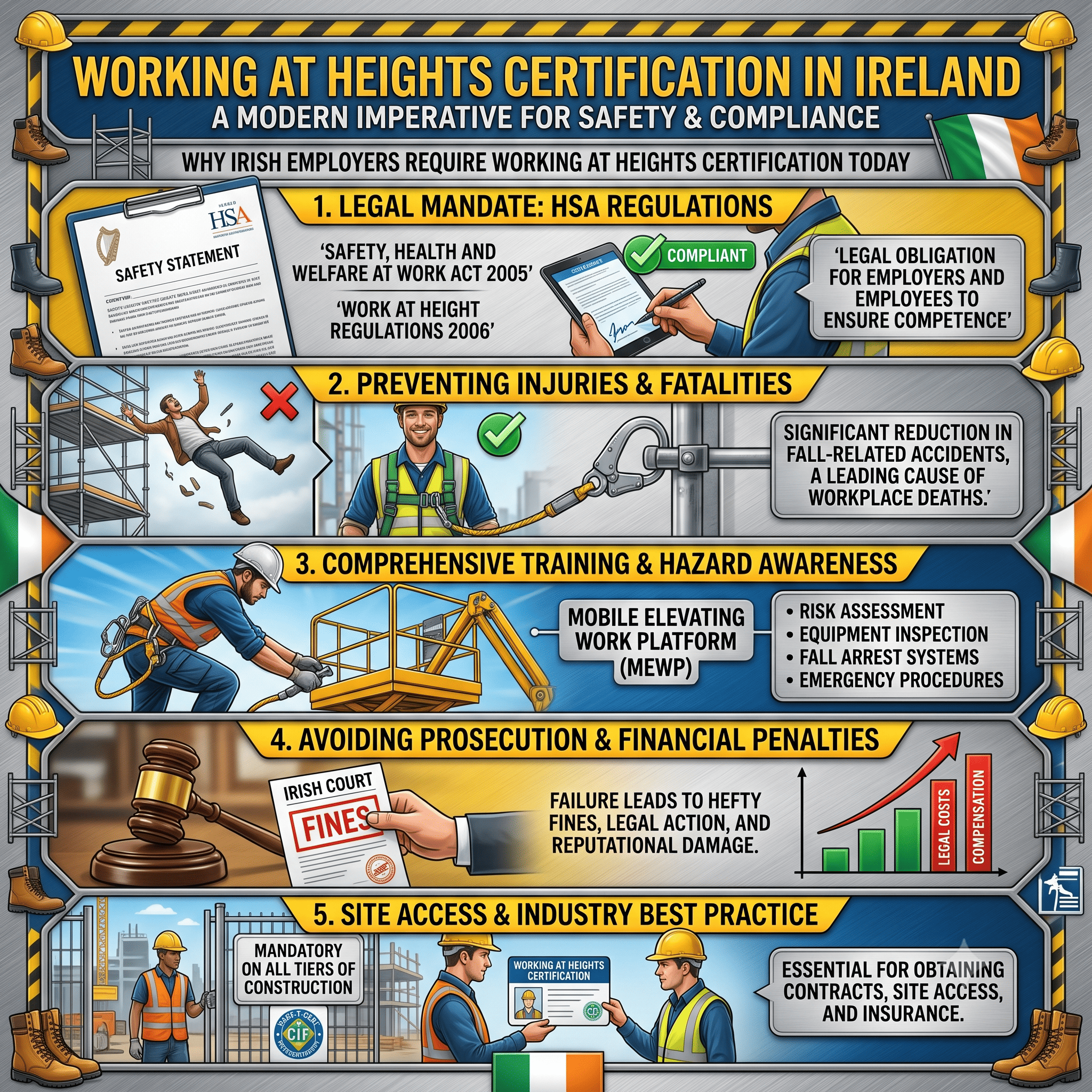
Working at height is one of the highest-risk activities carried out in Irish workplaces. Whether employees are installing roofing materials, maintaining industrial equipment, retrieving stock from warehouse shelving, or operating elevated work platforms, there is always a risk of falls that can result in serious injury or even fatalities. For this reason, understanding Working at Heights Safety Rules in Ireland is essential for both employers and employees.
Proper working at heights training in Ireland provides workers with the knowledge needed to recognise hazards, follow safe work procedures, and comply with workplace safety legislation. Combined with effective planning, suitable equipment, and regular supervision, training helps create safer workplaces while reducing the likelihood of accidents.
This guide explains the key safety rules for working at height in Ireland, the legal responsibilities of employers and employees, and how health and safety courses in Ireland support compliance and accident prevention.
What Is Considered Working at Height?
Working at height refers to any task where a person could fall from one level to another and suffer injury. Contrary to popular belief, it is not limited to high-rise construction sites. Even tasks carried out at relatively low heights can present serious risks if appropriate safety measures are not in place.
Examples include:
- Working on roofs
- Using portable ladders
- Working from scaffolding
- Operating mobile elevated work platforms (MEWPs)
- Accessing mezzanine floors
- Installing electrical equipment at height
- Window cleaning
- Warehouse stock retrieval
- Property maintenance
- Solar panel installation
Wherever there is a possibility of falling, suitable safety precautions should be implemented.
Why Working at Height Safety Is So Important
Falls from height remain one of the leading causes of workplace injuries across many industries. Common consequences include:
- Broken bones
- Head injuries
- Spinal injuries
- Long-term disability
- Lost working time
- Fatal accidents
Many incidents occur because workers underestimate the risks associated with routine tasks. Proper working at heights training in Ireland helps ensure employees understand these dangers before work begins.
Irish Legislation Governing Working at Height
Employers have clear legal responsibilities under Irish workplace safety legislation.
Safety, Health and Welfare at Work Act 2005
This legislation requires employers to:
- Provide safe places of work
- Identify hazards
- Carry out risk assessments
- Provide suitable training
- Maintain safe work equipment
- Ensure workers are competent
Employees also have responsibilities to cooperate with safety procedures and follow training instructions.
General Application Regulations
The regulations relating to work at height require employers to:
- Avoid working at height where reasonably possible
- Prevent falls wherever practical
- Minimise the consequences of falls if they cannot be prevented
- Provide suitable equipment
- Ensure workers receive appropriate training and supervision
Compliance with these requirements forms the foundation of safe working at height in Ireland.
Key Working at Heights Safety Rules
Following established safety rules helps reduce workplace risks and improve compliance.
1. Carry Out a Risk Assessment Before Work Begins
Every working at height task should begin with a risk assessment.
This should identify:
- Potential fall hazards
- Unsafe access routes
- Weather conditions
- Equipment requirements
- Emergency arrangements
Planning work carefully allows hazards to be addressed before employees are exposed to unnecessary risks.
2. Avoid Working at Height Where Possible
One of the basic safety principles is to avoid working at height if the task can be completed safely from ground level.
Examples include:
- Using extendable tools
- Lowering equipment for maintenance
- Repositioning work materials
Reducing the need for elevated work is often the safest solution.
3. Use Suitable Access Equipment
Employers should select equipment appropriate for the task.
Common options include:
- Ladders
- Scaffolding
- Mobile elevated work platforms
- Podium steps
- Elevated platforms
The choice of equipment should depend on the nature of the work, duration of the task, and level of risk.
4. Inspect Equipment Before Use
Workers should inspect equipment before beginning work.
Checks should include:
- Ladder stability
- Damaged rungs
- Scaffold condition
- Guardrails
- Harness integrity
- Anchor points
Damaged equipment should never be used.
5. Wear Appropriate Personal Protective Equipment (PPE)
Depending on the task, PPE may include:
- Safety harnesses
- Lanyards
- Helmets
- Safety footwear
- High-visibility clothing
PPE should be inspected regularly and used according to manufacturer instructions.
6. Maintain Three Points of Contact on Ladders
When using ladders, workers should maintain three points of contact whenever possible.
This usually means:
- Two hands and one foot
- Two feet and one hand
Maintaining stability significantly reduces fall risks.
7. Never Overreach
Overreaching is one of the most common causes of ladder-related accidents.
Instead, workers should:
- Reposition the ladder
- Move the access platform
- Maintain a stable working position
Attempting to reach beyond safe limits greatly increases the risk of falling.
8. Monitor Weather Conditions
Outdoor work at height may become unsafe during:
- High winds
- Heavy rain
- Ice
- Snow
- Poor visibility
Employers should review weather conditions before allowing elevated work to continue.
9. Keep Work Areas Organised
Good housekeeping helps reduce hazards.
Workers should:
- Remove unnecessary materials
- Secure loose tools
- Prevent trip hazards
- Keep access routes clear
A tidy workplace contributes to safer working conditions.
10. Plan for Emergencies
Every work at height activity should include emergency planning.
This should cover:
- Rescue procedures
- Emergency contacts
- Incident reporting
- First aid arrangements
Quick and effective responses can reduce the severity of workplace incidents.
How Working at Heights Training Supports Compliance
A professional working at heights training course in Ireland teaches workers how to apply these safety rules in real workplace situations.
Training usually covers:
Hazard Identification
Workers learn to recognise:
- Open edges
- Fragile surfaces
- Falling object risks
- Poor lighting
- Weather hazards
Risk Assessment
Employees learn how to:
- Evaluate workplace conditions
- Assess levels of risk
- Select suitable controls
- Plan safe working methods
Ladder Safety
Training includes:
- Equipment selection
- Inspection procedures
- Correct positioning
- Safe climbing techniques
Scaffolding Awareness
Workers learn how to:
- Access scaffolding safely
- Inspect working platforms
- Identify defects
- Report unsafe conditions
Fall Protection Systems
Instruction includes:
- Harness use
- Lanyards
- Anchor points
- Fall arrest systems
Workers also learn how to inspect equipment before use.
Emergency Procedures
Training prepares employees to:
- Respond to incidents
- Communicate emergencies
- Support rescue planning
- Follow reporting procedures
Benefits of Health and Safety Courses in Ireland
Completing health and safety courses in Ireland offers advantages for both employers and employees.
Benefits for Employees
- Improved safety awareness
- Increased confidence
- Better understanding of workplace risks
- Enhanced employability
- Recognised certification
Benefits for Employers
- Improved legal compliance
- Reduced workplace accidents
- Better workforce competence
- Stronger safety culture
- Simplified training records
Training represents an investment in both people and business performance.
Online Working at Heights Training
Many businesses now choose health and safety courses online in Ireland because they provide flexibility and convenience.
Online training allows employees to:
- Learn at their own pace
- Access training from any location
- Complete courses around work schedules
- Receive digital certification
This approach is particularly useful for organisations with multiple locations or remote workers.
Choosing the Right Training Provider
When selecting working at heights training in Ireland, consider providers that offer:
- Up-to-date course content
- Training aligned with Irish legislation
- Easy-to-use online platforms
- Recognised certification
- Practical workplace examples
- Ongoing learner support
Quality training should focus on helping workers apply safety principles in real working environments.
Final Thoughts
Working at Heights Safety Rules in Ireland: Training and Compliance Guide demonstrates why understanding workplace safety requirements is essential for any organisation where employees perform elevated tasks. Falls from height remain one of the most significant workplace hazards, but many incidents can be prevented through proper planning, suitable equipment, and effective training.
Completing working at heights training in Ireland helps workers recognise hazards, carry out risk assessments, use equipment correctly, and follow established safety procedures. Employers benefit through improved legal compliance, fewer accidents, stronger safety performance, and greater confidence that their workforce is prepared for high-risk tasks.
Whether delivered in person or through health and safety courses online in Ireland, working at heights training provides the knowledge and practical skills needed to build safer workplaces across Ireland.